Article
The hidden documentation problem in HVAC manufacturing

Summary:
HVAC technical documentation is hard to manage because a single product line generates more content, in more variations, under more moving regulations, than almost any other manufacturing category. A modern HVAC maker juggles thousands of SKUs and configurations, a refrigerant transition to A2L blends, multi-country distributor networks that each need translated and localised manuals, and a dense compliance web spanning UL, CE, AHRI, Ecodesign, and F-Gas rules. Most teams still produce this content in disconnected tools - Word, InDesign, PDFs, and shared drives - so one product change triggers weeks of manual rework across dozens of documents, and no one is sure which version the field is using. The fix is structural: manage content as reusable components in a single source, publish every format from that source, and govern what reaches AI systems. That is what a Component Content Management System (CCMS) like Author-it is built to do.
Why HVAC documentation is uniquely hard
Ask a technical publications lead at an HVAC manufacturer what keeps them up at night, and it's rarely the writing. It's everything around the writing. A single air-conditioning platform can spin out hundreds of model numbers, ship into 30-plus countries, and sit under half a dozen overlapping regulations - each with its own document requirements.
Compare that to a lot of other manufacturing documentation work and the difference is scale multiplied by change. HVAC content doesn't just have to be right once. It has to stay right across thousands of variants, dozens of languages, and a stream of regulatory updates that never really stops. Miss one and the consequences are real: a failed audit, a mislabelled refrigerant charge, a callback because the tech had the wrong manual.
Six pressures drive most of the pain. They rarely arrive one at a time, and each one multiplies the others. Handle them well and documentation becomes a competitive edge - faster launches, cleaner audits, fewer callbacks. Handle them badly and it becomes a permanent tax on every product change.
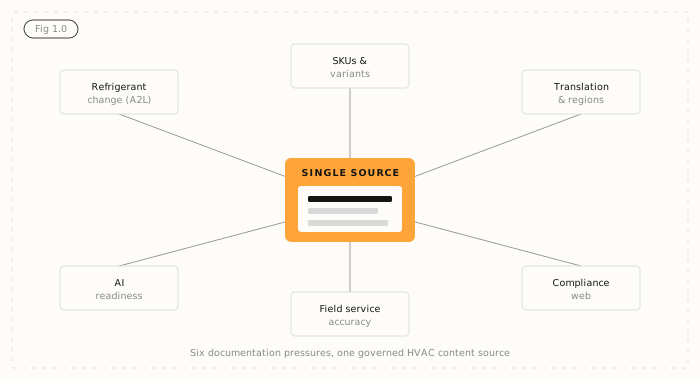
Refrigerant rules that keep changing
The move to A2L refrigerants is the clearest example. From 1 January 2026, new residential and light-commercial systems in the US can no longer use high-GWP refrigerants like R-410A, pushing the industry to lower-GWP A2L blends such as R-454B and R-32.
That's not just an engineering change. A2L systems carry new labelling requirements - refrigerant type, A2L classification, and charge weight - and commissioning packages now need refrigerant weigh-in records, leak-test results, and manufacturer compliance statements. Every affected manual, label, spec sheet, and training guide has to reflect the new chemistry, and it all has to land at the same time.
When that content lives in separate documents, one refrigerant change means editing the same warning and charge-weight detail in dozens of places by hand. We cover the full picture in our guide to managing HVAC documentation through the A2L refrigerant transition.
Thousands of SKUs, each needing its own documents
HVAC model numbers are dense by design. A single string can encode series, tonnage or BTU rating, efficiency tier, voltage and phase, and refrigerant type. Multiply those options together and one product family becomes thousands of sellable configurations.
Each configuration needs documentation that matches it exactly - the right wiring diagram, the right capacity tables, the right parts list. Get the variant wrong and a field tech installs against the wrong spec, or a customer downloads a manual that doesn't match the unit on the wall.
Copy-and-paste document production can't keep up with that combinatorial maths. The moment a shared component changes - a safety warning, a torque value, a diagram - every variant document that reuses it drifts out of sync. There's more on this in our breakdown of documenting HVAC SKUs and product variants.
Multiple regions, languages, and distributor networks
Most HVAC makers sell through distributors, and those distributors span countries, languages, and local regulations. The same condensing unit might ship to twelve markets, each expecting manuals in its own language and formatted to its own standards.
Recreate that content market by market and translation costs balloon. You end up paying to translate the same unchanged warning over and over, every time a document is reissued. Worse, a correction made in one language often never reaches the others, so your German manual says one thing and your Spanish manual says another. In a category where a mislabelled charge weight or a missing warning has safety and regulatory consequences, that inconsistency is a genuine liability, not just an inconvenience.
The scale of the distributor and translation challenge gets its own treatment in managing HVAC documentation across distributors and regions.
A compliance web that never sits still
Few product categories carry as many overlapping standards as HVAC. Depending on the market and product, a single unit might sit under UL 60335 safety standards, CE marking, AHRI performance ratings, ASHRAE 90.1 energy design, EU Ecodesign and energy labelling under ESPR, and the F-Gas Regulation.
Each standard shapes what the documentation must contain, and each gets revised on its own schedule. Newer rules pile on more: the EU Right to Repair Directive, in force across all 27 member states from 31 July 2026, and the Digital Product Passport add repair manuals, spare-parts availability periods, and disassembly instructions to the list of things you must publish and keep current.
Proving compliance is a documentation problem as much as an engineering one. When a regulator or auditor asks for evidence, you need the current, approved version - fast. See how manufacturers keep HVAC compliance documentation audit-ready.
Field service accuracy and stalled AI projects
All of this converges at the last mile: a technician standing in front of a unit, trying to fix it. Industry first-time-fix rates hover around 80%, which means roughly one in five calls needs a return visit - and each callback costs somewhere between $100 and $250. A big share of those repeat visits trace back to outdated or wrong documentation in the tech's hands.
The obvious modern fix is AI: a field-service assistant or customer portal that answers questions instantly. But those projects stall on the same content. Feed an AI model a pile of unstructured PDFs and shared-drive files, and it returns confident answers that can't be trusted or traced. Structured, governed content is what makes an AI answer accurate and citable - the model is only as good as the source it draws on. Every smart-factory dashboard, field copilot, and self-service portal you're planning depends on the same content layer being clean underneath.
We go deeper in making HVAC documentation AI-ready for field service.
What good looks like: one governed source
The common thread across all six pressures is the same: content trapped in disconnected documents. Fix the structure and the pressures become manageable instead of chronic.
Three shifts change the game. First, structured authoring - write content once as reusable components (a warning, a procedure, a spec) instead of as whole documents. Second, single-source publishing - assemble those components into any manual, in any language, and publish to PDF, HTML, or AI-ready output from one source, so a change made once flows to every deliverable that uses it. Third, governed AI output - only approved content reaches downstream systems, so your AI answers are as trustworthy as your sign-off process.
This is the job a Component Content Management System (CCMS) is built for. Author-it has done this in regulated manufacturing for 25-plus years. One global manufacturer reports over $3M saved a year, 60-70% content reuse, and translation costs cut by up to 90%.
Governance is the part that ties it all together. Every component moves through review and approval, with a full audit trail, before it can be published. That same approval gate controls what reaches AI systems, so an outdated warning or an unapproved spec can't quietly end up in a technician's copilot answer. This is what we mean by structured content as the AI Content Foundation: the governed source layer that enterprise AI depends on to stay accurate and traceable.
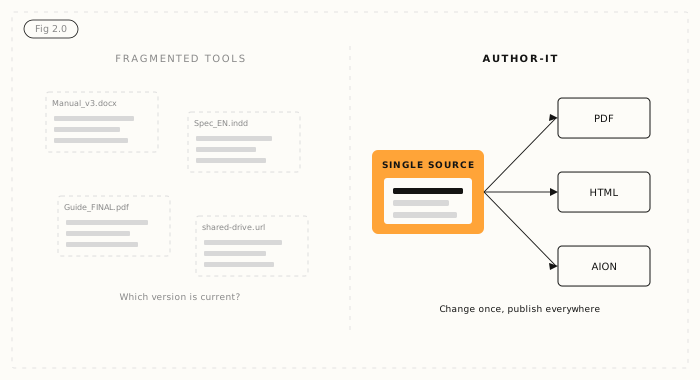
Here's how the two approaches compare for an HVAC documentation team.
On the publishing side, this is what single-source publishing for HVAC manuals delivers in practice. On the AI side, Author-it's structured JSON output (AION) gives field-service assistants and customer portals governed, traceable content to draw on - shipped as standard in 2026.R1.
Not sure what the fragmented approach is costing you today? Work it out with the Author-it ROI calculator and put a number on the rework, translation, and callback spend you're carrying right now.

HVAC documentation FAQ
Q: Why is HVAC product documentation so hard to manage?
A: HVAC documentation is hard because one product line generates huge volume, in constant variation, under shifting rules. A single platform can produce thousands of SKUs, ship through distributors in dozens of countries and languages, and sit under overlapping standards like UL, CE, AHRI, Ecodesign, and F-Gas. Add a refrigerant transition to A2L blends and every affected manual, label, and spec has to change together. When content lives in separate Word, InDesign, and PDF files, a single change means editing the same detail in dozens of places, and no one is sure which version the field has.
Q: What is a CCMS for HVAC manufacturers?
A: A Component Content Management System (CCMS) manages content as reusable components - a warning, a procedure, a spec - rather than as whole documents. For an HVAC maker, that means writing a safety warning or charge-weight table once and reusing it across every model, manual, and language. Change it once and every deliverable updates. Author-it is a CCMS built for regulated industries, with a full approval audit trail and single-source publishing to PDF, HTML, and AI-ready output.
Q: How does the A2L refrigerant transition affect HVAC documentation?
A: The switch to A2L refrigerants like R-454B and R-32 changes labelling, charge-weight details, safety warnings, and commissioning records across the whole document set. A2L systems must show refrigerant type, A2L classification, and charge weight, and commissioning packages now expect weigh-in and leak-test records. Every manual, label, spec sheet, and training guide has to reflect the new chemistry at the same time, which is far easier from a single structured source than across disconnected files.
Q: How do HVAC manufacturers handle documentation across so many SKUs?
A: HVAC model numbers encode series, tonnage, efficiency, voltage, and refrigerant, so one family becomes thousands of configurations. Managing a separate file per configuration doesn't scale. Structured authoring handles it with conditional variants: shared content is written once, and each configuration pulls the right wiring diagram, capacity table, and parts list from the same source. That keeps every variant accurate when a shared component changes.
Q: Why do HVAC AI and field-service projects stall on documentation?
A: AI assistants and customer portals are only as accurate as the content behind them. Fed unstructured PDFs and shared-drive files, they return confident answers that can't be traced or trusted. Structured, governed content fixes this at the source. Author-it's AION output publishes approved content as structured JSON that field-service assistants and portals can draw on, so answers are accurate and traceable back to a sign-off.
Q: How does structured content cut HVAC translation costs?
A: With single-source publishing, only new or changed components get sent for translation. If a warning or procedure hasn't changed, you don't pay to translate it again for every reissue or every market. Manufacturers with high content reuse commonly cut translation spend sharply; one Author-it customer reports translation costs down by up to 90%.
Q: Which standards govern HVAC technical documentation?
A: Depending on market and product, HVAC documentation may need to satisfy UL 60335 safety standards, CE marking, AHRI performance ratings, ASHRAE 90.1 energy design, EU Ecodesign and energy labelling under ESPR, and the F-Gas Regulation. Newer rules like the EU Right to Repair Directive and the Digital Product Passport add repair manuals, spare-parts availability, and disassembly instructions. Each is revised on its own schedule, so documentation has to stay current continuously, not just at launch.
Published on:
Author:
July 5, 2026
Ben Harris
Marketing Lead
Related Resources

Webinar
Author-it 2026.R3 Release Webinar - What's New
The full Author-it 2026.R3 release webinar recording, with the biggest New Word update yet, richer AION output, and the R3 go-live dates.

Article
Managing spare parts catalogs across variants
Options, revisions, and regional variants multiply parts lists and service manuals fast - here's how to maintain them all from a single source.

Guide
CCMS for HVAC manufacturers: a buyer's guide
CCMS for HVAC manufacturers must handle refrigerant change, variant sprawl, and multi-market translation. Here are the criteria to score vendors before you buy.