Article
Audit-ready compliance docs for HVAC manufacturers

Summary:
HVAC manufacturers carry one of the densest compliance loads in manufacturing. UL 60335-1 and UL 60335-2-40, CE marking, AHRI performance ratings, ASHRAE energy design, EU Ecodesign and A-G energy labelling under ESPR, and the F-Gas Regulation all demand documentation an auditor can trust. Keeping HVAC compliance documentation audit-ready comes down to three things: controlled versions, a complete approval trail, and one source of truth - so the version in front of a regulator is provably the one that was signed off. This article covers what good looks like and where Author-it fits, building on the wider HVAC documentation problem in manufacturing.
The compliance load HVAC makers actually carry
Few products sit under as many overlapping standards as a modern HVAC unit. A single air-source heat pump can be governed by a stack of regimes at once, each with its own documentation trail:
- UL 60335-1 and UL 60335-2-40 for the safety of heat pumps, air conditioners and dehumidifiers, plus UL 60335-2-89 for commercial refrigeration equipment
- CE marking across the EU, which ties several directives together into one declaration
- AHRI performance rating standards - there are more than 100 - that back the capacity and efficiency numbers you publish
- ASHRAE 90.1 energy design requirements
- EU Ecodesign and energy labelling on the A-G scale under the Ecodesign for Sustainable Products Regulation (ESPR)
- the F-Gas Regulation (EU) 517/2014, alongside refrigerant transition rules pushing the industry toward A2L refrigerants like R-454B and R-32
- ErP 2026 fan efficiency thresholds
Every one of these produces documents: test reports, declarations of conformity, performance certificates, refrigerant records, labels, and technical files. And each product variant - series, tonnage, voltage, refrigerant - needs its own matching set. HVAC lines run to thousands of configurations, so the volume compounds fast.
What audit-ready actually means
Audit-ready is not the same as "we have the documents somewhere". A regulator or notified body doesn't just want to see a declaration of conformity. They want to see that the specific version they're holding is the approved one, that it maps to the right product variant, and that you can show who approved it and when.
That comes down to three properties:
- Controlled versions - every document has a single, unambiguous current version, and superseded versions are clearly retired.
- An approval trail - a record of who reviewed, who signed off, and when, for the exact content in front of the auditor.
- One source of truth - the same approved content feeds every output, so the PDF, the label, and the service portal all say the same thing.
Miss any one of these and an audit turns into an archaeology exercise. The ISO 9001 technical documentation requirements lean on the same principles: document control and demonstrable approval.
Where HVAC documentation usually breaks
Most compliance gaps aren't caused by bad engineering. They're caused by how the documentation is managed. The common failure points are familiar to anyone who has run a technical publications team:
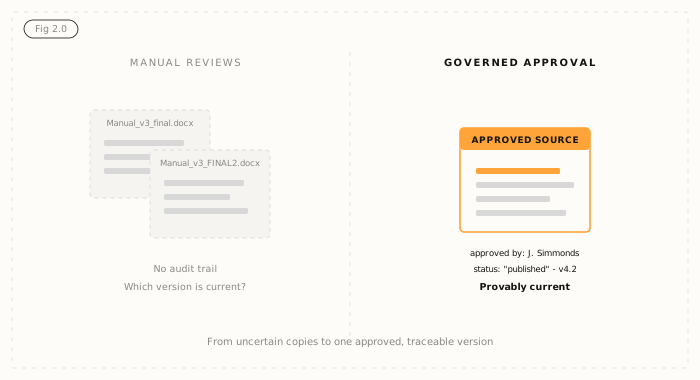
- Reviews happen over email, so the approval trail lives scattered across inboxes
- Files are copied per variant, so a fix in one doesn't reach the others
- No one can say with certainty which version is current across dozens of product lines
- Labels and declarations drift out of sync with the underlying spec
Here's the difference between an ad-hoc approach and a governed one:
What good looks like
A governed setup makes audit-readiness the default, not a scramble before each inspection. In practice that means four things:
- Managing content as components, not documents, so a warning or a spec is written once and reused across every manual and variant that needs it
- Running review and sign-off inside the system, so the approval trail is captured automatically rather than reconstructed later
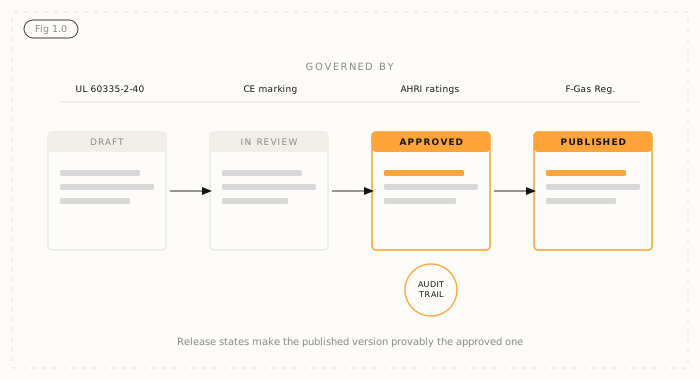
- Using defined release states so content moves Draft, In Review, Approved, Published - and only approved content publishes
- Publishing every output - PDF, label copy, service portal - from that one approved source
This is the model Author-it has run in regulated industries for more than 25 years. If you're weighing up systems for this kind of work, see how to choose the best CCMS for regulated industries.
Where Author-it fits
Author-it is a Component Content Management System (CCMS) built for exactly this kind of controlled, high-variant documentation. Three capabilities carry the audit-ready load:
- Review & Approve - built-in review workflows with a full audit trail, so every approval is recorded against the content it approved
- Release states - content follows Draft, In Review, Approved, Published, giving each component a clear current status
- The publishing gate - unapproved content cannot reach published output. That's architectural, not a setting you can switch off. The version you publish is provably the version that was approved.
Structured authoring and single-source publishing mean one approved component flows to every manual, label, and portal, so nothing drifts out of sync. For HVAC makers running thousands of configurations across their manufacturing product lines, that's the difference between an audit you dread and one you can walk into.
Start with where you stand
Audit-readiness is easier to fix once you can see the gaps. Try the Structured Content Challenge to benchmark your current documentation against what good looks like, and find the fastest path to a compliance trail you can prove.

HVAC compliance documentation FAQ
Q: How do HVAC manufacturers keep compliance documentation audit-ready?
A: HVAC manufacturers keep compliance documentation audit-ready by controlling three things: versions, approvals, and the source of truth. Audit-ready HVAC compliance documentation means every document has one unambiguous current version, a complete record of who reviewed and approved it and when, and a single approved source that feeds every output. That matters because HVAC products sit under overlapping regimes - UL 60335-2-40, CE marking, AHRI performance ratings, EU Ecodesign energy labelling, and the F-Gas Regulation - and each product variant needs its own matching documents. When reviews happen over email and files are copied per variant, no one can prove the version in front of a regulator is the approved one. A Component Content Management System like Author-it captures the approval trail automatically, moves content through defined release states, and uses a publishing gate so unapproved content cannot reach published output. The version you publish is provably the version that was signed off.
Q: What standards apply to HVAC compliance documentation?
A: HVAC products are typically covered by UL 60335-1 and UL 60335-2-40 for safety, CE marking in the EU, AHRI performance rating standards, ASHRAE 90.1 energy design, EU Ecodesign and A-G energy labelling under ESPR, and the F-Gas Regulation (EU) 517/2014. Each generates documents - test reports, declarations of conformity, performance certificates, and refrigerant records - that need to stay current and traceable.
Q: What does audit-ready mean for HVAC documentation?
A: Audit-ready means an auditor or notified body can confirm that the specific document in front of them is the approved, current version for the right product variant, with a clear record of who approved it and when. It is not enough to have the documents on file; you have to be able to prove which version is authoritative.
Q: Why is version control such a problem for HVAC manufacturers?
A: HVAC lines run to thousands of configurations - series, tonnage, voltage, and refrigerant all vary - and each variant needs its own matching documents. When files are copied per variant and edited separately, a fix in one place doesn't reach the others, and no one can be confident the field or the regulator has the current version.
Q: How does UL 60335-2-40 documentation stay current as refrigerants change?
A: The move to A2L refrigerants like R-454B and R-32 changes safety labelling, charge weights, and commissioning records tied to UL 60335-2-40. Managing that content as reusable components means a refrigerant change is updated once and flows to every affected manual, label, and declaration, rather than being re-edited product by product.
Q: What is the publishing gate, and why does it matter for compliance?
A: The publishing gate is an architectural constraint in Author-it: unapproved content cannot reach published output. It matters for compliance because it makes audit-readiness provable - the version you publish is, by design, the version that passed review and approval. There is no path for draft or unreviewed content to slip into a released document.
Q: Can a CCMS help with F-Gas and Ecodesign documentation specifically?
A: Yes. F-Gas records, Ecodesign technical files, and A-G energy labels all draw on shared product data that changes over time. A Component Content Management System keeps that data in one approved source and publishes it to every output, so labels and declarations stay in sync with the underlying spec and the approval trail is captured automatically.
Published on:
Author:
June 5, 2026
Adrian Winks
CEO
Related Resources

Article
Field crew AI: when a wrong answer is a safety risk
Why safety-critical field operations can't run AI on ungoverned content - and what deterministic, traceable answers actually require.

Article
AI-ready content: who has actually shipped it?
A practical field guide to separating AI-ready content marketing from vendors who have actually shipped a structured, governed output for AI.

Article
Future-proof your content for an AI stack that changes
Models and tools churn constantly. Future-proof content for AI by owning the one layer that lasts - your content, as open structured JSON.