Article
Single-source publishing for HVAC IOM manuals

Summary:
Single-source publishing for HVAC manuals means writing your installation, operation and maintenance (IOM) content once as reusable components, then publishing it to every output from one governed source. A warning, a wiring step, a refrigerant charge table - each is authored once and stored centrally, not copied into separate files per format. From that single source you publish print and PDF manuals, HTML help, a service portal, product labels, and AI-ready AION JSON. Change the source once and the update flows to every output automatically, so your field techs, distributors and AI agents all see the same current information. This is how HVAC manufacturers keep thousands of model variants in sync without recreating documents by hand. Author-it, a Component Content Management System with 25+ years in regulated manufacturing, runs this model through structured authoring - no DITA or XML required. The result is faster updates, fewer version errors, and documentation that scales with your product line.
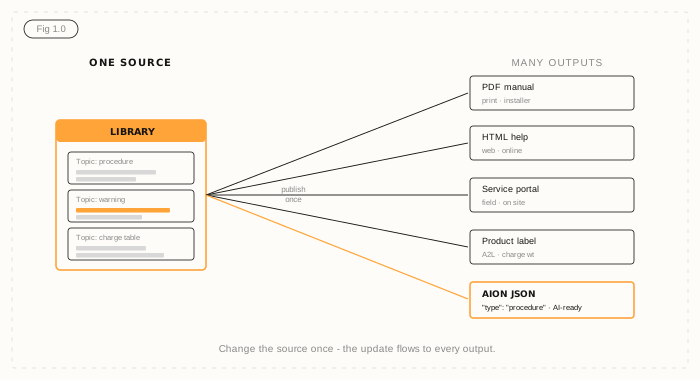
What single-source publishing means for HVAC manuals
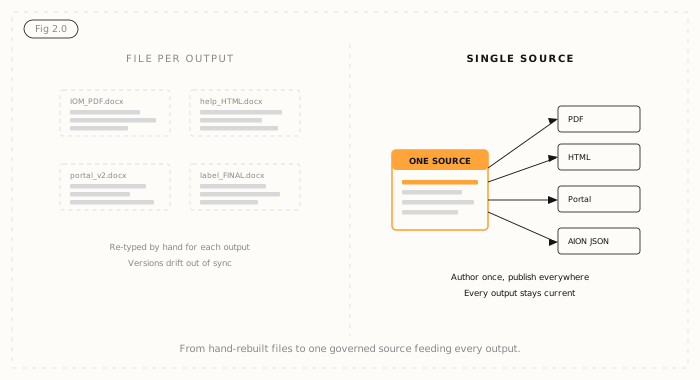
Most HVAC documentation trouble starts the same way: the same content lives in too many places. The install steps sit in a PDF, the maintenance schedule in a separate HTML help file, the safety note on a label, and after the third revision none of them agree.
Single-source publishing fixes that at the root. You author each piece of IOM content once, store it centrally, and publish it out to whatever format you need. Content and formatting stay separate, so one warning can appear in a printed manual, a web page, and a service portal without being retyped. If you want the full picture of why this bites manufacturers, the HVAC documentation problem in manufacturing breaks it down.
The payoff is simple. A change to a torque value or a charge weight happens in one place and reaches every output. Nobody hunts through a shared drive for the current file, and nobody ships a manual with last year's spec. For a product line that spans dozens of models and several refrigerants, that difference is the gap between documentation that keeps up and documentation that's always a revision behind.
How single-source HVAC documentation works
Single-source publishing runs on a Component Content Management System (CCMS). Instead of managing whole documents, you manage small reusable pieces of content. In Author-it these building blocks have clear roles.
Topics are the components - a procedure, a warning, a concept, or a specification table. You write a "refrigerant weigh-in" procedure once as a Topic, then use it wherever it belongs.
Books assemble Topics into a deliverable, like a full IOM manual for a specific model. The same Topic can sit in many Books at the same time.
The Library is the central repository where every Topic and Book lives. It's your single source of truth - one governed home for all IOM content.
Release states track each component through its lifecycle: Draft, In Review, Approved, Published. Unapproved content can't be published, which keeps a half-finished warning out of a live manual.
Variants let one component adapt to context. A single install Topic can flex by model, region, voltage, or refrigerant, so an R-32 split and an R-454B ducted system pull the right detail from the same source. Component-level authoring is what makes reuse across a wide product line practical rather than theoretical.
Here's how the old file-per-output habit compares with single-source publishing:
What you can publish from one HVAC source
The point of single-source HVAC documentation is that one Library feeds many outputs. Write the content once, then publish it to each channel your product and your regulators need.
From a single source you can produce:
- Print and PDF IOM manuals for the box and the installer
- HTML help and web-based documentation for online access
- A service portal your field technicians search on site
- Product and compliance labels that pull the same approved values
- AI-ready AION JSON for search, chatbots, and RAG pipelines
That last output matters more each quarter. AION is Author-it's structured JSON output for AI and LLM ingestion, shipped as standard in 2026.R1. Because content passes through the publishing gate before it reaches AION, unapproved content provably can't reach an AI answer. Your field service assistant cites the approved manual, not a stale PDF someone emailed around.
Where Author-it fits
Author-it is the Component Content Management System that runs this model for regulated manufacturers, with 25+ years behind it in industries where content accuracy is a compliance requirement. It uses structured authoring without DITA or XML, so your writers work in a familiar editor while the system handles reuse, variants, and multi-format output behind the scenes. Review and approval is built in, not bolted on, so every output traces back to signed-off content. See how the Author-it CCMS platform handles authoring, review, and publishing from one source.
The gains are measurable. Manufacturers running this way typically reuse 60-70% of their content and cut translation costs by up to 90%, because only new or changed components get sent for translation. Our content reuse handbook walks through how those numbers add up across a product line.
If you're weighing the switch, put real numbers against it. Use the Author-it ROI calculator to see what single-source publishing could save your documentation team.

HVAC documentation FAQ
Q: What is single-source publishing for HVAC manuals?
A: Single-source publishing for HVAC manuals is authoring your installation, operation and maintenance content once as reusable components, then publishing it to many outputs from one governed source. The same warning, step, or charge table feeds print and PDF manuals, HTML help, a service portal, labels, and AI-ready AION JSON. Change the source once and every output updates, so you never recreate documents by hand per format.
Q: What are HVAC IOM manuals?
A: IOM stands for installation, operation and maintenance. An HVAC IOM manual tells an installer how to fit a unit, an operator how to run it, and a technician how to service it. Each model or variant needs its own accurate manual, which is why keeping them all current is a real documentation challenge.
Q: How does single-source publishing keep HVAC model variants in sync?
A: Content is stored as components in one Library, and variants let a single component adapt by model, region, voltage, or refrigerant. When you change the shared source, every variant that uses it updates at once. You maintain one governed source instead of a separate file for each of thousands of configurations.
Q: Can I publish HVAC manuals to both PDF and HTML from the same source?
A: Yes. Single-source publishing separates content from formatting, so one source produces print and PDF manuals, HTML help, a service portal, labels, and structured JSON. You author once and publish to each format, rather than maintaining a separate document per output.
Q: What is AION and how does it make HVAC documentation AI-ready?
A: AION is Author-it's structured JSON output format for AI and LLM ingestion, shipped as standard in 2026.R1. It exposes your approved IOM content as clean, structured data that search tools, chatbots, and RAG pipelines can use. Because content must pass the publishing gate first, unapproved content can't reach the AI output.
Q: Does single-source publishing for HVAC require DITA or XML?
A: Not with Author-it. It delivers structured authoring and component reuse without asking writers to learn DITA or hand-code XML. Authors work in a familiar editor while the system manages components, variants, and multi-format publishing.
Q: How much content can HVAC manufacturers reuse with a CCMS?
A: Manufacturers running single-source publishing in a Component Content Management System typically reuse 60-70% of their content across product lines and markets. High reuse also cuts translation costs by up to 90%, because only new or changed components get sent for translation.
Published on:
Author:
June 10, 2026
Jamie Simmonds
Documentation Manager
Related Resources
Article
Field crew AI: when a wrong answer is a safety risk
Why safety-critical field operations can't run AI on ungoverned content - and what deterministic, traceable answers actually require.

Article
AI service assistants for manufacturing field techs
What it takes to put an AI service assistant in a manufacturing field tech's hands without risking a wrong, outdated, or unsafe answer.

Article
The real cost of DITA - and when you don't need it
The cost of DITA is mostly staffing and process. Here is where it hides - and how to get topic reuse and single-source publishing without XML.