Article
HVAC product documentation variants: taming SKU sprawl

Summary:
An HVAC product line can run to thousands of configurations, and a separate manual for every SKU is impossible to keep accurate. Model numbers encode series, tonnage or BTU rating, efficiency tier, voltage and phase, and refrigerant, and each variant needs matching documentation. The fix is conditional content and variants: assemble each model's docs from shared components, then change a shared spec or warning once so every affected variant updates. It's the practical answer to the wider HVAC documentation problem, applied at the variant level.
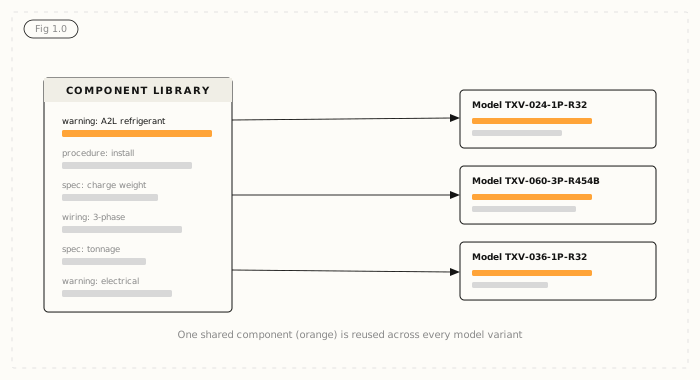
How one HVAC line becomes thousands of variants
Look at any HVAC model number and you're reading a spec sheet in shorthand. A handful of characters encode the series, the tonnage or BTU rating, the efficiency tier, the voltage and phase, and the refrigerant. Multiply those options together and a single product family fans out into hundreds or thousands of orderable configurations.
Each configuration is a genuinely different product to the person installing or servicing it. The 2-ton single-phase unit and the 5-ton three-phase unit in the same series share a chassis and most of their procedures, but they carry different wiring diagrams, different charge weights, and sometimes different refrigerants. Get one spec wrong in the documentation and a technician wires the wrong voltage or weighs in the wrong charge.
That's the core of the HVAC product documentation variants problem: the content is 80 percent shared and 20 percent different, but the 20 percent is safety-critical and it's scattered across thousands of SKUs.
Why a manual per SKU breaks down
The instinctive response is one manual per SKU. It feels safe because every model gets its own complete document. In practice it's how HVAC SKU sprawl turns into a documentation backlog.
Say you maintain 1,200 configurations across a few series. A regulator updates a refrigerant safety label requirement, or you re-rate a compressor. Now you're hunting through 1,200 near-identical files to find every one that references that spec, editing each by hand, and hoping nobody missed a variant. The change itself takes an afternoon. Propagating it across every affected manual takes weeks.
It gets worse with translation. Every one of those manuals, in every language, is a separate file to update and re-translate. The same wiring warning gets paid for and translated dozens of times because it lives in dozens of documents instead of one. This is the generic pattern behind managing growing product documentation, and in HVAC the variant maths makes it acute.
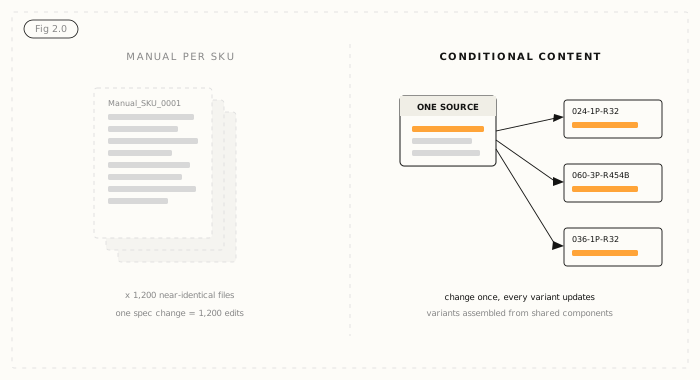
Conditional content and variants, explained
Conditional content and variants flip the model. Instead of writing complete manuals, you write components once - a procedure, a warning, a spec table - and store each one a single time. Every component carries conditions that decide when it appears.
A refrigerant safety warning might be tagged to show only on variants using a specific A2L refrigerant. A three-phase wiring diagram shows only on three-phase SKUs. A charge-weight table pulls the right value for each tonnage. The documentation for any given model is then assembled from the shared library, with conditions selecting the right pieces for that exact configuration.
Here's how the two approaches compare on the operations that actually cost you time.
Change once, update every affected variant
The payoff is what happens when something changes, which in HVAC is constantly. New efficiency regulations, refrigerant transitions, re-rated components, corrected torque values - every one of these touches content that is shared across many variants.
With shared components, you edit the source once. The updated warning, spec, or procedure flows to every variant that references it on the next publish. You're not searching for affected files because the system already knows which variants use that component. This is single-source publishing applied to HVAC manuals: one source, many governed outputs, no manual reconciliation.
It also closes the accuracy gap. When a refrigerant charge weight is wrong in a manual-per-SKU world, it's wrong in exactly the files someone forgot to update, and you find out in the field. When it lives in one component, correcting it corrects it everywhere at once. Reuse rates of 60 to 70 percent are common once a product line is componentised, which is a direct measure of how much duplicated effort disappears.
Where Author-it fits
This is the job a Component Content Management System is built for. Author-it is a CCMS that stores every warning, procedure, and specification as a reusable component with structured authoring, then uses conditional content and variants to assemble the correct documentation for each model number. No DITA or XML expertise required to author it.
For HVAC and other manufacturing documentation teams, that means a change to a shared A2L refrigerant warning or a compressor spec propagates to every affected variant automatically, with a full review-and-approval trail behind it. Component-level version control means you always know which content is current across the whole product line. The manual count stops driving the workload - the number of genuinely distinct components does, and that number is far smaller than your SKU list.
SKU sprawl isn't going away. HVAC lines will only get more configurable as efficiency tiers and refrigerant options multiply. The teams that stay accurate are the ones that stopped documenting SKUs and started documenting components.

HVAC documentation FAQ
Q: How do HVAC manufacturers manage documentation for thousands of product variants?
A: HVAC manufacturers manage documentation for thousands of product variants by assembling each model's documents from shared, reusable components instead of writing a separate manual per SKU. A model number encodes series, tonnage or BTU rating, efficiency tier, voltage and phase, and refrigerant, and each combination is a distinct variant that still shares most of its content with its neighbours. Conditional content lets one source component carry rules that decide which text, specs, or safety warnings appear for a given configuration. A CCMS such as Author-it stores every warning, procedure, and specification once, then publishes the correct version for each variant. Change a shared refrigerant warning or a torque spec in that single source, and every affected variant updates on the next publish. This is how HVAC product documentation variants stay accurate at scale, without the manual count multiplying every time a new configuration ships.
Q: What is conditional content in HVAC documentation?
A: Conditional content is content that appears only when certain conditions are met. A component - a warning, a diagram, a spec table - is tagged with rules such as refrigerant type, voltage, or tonnage, and it shows only on the variants that match. One source component can serve every configuration it applies to, so you write it once and let the conditions decide where it appears.
Q: What causes HVAC SKU sprawl in documentation?
A: HVAC SKU sprawl comes from the number of options encoded in a model number. Series, tonnage or BTU rating, efficiency tier, voltage and phase, and refrigerant each add configurations, and multiplied together they produce hundreds or thousands of orderable SKUs. When each SKU gets its own standalone manual, the document count grows with the option count, and keeping them all accurate becomes unmanageable.
Q: Why is one manual per SKU a problem?
A: One manual per SKU duplicates the same shared content across hundreds of near-identical files. When a spec, safety label, or refrigerant charge changes, you have to find and edit every affected manual by hand, which is slow and error-prone. Translation multiplies the cost, because the same unchanged warning gets re-translated in every document rather than once at the component level.
Q: How does single-source publishing help with HVAC model number variants?
A: Single-source publishing stores each piece of content once and publishes it to every output that needs it. For HVAC model number variants, that means a shared procedure or spec lives in one place and flows to every variant that references it. Change the source once and all affected variants update on the next publish, so the documentation stays consistent across the whole product line.
Q: Do you need DITA or XML to manage HVAC variant documentation?
A: No. Conditional content and variants are a structured authoring concept, not a specific file format. DITA-based systems can do it but require XML expertise to author and maintain. Author-it provides structured authoring, conditional content, and variants without DITA or XML, so documentation teams manage HVAC variants without needing developer-level tooling.
Q: How much duplicated effort does componentising an HVAC product line remove?
A: Once a product line is broken into reusable components, content reuse rates of 60 to 70 percent are common. That figure is a direct measure of how much writing and translation was previously duplicated across near-identical manuals. The higher the reuse, the more a single change propagates automatically instead of being re-done by hand for every variant.
Published on:
Author:
June 15, 2026
Osmar Silva
CTO
Related Resources
Article
Managing spare parts catalogs across variants
Options, revisions, and regional variants multiply parts lists and service manuals fast - here's how to maintain them all from a single source.
Article
Why equipment documentation breaks as you scale
As equipment makers add product lines, manual updates pile up faster than the products ship - the fix is managing content as components, not files.

Guide
CCMS for HVAC manufacturers: a buyer's guide
CCMS for HVAC manufacturers must handle refrigerant change, variant sprawl, and multi-market translation. Here are the criteria to score vendors before you buy.