CCMS COMPARISON

Author-it vs Adobe FrameMaker. An honest comparison.

Author-it is an enterprise CCMS built for teams. It manages every paragraph as a reusable, version-controlled component, with built-in review, translation, and multi-format publishing, plus AION, structured JSON output for AI. It has done this for 25+ years.

FrameMaker is a long-established desktop authoring and publishing tool. It handles large, complex documents, supports DITA and XML authoring, and produces market-leading WYSIWYG PDFs. It is a powerful writing tool, not a content management system.

This page lays out how they compare across 30+ capabilities - honestly.
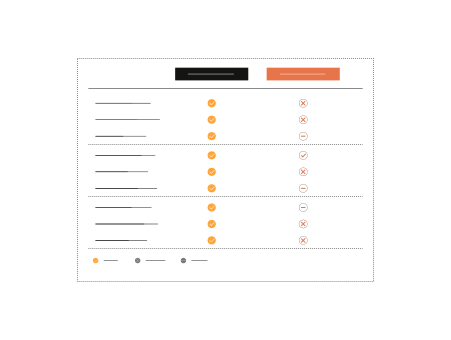
Book a demo
Calculate your ROI
Author-it vs Adobe Framemaker - which is best for your team

Author-it - Adobe Framemaker comparison

This comparison is published by Author-it. We have done our best to be fair and factual - including where Adobe Framemaker does things well.

At a glance

The quick comparison

Feature Author-it Adobe FrameMaker
Founded 1999 (25+ years) 1986, Adobe-owned since 1995
Product category Enterprise CCMS Desktop authoring and publishing tool
Content repository Yes, managed central store No, files on disk or a separate CMS
AI-ready output AION (structured JSON for LLMs, included) Not advertised
Deployment Cloud SaaS, on-premise option Desktop install (Windows)
DITA / XML required No Optional, DITA and XML supported
Component-level reuse Yes, managed single source File-based reuse via DITA and conref
Translation management Built-in, with TMS integrations XLIFF export, no built-in management
SME review and approval Built-in review module and sign-off PDF markup via Adobe Acrobat
Multi-author concurrency Yes, concurrent on shared components Single-author desktop editing
Structured authoring Yes, no XML skills needed Yes, via DITA and XML
PDF output Yes, templated from source Yes, market-leading WYSIWYG PDF
Compliance audit trail Yes, component-level history No, depends on external CMS
Implementation model Services-led Self-serve install and licence
Industries deeply served Manufacturing, software, utilities Aerospace, engineering, tech publishing
Pricing Contact us for a tailored quote Per-user subscription

AUTHORING

Authoring and content creation

FrameMaker is a capable authoring tool. The gap opens the moment more than one writer is involved.

Capability Author-it Adobe FrameMaker
Authoring environment
Strong
Browser-based editor with content managed in a shared repository.
Yes
Powerful desktop editor for long, complex documents.
Structured authoring
Strong
Full structure and reuse without needing DITA or XML skills.
Yes
Supports DITA, XML, S1000D, and DocBook structured authoring.
Learning curve
Moderate
Structured discipline takes onboarding, shortened by services.
Steeper
Deep tool with a dated interface. Structured mode needs XML skills.
Variables and conditions
Strong
Variables and conditions resolve one topic into many variants.
Yes
Conditional text and DITAVAL filtering for variants.
Templates and rules
Strong
Enforced templates keep structure consistent across authors.
Yes
EDD and template model enforce structure within a document.
Multi-author concurrency
Strong
Many authors work on shared components with locking and versioning.
Limited
Desktop, single-author. Concurrency needs a separate CMS on top.
Verdict: FrameMaker is a strong authoring tool, especially for long structured documents. But it is built around one writer and one file. Author-it is built for teams working on shared, managed content, which is a different job.

AI

AI and future-readiness

Adobe's AI story sits in AEM, not in FrameMaker. Your documents alone are not an AI-ready source.

Capability Author-it Adobe FrameMaker
AI-ready output
Shipped
AION produces structured JSON for LLM and RAG ingestion.
None
No AI-ready output format built into the tool.
Content architecture for AI
Strong
Managed components and approval gate make answers traceable.
Limited
Structured files, but no managed provenance for AI answers.
Governed AI source
Strong
Only approved content reaches the AI output layer.
None
No approval gate, so no way to govern what an AI would read.
Verdict: Adobe positions its AI and content management story around AEM, not FrameMaker. FrameMaker is an authoring tool, so it has no governed AI output. Author-it ships AION today, so approved content is AI-ready without adding another platform.

REUSE

Content reuse and structure

FrameMaker can reuse content through DITA references. Managing that reuse across a team is where a CCMS takes over.

Capability Author-it Adobe FrameMaker
Component-level reuse
Strong
Managed single-source components reused across all outputs.
Partial
DITA conref reuse works, but files are not centrally managed.
Proven reuse at scale
Strong
60-90% reuse across enterprise product lines.
Partial
Reuse depends on discipline and an external CMS to manage it.
Taxonomy and metadata
Strong
Structured metadata drives filtering, publishing, and AI output.
Partial
Attribute-based metadata per document, not a managed taxonomy.
Verdict: FrameMaker supports reuse mechanics, but it stores documents, not managed components. Author-it manages a single source of truth, so reuse is tracked, governed, and updated everywhere from one place.

PUBLISHING

Publishing and output formats

FrameMaker is a good WYSIWYG editor. The rest is where the source model matters.

Capability Author-it Adobe FrameMaker
PDF
Strong
Templated PDF from the same managed source as every format.
Strong
Market-leading WYSIWYG PDF. One of its signature strengths.
HTML5 / web
Strong
Responsive HTML5 and help portals from single source.
Yes
Responsive HTML5 output supported.
SCORM / eLearning
Strong
Built-in eLearning and SCORM output from the same content.
None
No native SCORM or eLearning output.
EPUB / mobile
Strong
Multi-channel output from the single managed source.
Yes
EPUB, Kindle, and mobile app output supported.
AI-ready JSON
Shipped
AION outputs component-level JSON for LLM and RAG ingestion.
None
No structured output built for AI ingestion.
Help portal publishing
Strong
Structured help portal published from single source.
Partial
Publishes HTML5, but portal hosting relies on other tools.
Verdict: FrameMaker's PDF is excellent and its output range is solid. The difference is that Author-it publishes every format, including AI-ready JSON, from one managed source rather than from individual documents.

REVIEW

Review and approval

Emailing a PDF for markup is not a review workflow. It is the workaround for not having one.

Capability Author-it Adobe FrameMaker
Review module
Strong
Built-in review and approve module for SMEs, in-product.
Partial
Online review via Adobe Acrobat, based on PDF markup.
Formal approval chains
Strong
Sign-off gates. Unapproved content cannot reach output.
None
No formal approval workflow. Needs an external CMS to add one.
Audit trail
Strong
Component-level history of edits, reviews, and approvals.
None
No native content audit trail without a separate system.
Verdict: FrameMaker's Acrobat review is fine for gathering comments on a PDF. It is not an auditable sign-off. Author-it has a formal review and approval workflow built in, which gates the output for compliance.

Translation

Translation and localization

FrameMaker exports XLIFF and hands the files off. Author-it manages the whole translation cycle in one place.

Capability Author-it Adobe FrameMaker
Translation management
Strong
Built-in workflow sends only changed components for translation.
Limited
XLIFF export and re-import. No managed translation workflow.
TMS integrations
Strong
Integrates with TMS tools and language vendors.
Partial
Files can go to a TMS manually, but nothing manages the cycle.
Proven cost reduction
Strong
Reuse plus change-only translation drove $3M+ savings.
None
No reuse-driven translation savings without an external system.
Verdict: FrameMaker gives you the export format for translation, and nothing more. Author-it manages the translation cycle end to end and translates only what changed, which is where the manufacturing savings come from.

Compliance

Compliance and governance

A desktop file store cannot answer an auditor. That governance layer has to live in the system, not the document.

Capability Author-it Adobe FrameMaker
Version control
Strong
Component-level versioning across every use of the content.
Limited
Track changes in a file. Real version control needs a CMS.
Compliance audit trails
Strong
Full edit, review, and approval history for regulated evidence.
None
No content audit trail without a separate content system.
Release states
Strong
Draft, review, and approved states control what publishes.
None
No content lifecycle states in the tool itself.
Accessibility (508 / WCAG)
Strong
Accessible output proven in regulated software deployments.
Yes
Produces 508-compliant PDFs for desktop and mobile.
Regulated industry track record
Strong
Proven in manufacturing, medical, utilities, and defence.
Partial
Long used in aerospace and engineering, as an authoring tool.
Verdict: FrameMaker produces accessible PDFs well. But governance, versioning, and audit trails have to live in a content system, and FrameMaker is not one. Author-it provides that layer natively.

Integrations

Integrations and API

FrameMaker's key integration is a connector to Adobe's own CMS. That tells you where the management layer really lives.

Capability Author-it Adobe FrameMaker
REST API
Strong
REST API for content operations and automated publishing.
Partial
FDK and scripting for automation, not a content API.
CMS connectors
Strong
Author-it is the content system, no separate CMS required.
Partial
Connects to Adobe Experience Manager and some other CMSs.
Enterprise PLM / ERP
Strong
Connects content to PLM and ERP for product accuracy.
Partial
Possible via a connected CMS, not FrameMaker directly.
Help desk integrations
Strong
Publishes approved content into help desk and support channels.
Limited
Not built for help desk delivery on its own.
Verdict: The telling detail is that FrameMaker's headline integration is a connector to Adobe's CMS. Author-it is the content system, so the management, governance, and delivery layers are already there.

Enterprise

Enterprise and scale

A cheap per-seat licence looks great until you add the CMS, the review tool, and the translation workflow around it.

Capability Author-it Adobe FrameMaker
Multi-team deployments
Strong
Built for many authors, products, and languages on one source.
Partial
Scales as an authoring tool, but needs a CMS to manage teams.
Time in market
Strong
25+ years focused on structured content management.
Yes
One of the oldest technical authoring tools, since 1986.
Managed content platform
Strong
Repository, workflow, translation, and delivery in one platform.
None
An authoring tool, not a managed content platform.
Proven ROI
Strong
$2M+ software and $3M+ manufacturing annual savings.
Partial
Low licence cost, but reuse and translation savings need a CMS.
Pricing
Contact us
Tailored quote for the full content platform.
Low entry
Cheap per user, but only one part of the content stack.
Verdict: FrameMaker's sticker price is low because it is one tool, not a platform. Once you add the content system, review, and translation it does not include, the comparison changes. Author-it delivers all of that as one platform with proven ROI.

Support

Support and services

Adobe gives you a product and a knowledge base. Author-it gives you a team to get structured content live.

Capability Author-it Adobe FrameMaker
Implementation
Strong
Services-led setup with IA and content strategy from experts.
Self-serve
Install and licence yourself. Partners exist for larger rollouts.
Self-serve resources
Strong
Guides, onboarding, and training for structured teams.
Yes
Large knowledge base and long-standing user community.
Ongoing support
Strong
Enterprise support from a focused structured-content team.
Partial
Standard Adobe product support, generalist rather than CCMS.
Verdict: FrameMaker is a self-serve product with good documentation. Moving to structured, managed content is a project, and that is where Author-it's services-led model turns a risky migration into a planned one.

WHY AUTHOR-IT

Why teams move from Adobe Framemaker to Author-it

FrameMaker is a capable authoring tool, and many teams have used it for years. The move to Author-it usually happens for the same three reasons: the content outgrew a single-author desktop app.

MANAGED CONTENT

A platform, not a file editor

Author-it manages content in one governed repository with reuse, versioning, and workflow built in. FrameMaker is a desktop authoring tool, so those management layers have to come from a separate CMS. Author-it is the CMS.

TEAM AND TRANSLATION

Built for teams and languages

Author-it supports concurrent multi-author work and manages the full translation cycle, translating only what changed. FrameMaker is single-author on the desktop and exports XLIFF for someone else to manage. That difference compounds at scale.

AI-READY TODAY

Content your AI can use today

AION outputs structured JSON that any LLM or RAG pipeline can ingest, governed so only approved content flows through. FrameMaker has no AI-ready output, and Adobe's AI story lives in AEM, not FrameMaker.

BY INDUSTRY

How we compare by vertical

Here is where a managed CCMS changes the outcome. Read some of our testimonials here.

MANUFACTURING

Complex, multilingual product content across many models is where file-based authoring struggles. Author-it reuse and change-only translation drove $3M+ in annual savings at one global manufacturer. FrameMaker is a common authoring tool in engineering, but content management and translation still need a system around it.

SOFTWARE

Release-coupled docs and help content need managed reuse and multi-format output. Author-it delivered $2M+ savings and 90% reuse for a global software leader. FrameMaker can author these documents, but managing them across releases and teams needs a CCMS.

UTILITIES

Field procedures and safety content need approval trails and current-version certainty. Author-it is proven in utilities risk mitigation with governance built in. FrameMaker can produce the documents, but it cannot prove which version was approved and in the field.

Case Studies

Precision that saves. Speed that scales. AI grounded in truth. ROI that grows.

Read our case study where a manufacturing org saved $3m per year

Manufacturing

$3m saved from translations

Global manufacturer cut $3m in costs and boosted NPS with Author-it CCMS.

Next
A software org raised reuse to 90% using Author-it, read the case study

Software

90% content reuse rate

Global software leader saved $2M annually and achieved ISO compliance with Author-it CCMS.

Next
Read our whitepaper on reducing risk for utilities

Utilities

Reducing risk for Utilities

Reducing Risk in Utilities: Why Modern Documentation Matters.

Next

The bottom line | Comparison summary

"Author-it and Adobe FrameMaker solve different parts of the problem. FrameMaker is a strong desktop authoring and publishing tool, and its WYSIWYG PDF is the best in the category, so it remains a fair choice for single authors producing long, complex documents. But it is not a content management system. Author-it manages a single source of truth with component reuse, built-in review and approval, translation management, compliance audit trails, and AION structured output for AI, all in one platform. If you need managed, governed, multi-author content that is also AI-ready, that is the deciding difference."

Updated 21st August 2026

Precise. accurate. compliant.

Make content your competitive advantage. And your AI’s source of truth.

Discover how Author-it helps your team reduce errors, accelerate workflows, and deliver accurate, compliant content at scale, and feed every AI you build with a source it can trust.

See it in action
Author-it component orange reuse left
Author-it component orange right

Author-it vs Adobe Framemaker FAQ

Author-it is an enterprise CCMS that manages content as reusable, version-controlled components with review, translation, and multi-format publishing built in. FrameMaker is a desktop authoring and publishing tool for individual documents. FrameMaker writes and publishes; Author-it manages, governs, and delivers content across teams.

No. FrameMaker is a desktop authoring and publishing application, not a content management system. It supports structured authoring in DITA and XML, but content management, versioning, and workflow require a separate system such as Adobe Experience Manager Guides.

Partly. FrameMaker supports DITA content references, so reuse is possible at the file level. But it stores documents, not managed components, so tracking and updating reuse across a team needs an external CMS. Author-it manages reuse centrally from a single source of truth.

Author-it ships AION, structured JSON output built for LLM and RAG ingestion, governed so only approved content flows through. FrameMaker has no AI-ready output, and Adobe's AI capabilities live in Adobe Experience Manager rather than in FrameMaker itself.

Yes. Author-it's services team regularly migrates content from FrameMaker and other authoring tools, scoping and planning the move rather than leaving it to the customer. Migration is a good moment to move from managed files to managed components.

Author-it. Regulated content needs managed version control, approval workflows, and audit trails, which live in a content system, not a desktop authoring tool. FrameMaker produces accessible PDFs well, but it cannot prove which version was approved without a separate CMS around it.

No. Author-it delivers structured authoring without DITA or XML expertise. FrameMaker can author DITA and XML, but that also means the structured mode carries an XML learning curve that Author-it avoids.

The per-user licence is low, but that is one tool, not a platform. Once you add the content management, review, and translation workflow that FrameMaker does not include, the total cost changes. Author-it delivers all of that as one platform with proven ROI.

When you have a single author producing long, complex documents, want best-in-class WYSIWYG PDF, and do not need managed multi-author content, translation management, or AI-ready output. For that specific use case, FrameMaker is a fair and capable choice.

FrameMaker dates back to 1986 and has been an Adobe product since 1995, making it one of the oldest technical authoring tools. Author-it has focused on structured content management since 1999, over 25 years. Both are mature, but they are different categories of product.