DITA COMPARISON

Author-it vs DITA. An honest comparison.

Author-it is an enterprise CCMS that delivers structured, single-source content without asking your writers to hand-code XML. Founded in 1999, it has 25+ years in regulated industries, a built-in translation and review module, and AION, its AI-ready JSON output, shipped in 2026.R1.

DITA is an open XML standard from OASIS, created at IBM and used across large technical documentation teams. It is mature, portable, and backed by a deep tool ecosystem, with strong topic typing and content reuse built into the model.

This page lays out how the two approaches compare across authoring, reuse, governance, translation, AI-readiness, and cost - honestly.
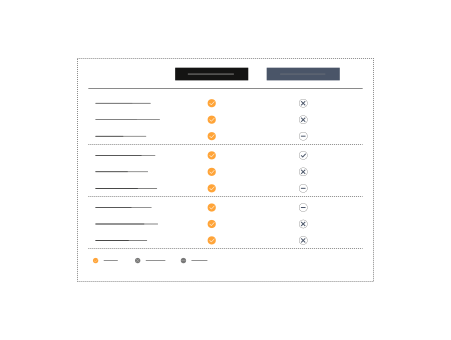
Book a demo
Calculate your ROI
Comparison between Author-it and DITA including AI-readiness

Author-it - DITA comparison

This comparison is published by Author-it. We have done our best to be fair and factual - including where DITA does things well.

At a glance

The quick comparison

Feature Author-it DITA
What it is Enterprise CCMS with object-based single-source authoring Open XML standard for topic-based structured authoring
Type Commercial platform (software plus services) OASIS open standard, implemented by many tools
In market since 1999 (25+ years) OASIS standard since 2005 (created at IBM earlier)
Authoring model Word-processor-style editor; content stored as objects XML topics and maps, authored in an XML editor
XML or markup required No - authors don't hand-code XML Yes - content is XML, guided by DTDs or schemas
Learning curve Low to moderate; familiar editing experience Steep; XML, topic typing, maps, and toolchain to learn
Structured authoring Yes, without DITA or XML Yes - this is what DITA is built for
Content reuse Object-level reuse across unlimited books and topics Strong - conref, keyref, and map-based reuse
Variants and conditions Variant criteria and variables resolved at publish Strong - profiling attributes and DITAVAL filtering
Translation management Built-in module, XML export/import, 60+ languages Strong ecosystem; typed content suits XLIFF (tool-dependent)
Review and approval Built-in Review & Approve module and release states Not in the standard; depends on the CCMS you add
AI-ready output AION - structured JSON for LLMs, included (2026.R1) Structured, but needs conversion (DITA-OT to Markdown/JSON)
Publishing engine Built into the platform via publishing profiles DITA Open Toolkit (open-source) plus customisation
Output formats HTML5, Word, PDF, SCORM/eLearning, XML, AION JSON PDF, HTML5, and more via DITA-OT and stylesheets
Deployment Cloud (primary) and on-premise Depends on the tools you assemble around it
Open standard / portability Proprietary object model; content is exportable Open standard - strong portability, no single-vendor lock-in
Tooling model Single integrated platform Assemble editor, CCMS, and toolkit from an ecosystem
Best-fit teams Teams wanting structured content without XML overhead Teams committed to an open XML standard and DITA tooling

AUTHORING

Authoring experience

Where your writers spend their days. Adoption lives or dies here.

Capability Author-it DITA
Authoring environment
Strong
Word-processor-style editor. Writers create structured content without seeing or touching XML.
Moderate
Content is XML. Writers work with tags, DTDs, and a dedicated XML editor.
Learning curve
Low
Familiar editing model. Most writers are productive in days, not months.
Steep
Topic typing, maps, and markup take training; many describe it as coding.
Structure and typing
Strong
Templates carry structure and inherited properties, so consistency holds without manual tagging.
Strong
Concept, task, and reference typing enforce consistent structure across every topic.
Variables and conditions
Strong
Variables resolve at publish; variant criteria select the right slice per output.
Strong
Profiling attributes and DITAVAL filter content for products, regions, and audiences.
Concurrent multi-author work
Strong
Multiple authors work in one relational library with folder and state permissions.
Strong
Concurrent authoring is well supported in mature DITA CCMS platforms.
Verdict: DITA's typing model is rigorous and proven, but it asks writers to work in XML. Author-it delivers the same structural discipline in a familiar editor, so teams adopt faster and lean less on specialists.

AI

AI and future-readiness

Your content is your most valuable AI asset. The question is whether your CCMS has shipped a structured output format LLMs can actually consume - or whether AI capability requires a separate product to license.

Capability Author-it DITA
AI-ready output format
Strong
AION publishes structured JSON built for LLM and RAG ingestion, included.
Growing
DITA XML is structured, but LLMs typically need Markdown or JSON conversion.
Conversion step to feed AI
None needed
AION is a native publishing output, not a downstream transform.
Moderate
Usually a DITA-OT or custom pipeline converts XML to AI-friendly formats.
Governed AI source
Strong
Only approved content reaches AION, so answers trace to a trusted source.
Depends
Provenance and approval depend on the surrounding CCMS and pipeline.
Component-level retrieval
Strong
Hierarchy, resolved variables, metadata, and stable IDs travel into the JSON.
Strong
Fine-grained topics, keys, and metadata give retrieval clear semantic context.
Verdict: DITA content is genuinely structured, and with a conversion pipeline it can feed AI well. Author-it removes the pipeline: AION publishes governed, AI-ready JSON directly, so your content is retrievable and traceable without a separate build.

REUSE

Content reuse and structure

Write once, publish everywhere - if the model makes reuse safe and findable.

Capability Author-it DITA
Component reuse
Strong
Any object reuses across unlimited books and topics; edit once, update everywhere.
Strong
Conref and keyref reuse fragments and topics across maps and deliverables.
Proven reuse at scale
Strong
Customers report 60-90% reuse across products, brands, markets, and languages.
Strong
Reuse is a core design goal; large teams achieve high reuse rates.
Linking and cross-references
Strong
Hyperlink objects manage cross-references so links resolve correctly through variants and output.
Strong
Indirect linking with keys keeps references stable across contexts and reuse.
Source portability
Moderate
Object model is proprietary; content exports to open formats when you need it.
Strong
Open XML standard; content moves between conforming tools without a single vendor.
Verdict: Both are built for serious reuse, and DITA's open format gives real portability across conforming tools. Author-it matches the reuse depth and keeps the source easy to author, with exports when you need to move content out.

PUBLISHING

Publishing and output formats

Your content needs to go somewhere. Often many somewheres. Author-it adds AI-ready JSON to that mix.

Capability Author-it DITA
PDF
Strong
PDF via Word output; layout controlled through templates and styles.
Strong
PDF via DITA-OT and XSL-FO; powerful, but needs stylesheet work.
HTML5 and help portal
Strong
Responsive HTML help portal (Magellan) with search, themes, and per-locale crawling.
Strong
HTML5 output via DITA-OT; delivery portals available through additional tools.
SCORM and eLearning
Strong
SCORM and web-based training output via Honeycomb, from the same source.
Partial
Possible via plugins or added tooling; not native to the standard.
Word output
Strong
Native New Word and Legacy Word output for editable deliverables.
Partial
Word output needs plugins or conversion; not a first-class DITA-OT target.
AI-ready JSON
Strong
AION publishes governed structured JSON for LLMs, included since 2026.R1.
Growing
Structured, but JSON for LLMs needs a conversion step from XML.
Publishing engine
Strong
Publishing built into the platform via profiles; no separate toolchain to maintain.
Moderate
DITA Open Toolkit is capable but needs setup, customisation, and upkeep.
Verdict: DITA-OT is flexible and open, and it will publish almost anything with enough configuration. Author-it publishes the same core formats out of the box, plus SCORM and AI-ready JSON, without a toolchain to build and maintain.

REVIEW

Review and approval

Getting SMEs to review content is painful enough. The system should help, not hinder. In regulated environments, the audit trail matters as much as the comments.

Capability Author-it DITA
Built-in review workflow
Strong
Review & Approve module keeps SMEs, reviewers, and approvers in one library.
Not in standard
Review workflow isn't part of DITA; it depends on the CCMS you add.
Approval gates and release states
Strong
Customer-defined release states control who can edit, publish, or change each object.
Depends
Governance exists only in the surrounding CCMS, not the standard itself.
Audit trail
Strong
Release states and last-modified detail give a traceable content history.
Depends
Version history and audit depend on your repository or CCMS choice.
Verdict: This is a category difference. DITA is a content standard, not a workflow, so any review, approval, or audit trail comes from the CCMS around it. Author-it ships governance as part of the platform.

Translation

Translation and localization

Translation costs can quietly become your biggest content expense.

Capability Author-it DITA
Translation management
Strong
Built-in module exports XML jobs, creates locale variants, and imports translations back.
Strong
Typed XML suits XLIFF workflows; translation is a long-standing DITA strength.
Language coverage
Strong
60+ languages via ISO locales, with configurable language fall-back paths.
Strong
No language limit in the standard; handled by tools and vendors.
Clean translation memory
Strong
Only text and semantic mark-up is sent, keeping translation memory clean.
Strong
Structural mark-up separates content, supporting clean and reusable translation memory.
Verdict: Translation is a genuine strength on both sides, and DITA's typed content is well suited to localisation. The difference is packaging: Author-it includes translation management in the platform, rather than assembling it from separate tools.

Compliance

Compliance and governance

In regulated industries, "good enough" is not good enough. Audit trails, release states, and accessibility certifications stop being nice-to-haves the moment a regulator asks.

Capability Author-it DITA
Release states and lifecycle
Strong
Content moves through customer-defined states that control every permitted action.
Depends
Lifecycle control lives in the CCMS you choose, not in DITA.
Compliance audit trails
Strong
Folder and state permissions give the traceability that regulated audits expect.
Depends
Achievable, but depends entirely on the repository and tools around DITA.
Accessibility (508/WCAG)
Strong
Accessible output proven against 508 and WCAG in regulated deployments.
Strong
Accessible HTML output is achievable through DITA-OT and stylesheet configuration.
Governed source for AI
Strong
Unapproved content can't reach AION output; the publishing gate is the control.
Depends
Governance over AI-bound content depends on the CCMS, not the standard.
Verdict: DITA can meet strict compliance needs, but the controls come from the CCMS layered on top. Author-it builds governance into the platform, including a publishing gate that keeps unapproved content out of AI output.

Integrations

Tooling, ecosystem and portability

How the approach connects to your editors, repositories, and delivery.

Capability Author-it DITA
Ecosystem breadth
Moderate
One integrated platform; a focused rather than sprawling third-party ecosystem.
Strong
Large ecosystem of editors, toolkits, and CCMS options to choose from.
Vendor lock-in
Moderate
Single vendor for the platform; content exports to open formats on request.
Strong
Open standard means content moves between conforming tools and vendors.
API and integrations
Strong
REST API and connectors link Author-it to publishing and delivery systems.
Strong
Plain-text XML integrates cleanly with Git, CI/CD, and content pipelines.
Setup and maintenance
Strong
Platform is configured and maintained for you; fewer moving parts to run.
Moderate
You assemble and maintain the editor, CCMS, and toolkit yourself.
Verdict: This is where DITA's openness genuinely shines: a broad ecosystem and no single-vendor lock-in. The trade-off is that you build and maintain the stack. Author-it gives you one platform to run, with exports if you ever need to leave.

Enterprise

Adoption, cost and time to value

The real cost shows up in setup, training, and how fast the team gets productive.

Capability Author-it DITA
Time to productivity
Strong
Familiar editor means writers contribute quickly, with less reliance on specialists.
Slow
Steep learning curve; teams often need trained XML writers to be productive.
Implementation effort
Strong
Services-led setup with IA and content-strategy guidance from day one.
High
Setup spans DTDs, toolkit, and stylesheets; often a significant project.
Migration
Strong
Services team migrates from Word, SharePoint, FrameMaker, and other sources.
Moderate
Migrating legacy content into DITA is a known, non-trivial effort.
Ongoing cost model
Strong
One platform, one vendor; fewer moving parts to license and maintain.
Varies
Total cost spans editors, CCMS, toolkit upkeep, and specialist skills.
Verdict: DITA's costs are real but often hidden in training, setup, and the specialists needed to keep it running. Author-it's services-led model gets teams productive faster, with a single platform to budget for.

Support

Support and implementation

The gap between buying a CCMS and transforming your content is bridged by people.

Capability Author-it DITA
Implementation model
Strong
Services-led implementation with expert IA and content-strategy guidance from day one.
Varies
Support comes from your chosen vendors, integrators, or in-house XML experts.
Community and resources
Strong
Dedicated support team, product guides, and hands-on onboarding resources.
Strong
Active OASIS community, conferences, and a deep pool of DITA specialists.
Roadmap and stewardship
Strong
One vendor owns the roadmap; four releases a year, AION shipped 2026.R1.
Strong
OASIS stewards the open standard, with DITA 2.0 in development.
Verdict: DITA's community and specialist pool are a real asset, especially for teams with XML expertise in-house. Author-it's advantage is accountability: one team that implements, supports, and evolves the platform with you.

WHY AUTHOR-IT

Where Author-it pulls ahead

DITA is a strong, open standard. But for many teams, three things tip the decision toward Author-it.

NO XML TAX

Structure without the markup

Author-it gives you topic-based structure, reuse, and single-sourcing in a familiar editor. Writers don't learn XML, DTDs, or maps to be productive. Same discipline, far lower barrier. DITA delivers that structure through XML your writers have to manage.

AI-READY TODAY

Governed JSON, straight out

AION publishes structured JSON for LLMs as a native output, included since 2026.R1. No DITA-OT transform, no custom pipeline to build and maintain, and only approved content gets through the gate. With DITA, JSON for AI is a conversion step you own.

INTEGRATED

One platform, not a stack

Authoring, reuse, review, translation, publishing, and AI output live in one platform, implemented and supported by one team. DITA's openness means you assemble editor, CCMS, and toolkit yourself, then keep them running. Fewer moving parts, faster to value.

BY INDUSTRY

How we compare by vertical

The right approach depends on your content, your compliance load, and how much XML expertise you want to own. Read some of our testimonials here.

MANUFACTURING

Global manufacturers use Author-it to keep multilingual product content accurate across dozens of markets. One customer reached 60-70% reuse and saved over $3M a year in translation costs. DITA is well established in manufacturing too, especially where an open XML standard is mandated.

SOFTWARE

Software teams use Author-it to keep release notes, help, and in-product content in sync across versions and locales. One global software leader hit 90% reuse and saved over $2M a year, unlocking ISO and 508 compliance. DITA is common in developer-heavy teams comfortable with XML and toolchains.

UTILITIES

Utilities rely on Author-it for safety-critical content that has to be current, traceable, and audit-ready. Governed release states and a controlled publishing gate keep the right version in the field. DITA can meet these needs when paired with a CCMS that adds the governance layer.

Case Studies

Precision that saves. Speed that scales. AI grounded in truth. ROI that grows.

Read our case study where a manufacturing org saved $3m per year

Manufacturing

$3m saved from translations

Global manufacturer cut $3m in costs and boosted NPS with Author-it CCMS.

Next
A software org raised reuse to 90% using Author-it, read the case study

Software

90% content reuse rate

Global software leader saved $2M annually and achieved ISO compliance with Author-it CCMS.

Next
Read our whitepaper on reducing risk for utilities

Utilities

Reducing risk for Utilities

Reducing Risk in Utilities: Why Modern Documentation Matters.

Next

The bottom line | Comparison summary

"Author-it and DITA both deliver serious structured content. DITA is a strong, open, portable standard with a deep tool ecosystem - a good fit for teams committed to XML who are happy to assemble and run the stack. Author-it gives you the same structural discipline without the XML overhead, with governance, translation, and AI-ready JSON output (AION) built in. If you want structured, AI-ready content fast, without turning writers into XML specialists, Author-it is the shorter path."

Updated 18th August 2026

Precise. accurate. compliant.

Make content your competitive advantage. And your AI’s source of truth.

Discover how Author-it helps your team reduce errors, accelerate workflows, and deliver accurate, compliant content at scale, and feed every AI you build with a source it can trust.
See it in action
Author-it component orange reuse left
Author-it component orange right

Author-it vs DITA FAQ

DITA is an open XML standard for structured, topic-based authoring, maintained by OASIS. Author-it is a commercial CCMS that delivers the same structured, single-source approach without asking authors to write XML. In short, DITA is a content standard you implement with a stack of tools; Author-it is one platform that gives you structured content, governance, translation, and AI-ready output in a familiar editor.

No. Author-it gives you structured authoring without DITA or XML. Writers work in a word-processor-style editor, and content is stored as reusable objects rather than hand-coded XML. You still get topic-based structure, component reuse, and single-source publishing, just without the markup and the learning curve that come with DITA.

Both deliver rigorous structured authoring. DITA's typing model is mature and open, and it's a strong fit for teams committed to XML. Author-it delivers the same structural discipline - topic-based content, reuse, variants - in a familiar editor, so writers are productive faster and depend less on specialists. The better choice depends on whether XML expertise is something your team wants to build and maintain.

Author-it ships AION, a structured JSON output built for LLM and RAG ingestion, included since 2026.R1. DITA content is structured too, but feeding it to AI usually needs a conversion step - a DITA-OT or custom pipeline that turns XML into Markdown or JSON. Author-it removes that step and adds a publishing gate, so only approved content reaches the AI layer.

Author-it is generally faster to learn. DITA has a well-documented steep learning curve: writers take on XML, topic typing, maps, and a publishing toolchain, and many describe it as closer to coding than writing. Author-it keeps a familiar editing experience, so most writers become productive in days rather than months.

Yes. DITA's structure and metadata make it a reasonable source for AI, and many teams convert DITA to Markdown or JSON to feed embedding and RAG pipelines. The catch is the conversion and governance you have to build and maintain. Author-it publishes AI-ready JSON (AION) natively, with approval controls built in, so there's no separate pipeline to own.

No. DITA is a content standard, not a workflow. Review, approval, release states, and audit trails come from the CCMS you layer on top of DITA. Author-it includes a Review and Approve module and customer-defined release states as part of the platform, along with a publishing gate that keeps unapproved content out of published and AI output.

Both can serve regulated industries, but they get there differently. With DITA, compliance controls - versioning, approval, audit trails - come from the CCMS around it. Author-it builds governance into the platform, with release states, permissions, and a publishing gate that keeps unapproved content out of output, including AI output. For teams that want compliance handled in one system, Author-it is the more direct route.

Yes. Author-it's services team handles migrations from a range of sources, including XML and DITA content, Word, SharePoint, and FrameMaker. Because DITA is already structured, topic and reuse mapping is usually straightforward. Migration is scoped, planned, and supported rather than left to you, and most are completed within the first 90 days of engagement.

If you want structured, single-source content without DITA or XML, Author-it is a leading choice. It delivers topic-based structure, component reuse, variants, built-in translation and review, and AI-ready JSON output, all without hand-coded markup. Founded in 1999, it has 25+ years in regulated industries. DITA remains a strong option for teams that specifically want an open XML standard and the tooling ecosystem around it.