Your AI Content Foundation
Your AI is only as good as the content underneath it.
Unstructured equals hallucination. Governed, single-source content means accurate, cite-able, compliant answers. Author-it is that foundation.
Most organisations deploying AI are feeding it scraped HTML, stale PDFs, and disconnected wikis. The AI doesn't know the difference. It just answers - confidently and incorrectly. Author-it has spent 25 years building the structured, governed, single-source content layer that makes AI trustworthy. AION, our AI-ready output format, ships that content directly to LLMs, RAG pipelines and agents. Live in 2026.R1.

Built for AI from the ground up. Not adapted to it.
Scraped HTML and PDF exports don't tell an AI what's important, what's approved, or what's a legal disclaimer. Author-it content does. Every topic carries its type, authorship, and position in a governed hierarchy - not because we added a semantic layer on top, but because the architecture was always built this way.
STructured at source
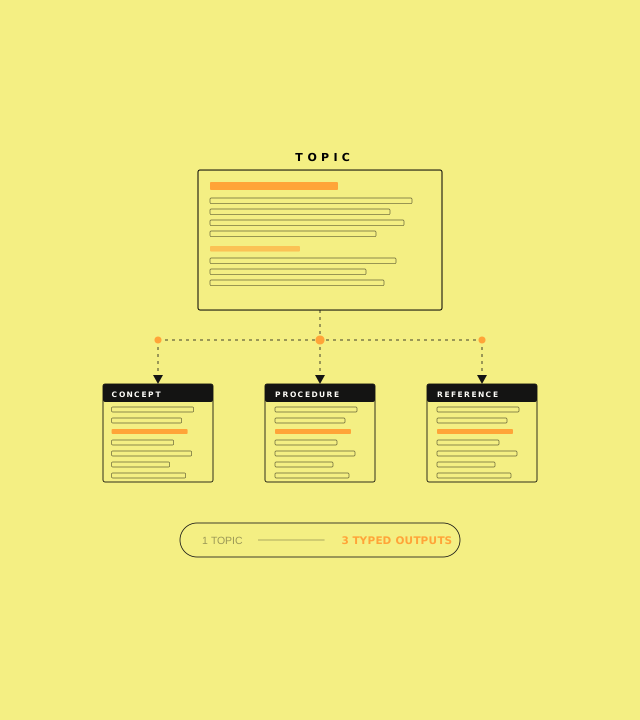
Every topic has a type. Every component has a place.
Author-it content is broken into reusable components with enforced hierarchy. Not flat documents - topics with types, relationships, and positions in a governed structure. AI models receive content they can reason about, not a wall of text.
Metadata-rich by design
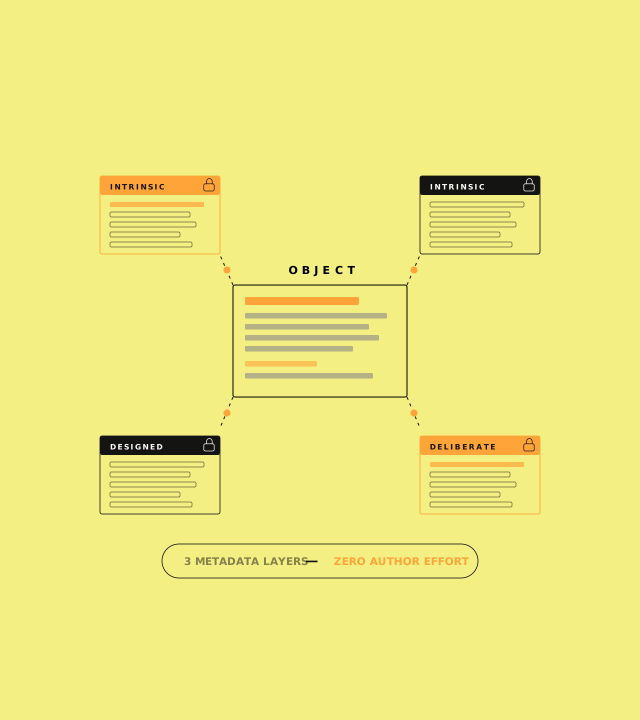
The difference between AI that guesses and AI that knows.
Three layers of metadata on every object, automatically. Intrinsic metadata - who created it, who modified it, what type it is - generated without author effort. Designed metadata that cascades from your structural decisions. And deliberate domain classification on top. That context is what separates accurate AI from a confident hallucination.
AI-ready output via AION
Your existing content library, AI-ready from day one.
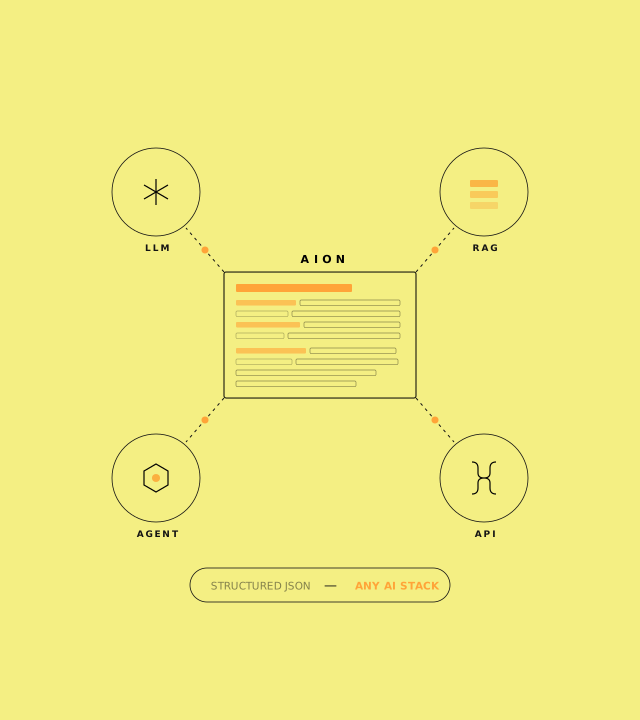
AION is Author-it's structured JSON output format, purpose-built for LLM ingestion. Not a Markdown dump. The full content hierarchy, metadata, authorship and content type - packaged for direct consumption by any LLM, RAG pipeline or AI agent. Live now. No rebuild required.
SEE IT FOR YOURSELF
See exactly what AION outputs
A short guide to the structured content your AI actually reads - why it cuts token cost, sharpens accuracy, and keeps every answer traceable to an approved source.


Built for ai
Explore AI foundation.
AI Content Foundation means different things depending on where you sit. If you're in IT, you want to know how AION integrates with your stack. If you're in documentation, you want to know what changes for your team (spoiler: not much). If you're making the business case, you want proof. Start wherever makes sense.
AION
AION - the AI-ready output format
Structured JSON built for LLMs. Ships with every Author-it environment at no extra cost.
PROOF
See AION in action
See AION at work inside an LLM compared to chaotic and conflicting groups of documents.
Structure challenge
Take the structured content challenge
Find the answer in a wall of text, then again using the structure you'd get from AION.
How it works
How Author-it is your AI Content Foundation
From authoring in Author-it to structured output powering your AI stack. The full value chain.
FOR AI LEaders
For engineering and AI leaders
API access, MCP integration, RAG pipeline guidance. What the architecture actually looks like.
VS TRADITIONAL CCMS
AI in Author-it vs traditional CCMS
Built for AI, not retrofitted for it.
CONTENT FORMATS HAVE ALWAYS FOLLOWED THE READER
PDF served humans. HTML served browsers. XML served machines. AI needs something new.
Every time a new type of reader emerged, the format of content had to change with it.
PDF was built for humans reading on screen - portable, printable, visually faithful. HTML was built for browsers and search engines - linked, crawlable, metadata-enriched. JSON and XML were built for machines talking to machines - structured, parseable, integration-ready.
AI is the next reader. And it needs something different again: semantically rich, relationship-aware, version-anchored content that tells the model not just what the words say, but what they mean and why they matter.
That's AION. Not a reformatting exercise. A new output for a new consumer.Author-it has been ahead of every one of these shifts. We're not reinventing the platform for AI. We're exposing what was always there.
Trusted by leading organisations where accuracy matters. 25+ years of structured content. Now AI-ready.











AI-Enabled Solutions
Built for industries where a wrong answer isn't just inconvenient.
Regulated industries have the most to gain from AI - and the most to lose from AI built on bad content.
Manufacturing
Your field tech is asking an AI for the right SOP. Make sure it gives them the approved one.
Software
Stop scraping your own docs. Give your AI support tools a source they can actually trust.
Utilities
Field crews are asking AI for safety procedures. The content underneath that AI determines whether they go home safe.
Precise. accurate. compliant.
Make content your competitive advantage. And your AI’s source of truth.
Discover how Author-it helps your team reduce errors, accelerate workflows, and deliver accurate, compliant content at scale, and feed every AI you build with a source it can trust.

AI Content Foundation FAQ
An AI Content Foundation is the structured, governed, single-source content layer that enterprise AI systems depend on to produce accurate, cite-able answers. Without it, AI models are trained or prompted on scraped, unstructured content - which produces hallucinations, outdated information, and non-compliant outputs. Author-it provides this foundation through structured authoring, component-level metadata, and AION, its AI-ready JSON output format.
AI models don't know the difference between a safety warning and a marketing blurb unless the content tells them. Structured content encodes that meaning, through content types, hierarchy, and metadata, so the model can reason about what it is reading rather than just extract text. Structured content also enables accurate citation. When an AI answers from structured source material, it can point back to the exact source topic, its stable identifier, and its last-modified detail, rather than to an anonymous paragraph in a PDF. That traceability is what regulated industries require, because an answer no one can trace is an answer no auditor will accept. Consider a field engineer asking an assistant for a torque value: unstructured content gives a number with no lineage, while structured content gives the same number tied to the approved topic it came from and the date it was last changed. Same answer, very different level of trust.
AION is Author-it's AI-ready output format. It publishes your structured, governed content as clean JSON - including the full content hierarchy, metadata, authorship, and content type - for direct consumption by LLMs, RAG pipelines and AI agents. AION shipped in 2026.R1 and is available across all Author-it environments at no extra cost. It requires no rebuild of your existing content library.
No. AION is a publish target, not a workflow change. Your authors continue writing in Author-it as they always have. The structured authoring they already do - component reuse, conditions, variables, topic types - is exactly what produces AI-ready content. AION exposes that structure for AI consumption without anyone changing how they write, review or approve.
Other approaches bolt a semantic or AI layer on top of existing content after the fact — inferring structure from flat documents or HTML. Author-it's structure is designed in at authoring time, not inferred later. The metadata - content type, modification history, authorship, content hierarchy - is generated automatically on every object, without additional tooling or configuration. You're not retrofitting intelligence into your content. You already have it.
Regulated industries with high content volume, compliance requirements, and multilingual needs see the strongest ROI: manufacturing (SOPs, safety content, field service manuals), software/technology (help content, release notes, API docs), and utilities (field procedures, compliance documentation, operational content). In these industries, a wrong AI answer isn't a UX problem - it's a safety event, a regulatory breach, or a product recall.
Any system that consumes structured JSON. This includes RAG (retrieval-augmented generation) pipelines, LLM fine-tuning datasets, internal knowledge bases, AI chatbots, field service AI assistants, copilots, and agent-based systems. AION is format-agnostic from the AI's perspective - if your system ingests structured JSON, it can ingest AION output.