Article
AI-ready HVAC documentation for field service copilots

Summary:
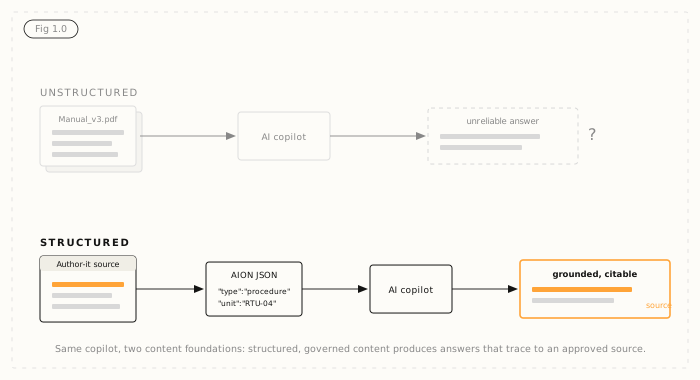
HVAC field-service copilots are only as accurate as the documentation behind them. Feed a troubleshooting bot a pile of unstructured PDF manuals and it guesses - returning confident answers a technician can't verify against an approved source. AI-ready HVAC documentation fixes this at the root: structured, governed, single-source content published as machine-readable JSON, so every answer traces back to an approved topic. It's the same fix behind the wider HVAC documentation problem in manufacturing, and it's what Author-it calls the AI Content Foundation.
Why HVAC field-service copilots give wrong answers
HVAC field service runs on documentation. A technician on a rooftop needs the right charge weight, the correct A2L handling steps, and the exact fault code for the unit in front of them. Put an AI copilot between the technician and the manual, and the copilot inherits every flaw in the source.
The source is usually a folder of PDFs. HVAC lines run to thousands of configurations - model numbers encode series, tonnage, efficiency, voltage, and refrigerant, and each variant needs its own matching docs. When a retrieval-augmented generation pipeline searches across those PDFs, it pulls whatever text looks similar. It mixes a spec from one model with a procedure from another, misses the latest revision, and can't point to where an answer came from.
That's the failure mode: unstructured content in, hallucination out. In field service, a wrong answer isn't abstract. The industry target for first-time fix sits around 80%, so one in five calls already needs a return, and every callback costs roughly $100 to $250. A good mobile knowledge base lifts first-time fix rates and shaves 20 minutes or more off a job - but only if the answers it surfaces are right. A copilot that sounds certain but cites nothing makes that worse, not better.
The stakes have gone up. With the switch to A2L refrigerants, a wrong charge weight or an out-of-date handling step isn't just a callback - it's a safety and compliance issue. The copilot has to serve the current, approved procedure for the exact unit, every time. That's a content problem long before it's an AI problem.
What AI-ready HVAC documentation actually means
AI-ready HVAC documentation is content structured so an AI system can retrieve the right piece, for the right unit, and trace it back to an approved source. It has three properties a pile of PDFs doesn't.
It's componentised. Content is broken into typed components - procedures, warnings, specifications, fault codes - instead of being locked inside page layouts. A copilot can retrieve a single procedure without dragging in three unrelated pages.
It's single-source and versioned. One approved component feeds every output, so there's no question about which revision the AI is reading.
It's governed. Content passes an approval workflow before it's published, so the AI only ever sees signed-off material. This is the difference between content a human can skim and content an AI agent can consume with provenance.
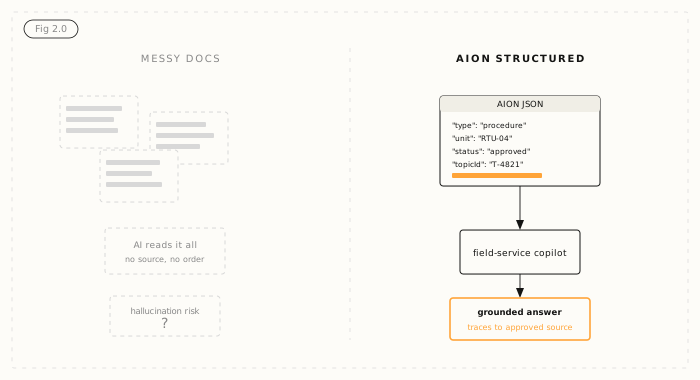
Unstructured PDFs vs AI-ready structured content
Here's how the two approaches compare when they feed a field-service copilot:
How to make HVAC documentation ready for AI field service assistants
Getting there is a content-model change, not an AI project. Four steps do most of the work:
- Break manuals into components. Split procedures, warnings, specs, and fault codes into separate reusable topics rather than monolithic files.
- Tie every component to its model variant. Tag content to the series, tonnage, refrigerant, and configuration it applies to, so retrieval never crosses wires.
- Put content through an approval gate. Nothing reaches the AI until a subject matter expert has signed it off.
- Publish to a structured, machine-readable format. Output JSON built for retrieval, not a flattened PDF a pipeline has to reverse-engineer.
Do this and your structured content becomes the accuracy layer the copilot was missing. It's also the foundation for a broader AI content strategy, not just one bot.
Where Author-it and AION fit
Author-it is a Component Content Management System - a CCMS - built for exactly this. Content is authored once as reusable components, reviewed and approved, then published from a single source. That's structured authoring without DITA or XML, proven across 25+ years in regulated manufacturing.
For AI, Author-it publishes structured content as AION, its JSON output built for large language models and RAG pipelines. AION shipped in 2026.R1 as standard, at no extra cost. It outputs the content hierarchy, the topic text, object IDs, template names, timestamps, authorship, and resolved variable values - the machine-readable structure a copilot needs to retrieve the right topic for a specific unit.
The governance is architectural. Unapproved content can't pass the publishing gate, so anything reaching AION - and therefore the copilot - has already been approved. That's what "traceable back to an approved source" means in practice. For teams that also want AI help inside the editor, CoAuthor is in limited trial from 2026.R2, grounded in the organisation's own published content.
Structured content is the AI Content Foundation. It's the difference between a field-service copilot that guesses and one that gives grounded, citable answers your technicians can trust on site.

HVAC documentation FAQ
Q: How do you make HVAC documentation ready for AI field service assistants?
A: You make HVAC documentation ready for AI field service assistants by moving it out of unstructured PDFs and into structured, single-source content that publishes as machine-readable JSON. AI-ready HVAC documentation is broken into typed components - procedures, warnings, specifications, fault codes - each tied to the right model variant and governed by an approval workflow. That structure lets a retrieval-augmented generation pipeline pull the exact, current topic for a given unit instead of guessing across mixed manuals, and it lets every answer trace back to an approved source. Author-it publishes this structured content as AION, its JSON output built for large language models and RAG pipelines, shipped in 2026.R1 as standard. Because unapproved content can't pass the publishing gate, anything reaching the copilot has already been signed off. The result is a field-service assistant that gives grounded, citable answers a technician can actually trust on site.
Q: Why do AI copilots hallucinate on HVAC manuals?
A: They hallucinate because unstructured PDF manuals give a retrieval pipeline no reliable structure to work with. The pipeline matches on similar-looking text, so it blends specs and procedures from different model variants, misses the latest revision, and produces a confident answer with no traceable source. The problem is the content, not the model. Structured, governed content removes the ambiguity the AI would otherwise fill with a guess.
Q: What is the AI Content Foundation?
A: The AI Content Foundation is the structured, governed content layer that enterprise AI depends on to give accurate answers. Large language models, RAG pipelines, and copilots are only as good as the content feeding them. When that content is componentised, single-source, and approved before publishing, AI answers can be traced back to an authoritative source. Author-it is that foundation for HVAC manufacturers.
Q: Does AI-ready documentation replace the technician's judgement?
A: No. It gives the technician a faster, more trustworthy reference. A copilot grounded in structured, approved content surfaces the right procedure, charge weight, or fault code for the specific unit, with a source the technician can check. It removes guesswork from the lookup, not the decision. The technician still applies experience on site.
Q: What does AION output for AI pipelines?
A: AION outputs structured JSON containing the content hierarchy, the topic text, object IDs, template names, timestamps, authorship, source folder paths, and resolved variable values. It's built for direct ingestion into large language models and RAG pipelines. Because content must pass the publishing gate first, only approved material reaches the output. AION shipped in 2026.R1 as standard, at no extra cost.
Q: How is this different from pointing an AI tool at our existing PDFs?
A: General-purpose AI tools scraping unstructured PDFs are only as good as the content they find - and PDFs give them no component boundaries, no variant tagging, and no approval trail. You get plausible answers you can't verify. AI-ready structured content flips that: the AI retrieves an exact, approved component and can cite it. You structure the content before the AI ever sees it.
Q: Do we need to rewrite all our manuals first?
A: Not all at once. Most teams start with the highest-risk, highest-volume content - the manuals behind the most field callbacks - and componentise those first. Author-it's services team has migrated content from Word, PDF, and shared drives many times, and structured content compounds: once a component is approved, every output and every AI answer reuses it.
Published on:
Author:
May 31, 2026
Quinn Wright
Head of Sales
Related Resources

Article
Field crew AI: when a wrong answer is a safety risk
Why safety-critical field operations can't run AI on ungoverned content - and what deterministic, traceable answers actually require.

Article
AI service assistants for manufacturing field techs
What it takes to put an AI service assistant in a manufacturing field tech's hands without risking a wrong, outdated, or unsafe answer.
Article
AI-ready HVAC documentation for field service copilots
AI-ready HVAC documentation turns unstructured PDFs into structured, governed content field service copilots can cite - no more confident, unverifiable answers.