Article
A2L refrigerant documentation: updating HVAC manuals

Summary:
The A2L refrigerant transition affects HVAC documentation because the rule changed the product, and every document tied to that product has to change with it. From 1 January 2026, the EPA AIM Act bans new residential and light-commercial systems that use high-GWP refrigerants like R-410A, so manufacturers have moved to A2L refrigerants R-454B and R-32. That single switch cascades into installation and operation manuals, safety labels, charge-weight specifications, leak-test records and service guides - across every product line, language and market. A2L refrigerant documentation also carries new labelling and commissioning requirements, so a wrong charge weight or a missing classification is a compliance risk, not a typo. Hand-editing hundreds of separate files invites version drift and error. Structured, single-source content lets an HVAC maker update the refrigerant spec once and republish it everywhere - PDF, HTML and AI-ready output - instead of chasing every manual and label by hand.
What the A2L refrigerant switch actually changed
The refrigerant rule looks like a chemistry change. For your documentation team, it's a product change with a long tail.
Under the EPA AIM Act Technology Transitions Rule, new residential and light-commercial HVAC systems built with high-GWP refrigerants like R-410A are off the table from January 2026. The industry moved to A2L refrigerants: R-454B for larger ducted systems and R-32 for smaller residential and light-commercial splits. Both are classed as mildly flammable, so they come with new handling, labelling and commissioning rules.
That reclassification touches almost every document you ship. This is the same downstream update problem that sits at the heart of the HVAC documentation problem in manufacturing - one change at the product level, hundreds of edits everywhere else.
A single A2L switch means updating:
- Installation and operation (IOM) manuals - handling, clearances, ventilation notes
- Safety labels - refrigerant type, A2L classification and charge weight per updated ASHRAE 15 labelling
- Charge-weight specifications - different per model and refrigerant
- Commissioning packages - refrigerant weigh-in, leak-test records, compliance statements
- Service and repair guides - flammability-aware procedures
- Every translated variant of all of the above
One spec change, hundreds of documents
Here's the part that hurts. HVAC lines run to thousands of configurations - model numbers encode series, tonnage, efficiency, voltage and refrigerant, and each variant needs matching docs. A refrigerant change doesn't hit one manual. It hits every document, in every language, for every affected SKU.
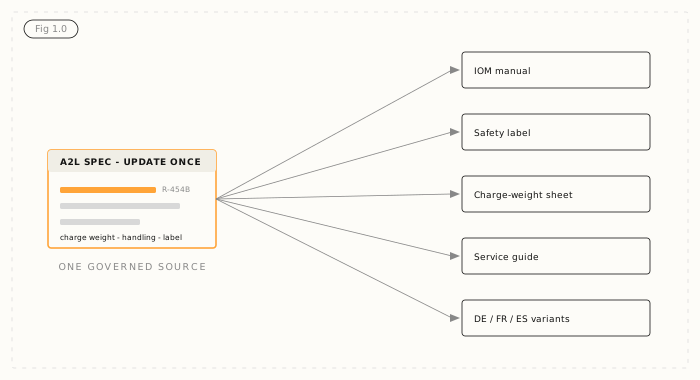
If those documents live as separate files - a Word manual here, an InDesign label sheet there, a PDF service guide somewhere else - the change has to be made by hand, one file at a time. Miss one and you ship a manual with the wrong charge weight or an old refrigerant callout. In an HVAC manufacturing context, that's not a cosmetic error. It's a labelling and compliance gap that a distributor, installer or auditor will find.
Hand-editing versus updating once
The difference between the two approaches shows up fast when a rule changes mid-catalogue. Here's how they compare.
How single-source publishing handles the A2L update
Structured authoring fixes this at the root. Instead of storing the refrigerant spec inside each document, you store it once as a reusable component and pull it into every manual, label and service guide that needs it.
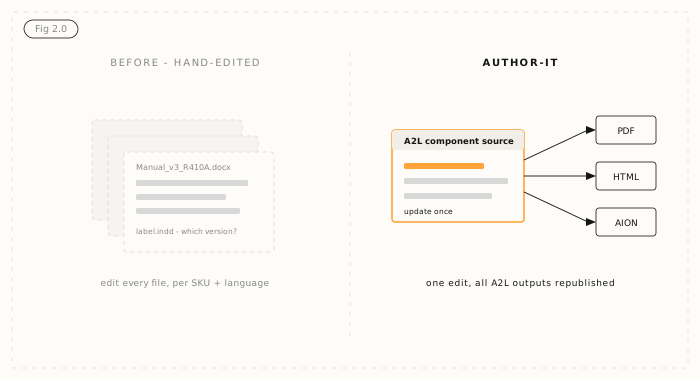
When R-410A becomes R-454B on a product line, you change the charge-weight and refrigerant components in one place. Every deliverable that references them updates on the next publish - the IOM manual, the safety label, the commissioning sheet, the German, French and Spanish variants. This is the same discipline that ends the version-control problems teams hit with InDesign and Word manuals, where the "current" file is whatever someone last saved.
A Component Content Management System (CCMS) like Author-it is built for exactly this. Content is authored as components, assembled into deliverables, and published to multiple formats - PDF, HTML5, and AI-ready structured JSON - from one source. A refrigerant change becomes a single controlled edit with an audit trail, not a hundred-file scramble. Translation follows the same logic: only the components you changed get sent for translation, so you're not paying to re-translate a manual that's identical apart from a charge weight. Manufacturers running this way report content reuse of 60-70% and translation costs cut by up to 90%, which is exactly the leverage you want when a rule change lands across a full catalogue.
Why this matters beyond January 2026
A2L is not a one-off. Refrigerant rules, efficiency standards and labelling requirements keep moving, and each shift repeats the same documentation exercise. The manufacturers who handle A2L cleanly are the ones who already treat product content as structured, single-source data rather than a folder of files.
There's an AI angle too. Field technicians increasingly pull answers from search and AI assistants, and those tools are only as accurate as the content behind them. Author-it's structured JSON output, AION, gives AI systems governed, up-to-date content to ground their answers in - so a technician asking about A2L charge weight gets the approved figure, not a guess from an outdated PDF.
If you want to see how ready your current setup is for the next product change, take the Structured Content Challenge and benchmark where your documentation stands today.

A2L documentation FAQ
Q: What HVAC documents have to change for the A2L refrigerant transition?
A: Almost every product document tied to an affected system. That includes installation and operation manuals, safety labels showing refrigerant type and charge weight, charge-weight specifications, commissioning packages with leak-test and weigh-in records, service and repair guides, and every translated variant of those documents. Because A2L refrigerants R-454B and R-32 are mildly flammable, handling, ventilation and labelling content all need updating, not just the refrigerant name.
Q: When did the R-410A ban take effect?
A: Under the EPA AIM Act Technology Transitions Rule, new residential and light-commercial HVAC systems using high-GWP refrigerants like R-410A are banned from 1 January 2026. Manufacturers moved to A2L refrigerants - R-454B for larger ducted systems and R-32 for smaller residential and light-commercial splits.
Q: What are the new A2L labelling requirements?
A: A2L systems must be labelled with the refrigerant type, the A2L classification, and the charge weight, in line with updated ASHRAE 15 labelling. Commissioning packages are now expected to include a refrigerant weigh-in, leak-test records, and a manufacturer compliance statement. Getting a charge weight or classification wrong on a label is a compliance issue, so accuracy across every SKU matters.
Q: Why is updating HVAC manuals for A2L so time-consuming?
A: HVAC lines run to thousands of configurations, and each model variant needs matching documents in multiple languages. If those documents are stored as separate files, the refrigerant change has to be made by hand in every one. The volume, not the difficulty of any single edit, is what makes it slow and error-prone.
Q: How does single-source publishing help with the refrigerant transition?
A: Single-source publishing stores the refrigerant spec once as a reusable component instead of copying it into every document. When the spec changes, you edit it once and republish every manual, label and service guide that uses it - including translated versions. This turns a hundred-file update into one controlled change with an audit trail.
Q: Does a CCMS reduce compliance risk during a refrigerant change?
A: Yes. A Component Content Management System keeps the charge weight, refrigerant type and safety content in one governed source, so every output shows the same approved values. Built-in review and approval means a change is signed off before it publishes, which lowers the risk of an outdated or incorrect figure reaching an installer or auditor.
Q: How does structured content support AI tools for field technicians?
A: AI assistants and search tools are only as accurate as the content behind them. Author-it's structured JSON output, AION, gives those tools governed, current content to ground their answers in. A technician asking about A2L charge weight or handling gets the approved figure from the single source, not a guess pulled from an outdated document.
Published on:
Author:
July 15, 2026
Jamie Simmonds
Documentation Manager
Related Resources

Article
Field crew AI: when a wrong answer is a safety risk
Why safety-critical field operations can't run AI on ungoverned content - and what deterministic, traceable answers actually require.
Article
AI-ready content: who has actually shipped it?
A practical field guide to separating AI-ready content marketing from vendors who have actually shipped a structured, governed output for AI.
Article
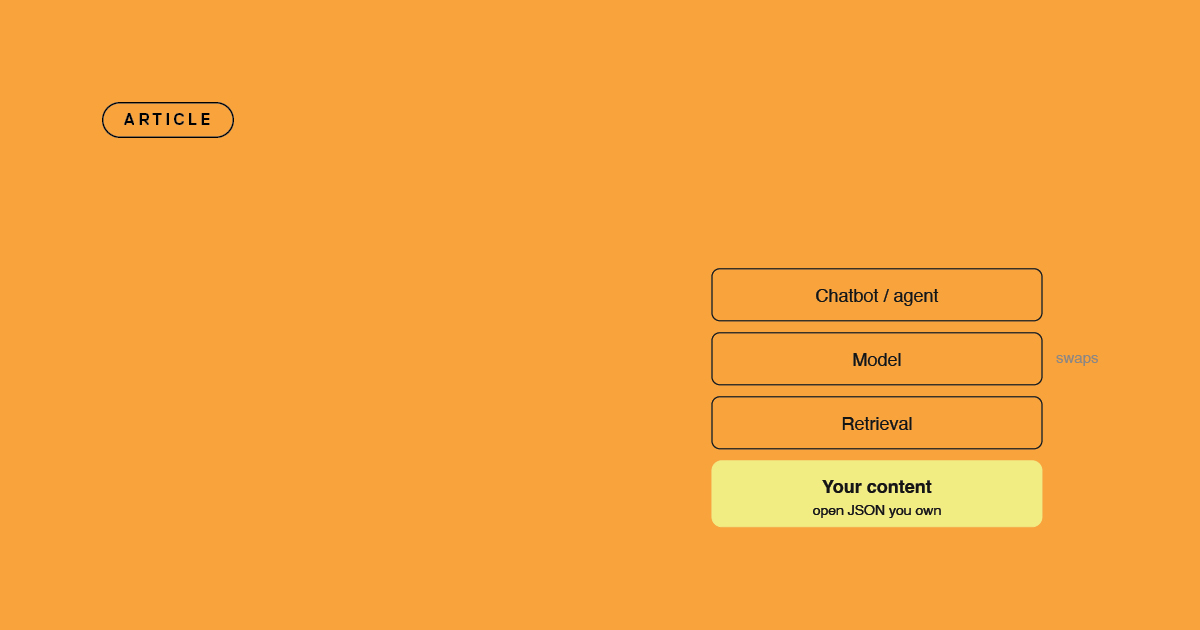
Future-proof your content for an AI stack that changes
Models and tools churn constantly. Future-proof content for AI by owning the one layer that lasts - your content, as open structured JSON.