Article
Managing spare parts catalogs across variants

Summary:
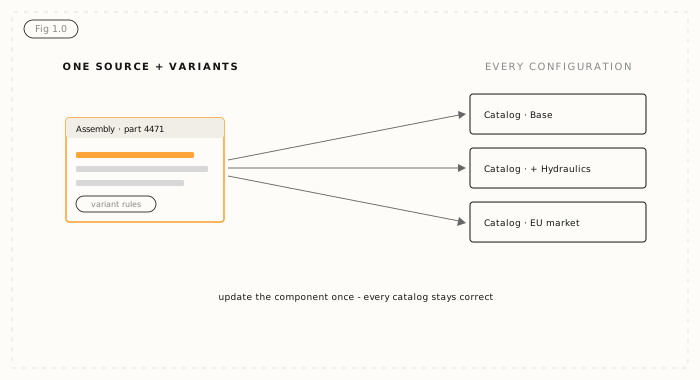
Equipment manufacturers manage spare parts catalogs and service manuals across many product variants by treating content as reusable components with conditional variants, rather than maintaining a separate document per model. In a Component Content Management System (CCMS), each part, procedure, and warning is authored once and stored in a single source. Variants, sometimes called conditional or filtered content, let one source serve every configuration: a base machine, its options, and each regional version are all generated from the same components, with only the differences flagged. When a part number changes or a procedure is revised, you update it once and every affected catalog and manual updates automatically. Translation follows the same logic, so only changed content is sent for translation. The result is that adding a variant no longer means cloning and maintaining another full document set - it means describing what is different. That is how manufacturers keep hundreds of parts catalogs accurate without a proportional rise in effort.
The variant explosion in parts and service content
Spare parts and service content multiply faster than almost anything else a manufacturer produces. A base machine has options. Options have revisions. Revisions differ by region. Each combination needs a parts catalog and a service manual that is correct for that exact configuration.
Do the arithmetic and it gets uncomfortable quickly. A handful of models, a few options each, several markets, and multiple languages turns into hundreds of documents that all have to agree with each other and with engineering.
The trouble is that most of that content is shared. The same hydraulic assembly, the same lockout procedure, the same warning appears in dozens of catalogs. Maintaining it as separate documents means maintaining the same content dozens of times.
Why cloned documents are the wrong unit
The instinct is to clone: copy last model's catalog, change what's different, ship it. It feels fast. It is also where errors start.
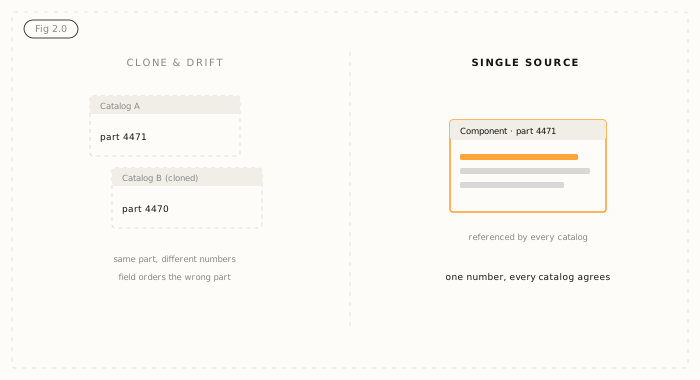
Once a catalog is cloned, it drifts. A superseded part number gets fixed in the new model but not the three it was copied from. A service step changes, and only some manuals catch up. The field ends up ordering the wrong part or following an outdated procedure - and in service content, that carries warranty and safety cost.
If you want to size that exposure, it's worth putting numbers on your current documentation effort before deciding how to fix it.
Manage the difference, not the document
The shift that fixes this is to stop treating a catalog as the unit of work. The unit is the component: a part entry, an assembly, a procedure, a warning.
Each component is authored once. Variants - conditional or filtered content - describe what differs between configurations. A base machine and its options draw on the same components; only the differences are flagged. One source produces the correct catalog for every variant.
The same principle drives content reuse across the whole range. Change a part number in one place and every catalog that references it updates. Here's the contrast in practice:
Keeping part data in sync with engineering
Parts content has a second problem: it has to match what engineering actually ships. Hand-copying part numbers and specs from PLM or ERP into documents is where a lot of catalog errors come from.
A CCMS with integration capabilities can pull part numbers, specifications, and metadata from upstream systems through an API, so the catalog reflects current engineering data instead of a copied snapshot. Illustrations and exploded views are reused as linked assets, with callouts tied to the same part data - so the picture, the part number, and the description stay consistent.
Where Author-it fits
Author-it has spent 25+ years managing structured content for manufacturers with exactly this problem.
Parts, procedures, and warnings live as single-source components. Variants handle the differences between models, options, and markets. Translation reuses everything that hasn't changed. Integration keeps content aligned with PLM and ERP data. And because every catalog is generated from approved content, the version in a technician's hands matches the version you signed off.
The same structured content also publishes to AI-ready output via AION, so after-sales portals and service assistants can answer parts questions from governed, traceable data rather than guessing from scattered PDFs.
A quick way to see where your parts content stands today is the Structured Content Challenge.

Spare parts documentation FAQ
Q: How do you manage spare parts catalogs for many product variants?
A: Author each part, assembly, procedure, and warning once as a component, then use variants to describe only what differs between models, options, and regions. Every catalog is generated from the same source, so a change flows to all of them at once. You maintain one set of components instead of one document per variant.
Q: What are content variants, or conditional content?
A: Variants are rules that let a single source serve multiple configurations. You tag content so it appears only for the relevant model, option, market, or output. One source topic can produce the correct catalog for a base machine and each of its variants without duplicating the shared content.
Q: How does single-sourcing reduce parts documentation errors?
A: When a part number, torque value, or safety warning lives in one component, it is corrected in one place and every catalog and manual that references it updates. That removes the main cause of field errors: the same detail edited in some documents but missed in others.
Q: Can parts data stay in sync with our PLM or ERP?
A: Yes. A CCMS with integration capabilities can pull part numbers, specifications, and metadata from PLM or ERP systems through an API, so the documentation reflects current engineering data rather than a manually copied snapshot. That keeps catalogs aligned with what is actually shipping.
Q: How does this cut translation costs for service manuals?
A: Because content is reused, only new or changed components are sent for translation. Shared procedures and warnings that already exist in a language are not re-translated. Manufacturers with high reuse typically cut translation spend significantly across a multi-market product range.
Q: What about exploded-view diagrams and illustrations?
A: Illustrations and exploded views are managed as reusable assets referenced by the relevant components, with callouts linked to part data. Reusing a diagram across every catalog that includes that assembly keeps the visuals consistent and avoids maintaining multiple copies of the same image.
Q: How does structured parts content help after-sales AI and portals?
A: Structured, governed parts and service content gives search tools, self-service portals, and AI assistants clean, traceable data to draw on. Answers about the right part or procedure can be tied back to an approved source, which is what makes an after-sales assistant trustworthy rather than a guess.
Published on:
Author:
July 4, 2026
Osmar Silva
CTO
Related Resources
Article
Managing spare parts catalogs across variants
Options, revisions, and regional variants multiply parts lists and service manuals fast - here's how to maintain them all from a single source.
Article
Why equipment documentation breaks as you scale
As equipment makers add product lines, manual updates pile up faster than the products ship - the fix is managing content as components, not files.
Guide
CCMS for HVAC manufacturers: a buyer's guide
CCMS for HVAC manufacturers must handle refrigerant change, variant sprawl, and multi-market translation. Here are the criteria to score vendors before you buy.