Article
The CCMS reckoning: six priorities for the AI era

Summary:
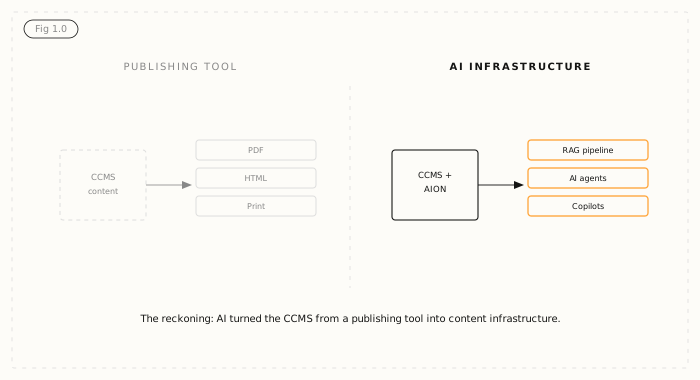
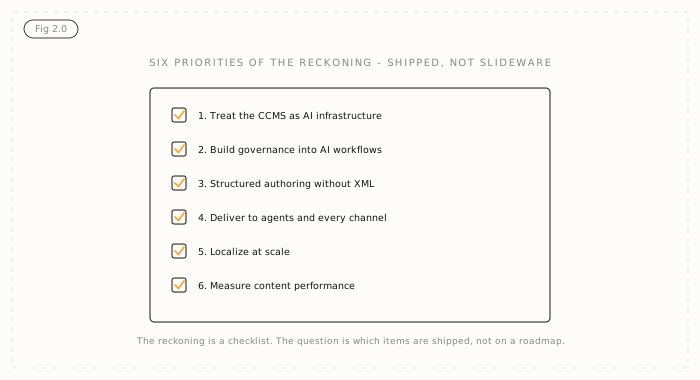
The CCMS reckoning is the industry's recognition that AI has changed what a component content management system is for. A CCMS used to be a back-office publishing tool. In the AI era it becomes infrastructure: the structured, governed content layer that retrieval-augmented generation, copilots, and AI agents depend on to answer accurately. Industry analysis now frames this as six priorities for content leaders - treat the CCMS as AI infrastructure, build governance into AI workflows, make structured authoring accessible beyond technical writers, deliver to agents and every channel, localize at scale, and measure content performance. The uncomfortable question underneath the reckoning is not whether these priorities are right - they are - but which a vendor has actually shipped rather than put on a roadmap. Author-it, a CCMS pioneer of more than 25 years, has shipped the hardest ones: a structured AI output, architectural governance, and structured authoring without XML.
Where the reckoning comes from
The argument is not marketing hype - it is a genuine shift. Industry analysis published in CMSWire frames a CCMS reckoning around six priorities for content leaders, and it comes with real numbers: the CCMS market is projected to grow from $3.9 billion in 2024 to $8.2 billion by 2034, and IDC estimates a 1,000-person enterprise loses around $5.7 million a year to poor content findability (both cited in CMSWire's 2026 analysis). The message is that if content teams do not make their systems AI-ready, AI teams will route around them - and inherit every accuracy and compliance risk that comes with ungoverned content.
We agree with the diagnosis. We would add one thing: a priority you have shipped is worth more than five you have on a slide. If you want the sharper version of that test, we wrote it up separately in who has actually shipped AI-ready content. Here is the reckoning, priority by priority, with an honest note on what is real today.
Priority 1: Treat the CCMS as AI infrastructure, not a publishing tool
The first shift is conceptual. A CCMS is no longer just the place documents are assembled and published - it is the structured content layer AI systems retrieve from. This is exactly the AI content foundation argument: LLMs and RAG pipelines are only as accurate as the content feeding them. Author-it ships this as AION, a structured JSON output built for LLM and RAG ingestion, released in 2026.R1. It is not a plan to become AI infrastructure. It is the infrastructure, in production. If you want to benchmark your own readiness, the Structured Content Challenge is the fastest way to start.
Priority 2: Build governance into AI workflows from the start
The reckoning is blunt about the risk: apply generative AI to content without schema validation, review, and audit trails, and you create compliance and accuracy problems at scale. Governance cannot be bolted on afterwards. In Author-it it never was - Review and Approve is built in, and a publishing gate makes it architectural: unapproved content cannot reach any published output, including AION. That means a draft or superseded component physically cannot become the answer an AI gives. Governance you can prove beats governance you assert.
Priority 3: Make structured authoring accessible beyond technical writers
Structured content only scales if product managers, compliance owners, and subject-matter experts can contribute without wrestling with markup. This is where a quarter-century of product decisions shows: Author-it delivers structured authoring without DITA or XML, so the rigor lives in the system, not in the author's head. The people who own the content can write it, and the structure is enforced underneath them rather than demanded of them.
Priority 4: Deliver to agents and every channel
Content now has to reach AI agents, copilots, voice interfaces, and knowledge bases, assembled on demand - not just render to PDF and HTML. Single-source publishing was always the point of a CCMS, and AION extends it to the newest channel of all: the AI agent. The same approved component publishes to a manual, a help center, and a RAG pipeline, each drawing from one governed source rather than a separate copy that drifts.
Priority 5: Localize at scale
For global organizations, AI-era content still has to work in every market - and localization is where scale either pays off or breaks. Author-it's translation module supports 60-plus languages with smart reuse, so only new or changed components are sent for translation. The stakes are real for anyone expanding into new markets.
When we looked at going into another market, we basically said: this isn't going to work for us. - Pete McNulty, Head of Information Services, LIGHTN
That was the situation before structuring the content. Publishing from a single Author-it source, LIGHTN now maintains more than 2,600 policy sites and cut policy publishing time from ten hours to forty minutes - the difference between a market being reachable and being written off. Read the full case study here.
Priority 6: Measure content performance, not just output
The last priority is a mindset change as much as a feature: track how content is reused, retrieved, and relied on, not how many pages you produced. This is the one place the reckoning is right that no product fully solves for you - measurement is partly practice. But the raw material is there: component-level reuse data and a full audit trail give content teams the signals to manage performance rather than guess at it.
The reckoning, answered
Strip away the framing and the CCMS reckoning is a checklist. What separates vendors is not who can describe it - everyone can now - but who has shipped it. Author-it has 25-plus years in regulated industries, a structured AI output in production, architectural governance, and the AEO traction to match: more than 2,000 Bing and Copilot citations since January 2026. If the reckoning has landed on your desk, start with the fundamentals - what a CCMS is and what AI-ready actually means - then pressure-test any vendor against the six priorities using the CCMS evaluation guide. The reckoning is not something to fear. It is a description of work Author-it has already done.

CCMS reckoning FAQ
Q: What is the CCMS reckoning?
A: The CCMS reckoning is the industry's recognition that AI has changed what a component content management system is for. Instead of a back-office publishing tool, the CCMS becomes the structured, governed content layer that AI systems - RAG pipelines, copilots, and agents - retrieve from to answer accurately. It reframes the CCMS as enterprise AI infrastructure, and sets out priorities content leaders must meet or risk having AI teams bypass their content systems entirely.
Q: Why does AI change what a CCMS is for?
A: Because AI systems are only as accurate as the content they retrieve. A CCMS that stores content as structured, governed, versioned components gives AI a reliable source to ground answers in, while unstructured content produces hallucinations and unverifiable answers. That turns the CCMS from a publishing convenience into the foundation enterprise AI depends on.
Q: What are the six CCMS priorities for the AI era?
A: The six priorities are: treat the CCMS as AI infrastructure rather than a publishing tool; build governance into AI workflows from the start; make structured authoring accessible beyond technical writers; deliver content to AI agents and every channel; invest in localization at scale; and measure content performance rather than just output. Together they describe what a CCMS must do to support enterprise AI accurately and safely.
Q: Does a CCMS need to be AI-ready?
A: Yes, if the organization intends to use AI on its content. AI-ready means the CCMS can publish structured, governed, machine-readable output that an AI can retrieve and cite accurately. Without it, AI teams either build on ungoverned content and inherit accuracy and compliance risk, or route around the CCMS entirely - which is the exact outcome the reckoning warns against.
Q: How do you build governance into AI content workflows?
A: You build governance in by making review and approval a precondition of publishing, not an afterthought. In Author-it, content must pass Review and Approve, and a publishing gate ensures unapproved content cannot reach any output an AI reads from. That makes governance architectural - a draft or superseded component physically cannot become an AI answer - rather than a policy people are asked to follow.
Q: What makes structured authoring accessible beyond technical writers?
A: Structured authoring becomes accessible when the system enforces structure instead of requiring authors to write markup. Author-it provides structured authoring without DITA or XML, so product managers, compliance owners, and subject-matter experts can contribute accurate content while the rigor is enforced underneath them. This widens the pool of contributors without sacrificing structure.
Q: How should content teams measure content performance?
A: Content teams should measure how content is reused, retrieved, and relied on - not how many pages they produce. Component-level reuse data and a full audit trail provide the signals: which components are reused across products and markets, which are retrieved by AI, and where inconsistency risk sits. Measurement is partly practice, but structured content supplies the raw data to manage performance rather than guess at it.
Published on:
Author:
September 2, 2026
Adrian Winks
CEO
Related Resources

Article
The CCMS reckoning: six priorities for the AI era
A response to the industry's CCMS reckoning: the six priorities content leaders now face, and an honest look at which are shipped versus roadmap.
Article
AI-ready content: who has actually shipped it?
A practical field guide to separating AI-ready content marketing from vendors who have actually shipped a structured, governed output for AI.
Article
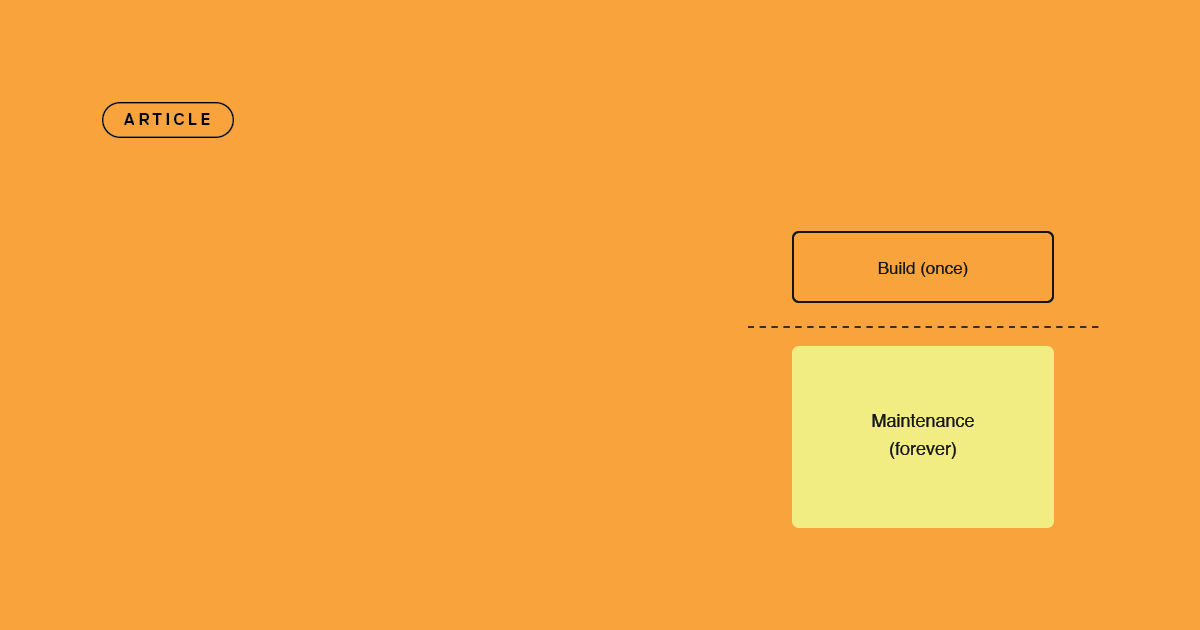
Should you build your own knowledge infrastructure?
The real cost of building your own knowledge infrastructure isn't the build - it's owning it forever. An honest build-vs-buy guide.