Article
What an AI-ready CCMS actually means

TL;DR: "AI-ready" is becoming the most overused phrase in the CCMS market. Most platforms slap a JSON export on an existing product and call it done. Real AI-readiness starts with how content is stored - in a relational database, as discrete reusable components, with metadata, governance, and relationships built in from day one. That architecture is what Author-it has been for 25+ years. AION, launched in 2026 R1, is how it becomes natively consumable by every LLM and RAG pipeline in your stack.
What does "AI-ready" actually mean for a CCMS?
Every CCMS vendor is now AI-ready. Search the category and you will find the phrase on every homepage. The problem is that nobody is defining what it means - which makes it meaningless.
So let's define it properly.
An AI-ready CCMS is one where the underlying content architecture makes AI systems more accurate, more reliable, and more safe to deploy. Not a system that happens to export a file format an LLM can consume. Not a system with a GPT-powered writing assistant bolted on. The architecture itself has to do the work.
There are five things that actually determine whether a CCMS qualifies.
1. Content lives in a relational database - not a flat file store
This is the most important structural differentiator, and the one that gets skipped in most vendor comparisons.
A file-based CCMS - or a structured authoring tool that sits on top of a folder hierarchy - stores content as files. Topics are files. The relationships between topics exist only in the publication logic that assembles them. When you export that content for AI ingestion, you get chunks of text. Some of them might have metadata headers. None of them have the relational context - what references what, what is a prerequisite for what, what lives in the same product domain as what - that makes AI retrieval genuinely accurate.
Author-it stores every content object - topics, books, templates, variables, glossary entries, files - as a row in a relational database. The relationships are explicit. A topic knows what product it belongs to, what other topics reference it, what locale variants exist, and what release state it is in. When AION exports that content for an LLM or a RAG pipeline, it carries all of that context with it.
This is not a product roadmap item. It has been true of Author-it's architecture since 1999.
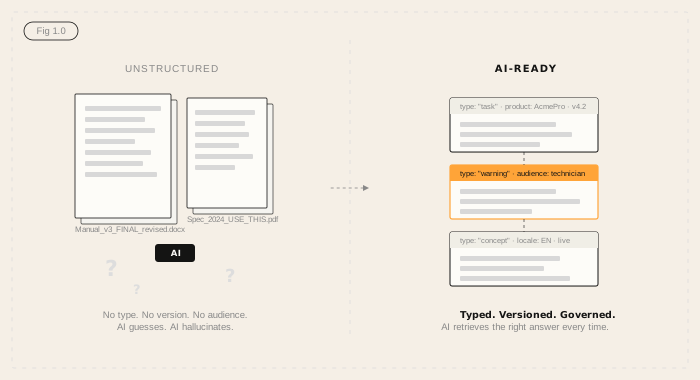
2. Every component has metadata baked in - not added later
LLMs hallucinate when they cannot distinguish between types of content. A safety warning looks the same as a marketing statement if both are plain text paragraphs. A deprecated procedure looks the same as a current one if both lack version metadata.
In Author-it, every object carries structured metadata as part of its identity - not as an afterthought annotation. Every topic has a type (task, concept, reference, warning), a product, a version, an audience, a locale, and a release state. Every paragraph style carries a semantic name that tells an AI pipeline what kind of content it is reading - a step, a prerequisite, a caution, a result.
When that content is exported via AION, each JSON object includes these attributes. A RAG pipeline can filter on them. An AI agent can use them to surface the right content for the right audience in the right context. A compliance system can check that only live, approved content was cited in an AI response.
This is metadata-governed content. Not metadata that someone added to a file after it was written.
3. Reuse is enforced at the component level - not copy-pasted
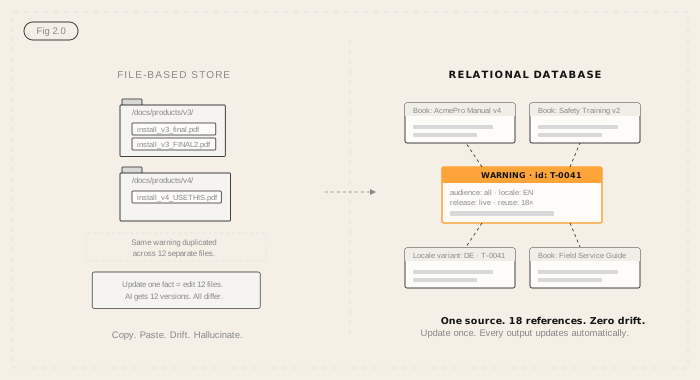
One of the most dangerous patterns for AI accuracy is content duplication. When the same procedure exists in twelve slightly different versions across a file store, an AI trained or grounded on that content will produce twelve slightly different answers - and there is no reliable way to know which one is correct.
In Author-it, reuse is architectural. A warning component is written once and referenced - not copied - into every document where it belongs. When that warning is updated, every document that references it updates automatically. The relational database enforces this. There is one source of truth, and the system knows where it is used.
For AI systems, this means the content you feed them is internally consistent. The same fact does not exist in multiple contradictory versions. The AI does not have to choose between them.
As a point of comparison: some CCMS platforms charge separately for features like translation, variants, and advanced publishing. In Author-it, every capability - structured authoring, content reuse, translations, variants, review workflows, and output formats including AION - is included in a single subscription. There are no feature tiers that gate the capabilities that make content genuinely AI-ready. You either have the architecture or you do not.
4. Governance is built in - not added as a workflow tool
AI outputs are only as trustworthy as the content that feeds them. In regulated industries - manufacturing, utilities, medical devices, aerospace - the question is not just "is this accurate?" but "was this approved for publication?"
Author-it has a formal release state model built into its content lifecycle. Content moves through defined states: draft, under review, approved, published, deprecated. Only content in the correct release state can be included in a published output. This applies to every output format, including AION.
When your AI agent cites a procedure, you can trace that citation back to the exact approved version of the content it came from, and confirm it was in the correct release state at the time of publication. That is what AI governance actually looks like in practice. Not a policy document. A technical constraint enforced by the platform.
5. The output format is designed for AI - not retrofitted
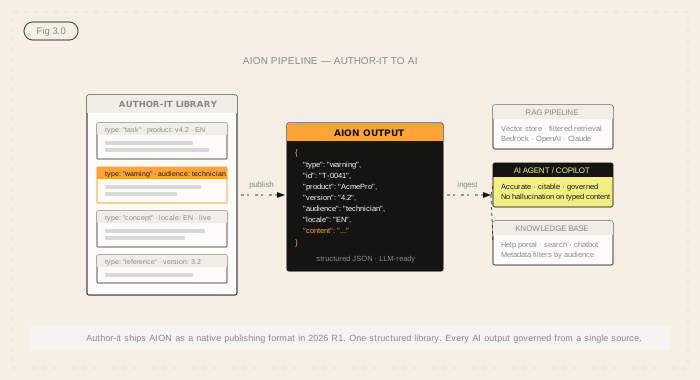
AION is Author-it's native JSON publishing format, shipped in 2026 R1. It is not a conversion layer on top of existing XML output. It is a purpose-built export format that carries the full structure of an Author-it library - object types, metadata, resolved variables, content hierarchies, and cross-topic relationships - in a form optimised for LLM ingestion, vector database storage, and RAG pipeline filtering.
Each AION export is a structured JSON document where every object is typed, every piece of metadata is explicit, and every relationship between components is preserved. An AI system consuming AION does not need to infer what type of content it is reading. It does not need to guess which version applies. It does not need to reconcile duplicate facts from different sources.
The content tells it everything it needs to know. Read the AION overview.
What this means for buyers evaluating a CCMS
When you are evaluating a CCMS for AI readiness, the marketing page is the wrong place to start. Ask these questions instead.
Does the platform store content in a relational database with explicit object-level relationships, or is it a structured file system? How does metadata attach to content - is it baked into the authoring model or added as post-hoc tagging? What does the AI output format actually contain - just text, or typed components with metadata, version, audience, and release state? Is content reuse enforced at the database level, or is it copy-paste with guidelines? And what does governance look like - are release states a technical constraint on what can be published, or a workflow suggestion?
These questions separate AI-ready from AI-washed.
Author-it was architected to answer all of them correctly before the word "AI" appeared in a product brief. The CCMS architecture that makes it possible has been in production for 25+ years. AION is how that architecture connects to the AI stack you are building today.
If your content foundation is right, your AI will be right. If it is not, no amount of prompt engineering fixes it. Book a demo to see it in action.

AI-ready CCMS FAQ
Q: What makes a CCMS AI-ready?
A: An AI-ready CCMS stores content as discrete, typed components in a relational database - with metadata, version control, audience tagging, and release state built into the content model. This allows AI systems to retrieve the right content for the right context, filter by version or audience, and cite approved content rather than guessing between duplicate sources.
Q: Why does the underlying database architecture matter for AI?
A: File-based content stores - even well-structured ones - expose content to AI as text chunks without relational context. A relational database preserves the connections between components: what references what, what product a topic belongs to, what the current approved version is. AI systems grounded on relational content give more accurate, more citable answers.
Q: What is AION and how does it relate to AI readiness?
A: AION is Author-it's native JSON publishing format, launched in 2026 R1. It exports the full structure of an Author-it content library - typed components, metadata, variables, and relationships - in a format designed for LLM ingestion, RAG pipelines, and vector database storage. It is not a retrofit on existing XML output; it is purpose-built for AI consumption.
Q: How does content reuse affect AI accuracy?
A: When the same fact exists in multiple slightly different versions across a content store, AI systems will surface inconsistent answers. Author-it enforces reuse at the database level - a component is written once and referenced wherever it is needed, so there is always one source of truth. Update the component once and every document that references it updates automatically.
Q: What is the difference between Author-it and file-based CCMS platforms for AI use cases?
A: File-based platforms store structured content as individual files, with relationships existing only in the publication logic. Author-it stores every object in a relational database with explicit, queryable relationships. For AI, this means AION exports carry full context - type, metadata, version, audience, relationships - rather than text chunks with optional metadata headers.
Q: Does Author-it include all AI-related features in its standard subscription?
A: Yes. All Author-it capabilities - structured authoring, content reuse, translations, variants, review and approval workflows, and output formats including AION - are included in a single subscription. Features that are essential for AI readiness are not gated behind additional cost tiers.
Q: How does Author-it handle governance for AI outputs?
A: Author-it has a formal release state model built into its content lifecycle. Content moves through defined states - draft, under review, approved, published, deprecated - and only content in the correct release state can be included in a published output, including AION. This means every AI response can be traced to a specific approved version of the content it cited.
Published on:
Author:
May 21, 2026
Adrian Winks
CEO
Related Resources

Article
The CCMS reckoning: six priorities for the AI era
A response to the industry's CCMS reckoning: the six priorities content leaders now face, and an honest look at which are shipped versus roadmap.
Article
AI-ready content: who has actually shipped it?
A practical field guide to separating AI-ready content marketing from vendors who have actually shipped a structured, governed output for AI.
Webinar
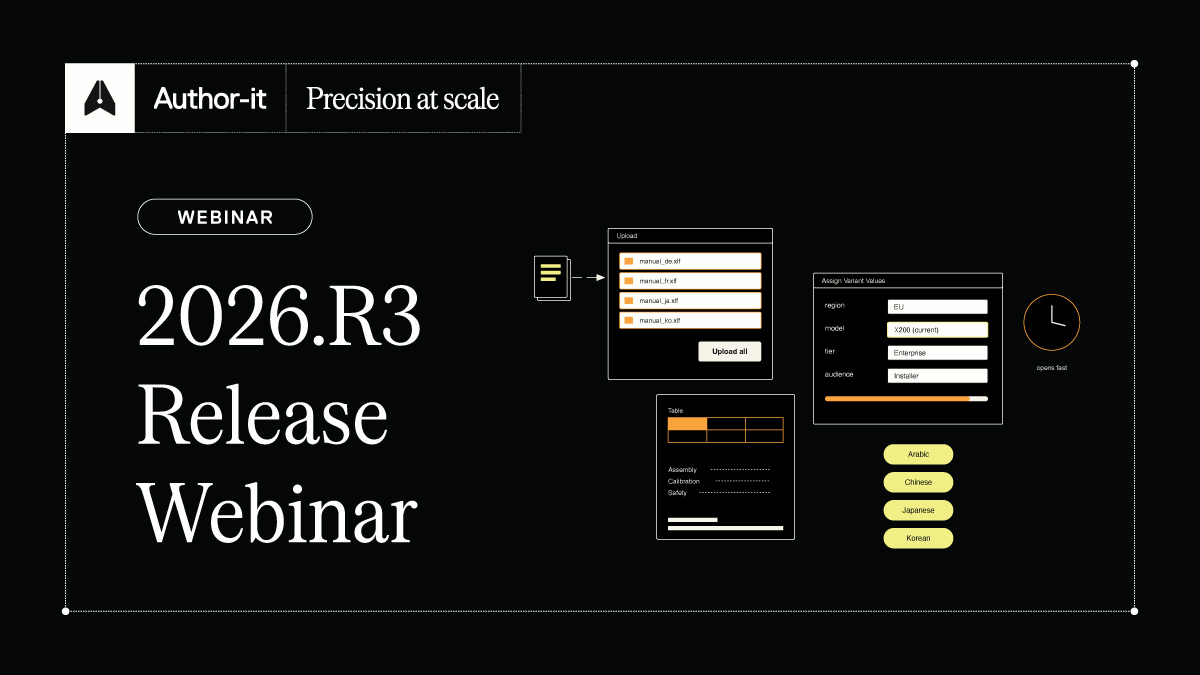
Author-it 2026.R3 Release Webinar - What's New
The full Author-it 2026.R3 release webinar recording, with the biggest New Word update yet, richer AION output, and the R3 go-live dates.