Your AI project will fail on your content, not your model
Most documentation teams discover this six months in: the model is fine, the retrieval is fine, and the answers are still wrong. This guide shows what your content has to look like before an LLM can be trusted on it, and how to check whether yours qualifies.
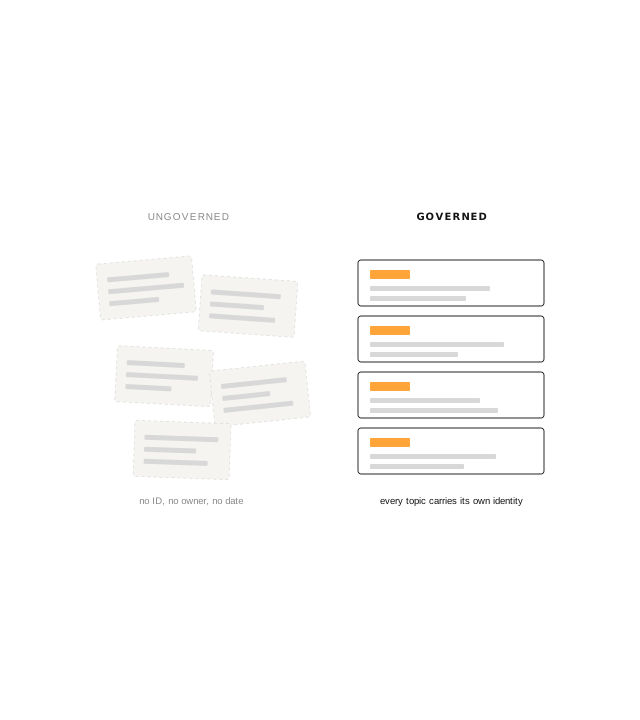
Written for the person who has to make it work
Enterprise architects and AI platform leads
Building a RAG pipeline on content someone else owns.
Documentation and content operations leads
Being asked whether the content is "AI ready" without a definition of ready.
Anyone who has watched a pilot pass
And a rollout stall on the same content.
What's in the AI Content Readiness Guide
THE FOUR PROPERTIES
Provenance, governance, currency and structure. What "good enough to ground an AI" actually means.
AUDIT YOUR OWN ESTATE
Six questions, twenty documents, one afternoon. The number you land on is your hallucination budget.
CHUNKING
Why fixed-size chunking cuts a torque value away from the procedure it belongs to, with a worked example.
EMBED VS METADATA
What to embed, what to keep filterable, and why embedding the topic ID actively hurts retrieval.
GROUNDING EVALUATION
Build a gold set. Score answer accuracy, citation accuracy and refusal rate separately.
THE 30 DAY PLAN
Measure, baseline, fix one thing. Report the delta, not the absolute.
WHY IT'S HARD
Retrieval was supposed to fix this
Ground the model in your own documents and it stops making things up. That is the promise, and it helps. It does not finish the job.
In 2025, Stanford researchers tested the purpose-built, RAG-based legal research tools sold by the two largest legal information providers. Commercial products, professionally curated legal databases, teams with every incentive to get it right.
If retrieval over a curated legal corpus lands there, retrieval over your shared drive is not going to do better. The gap is not in the model and it is not in the vector database. It is in what those systems were given to work with.
17-33%
Hallucination rate across leading commercial RAG legal research tools, on professionally curated source material.
Source: Magesh, Surani, Dahl, Suzgun, Manning and Ho, "Hallucination-Free? Assessing the Reliability of Leading AI Legal Research Tools," Journal of Empirical Legal Studies 22 (2025): 216-242.
SEE IT BEFORE YOU READ IT
Or watch it happen first
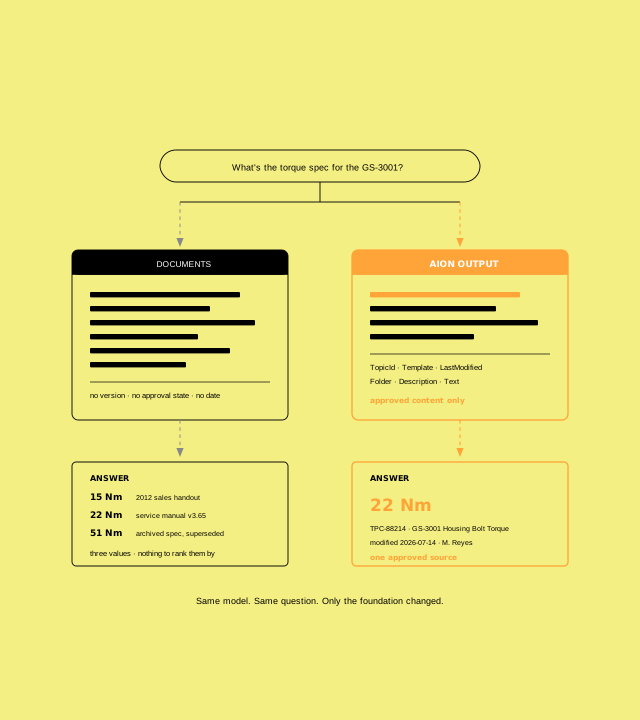
If you would rather see the problem than read about it, the interactive proof puts the same six questions to a folder of documents and to governed structured content, in your own industry. About three minutes, no form.
FREE GUIDE · PDF
AI Content Readiness Guide
The demo shows what a governed foundation buys you. The guide covers how to build one on your own content, in your own stack. It's vendor-neutral and practical: you could follow it without ever buying anything from us.


AI Content Readiness Guide FAQ
It means your content carries four things an AI needs and most documentation does not: provenance, so every passage traces to an identifiable object rather than a filename; governance, so something decides what is in scope before retrieval happens; currency, so every passage carries a date you can trust; and structure, so meaning survives extraction to plain text. A source missing any one of them will produce answers you cannot defend.
No. Every step works on any content source, and you could follow the whole thing without buying anything. Author-it appears on one page near the end, because a guide that pretended this problem was unique to one vendor would not be worth reading.
14 pages, and a work email address. No phone number, no company size dropdown, and no sales call attached to the download.
Probably more useful. Most of the guide is about the source rather than the pipeline, and teams with a working pipeline are usually the ones who have discovered that a working pipeline is not enough. The evaluation and filtering sections assume you already have something running.