Choose your CCMS with your eyes open.
The 10 questions to ask every vendor, the 3 most buyers forget, and a free scorecard to compare your shortlist. From a team that's been doing structured content for 25+ years.
Trusted by leading organisations where accuracy matters. 25+ years of structured content. Now AI-ready.











THE PROBLEM
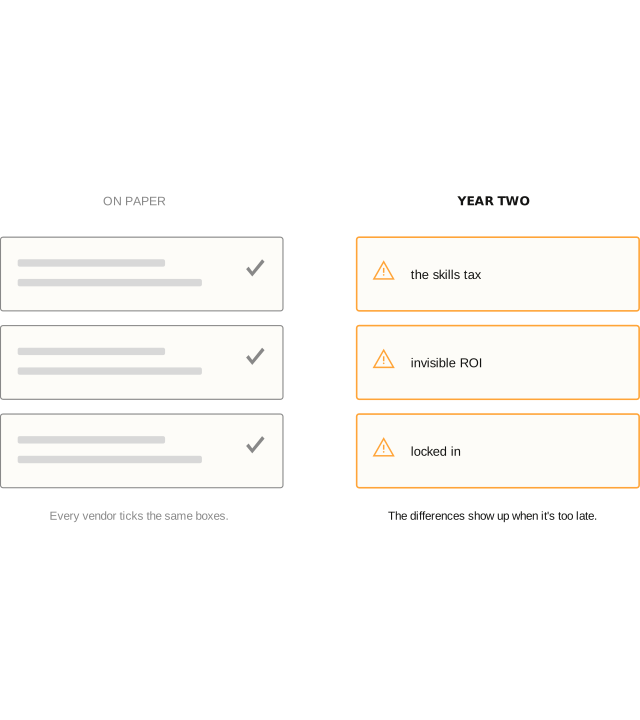
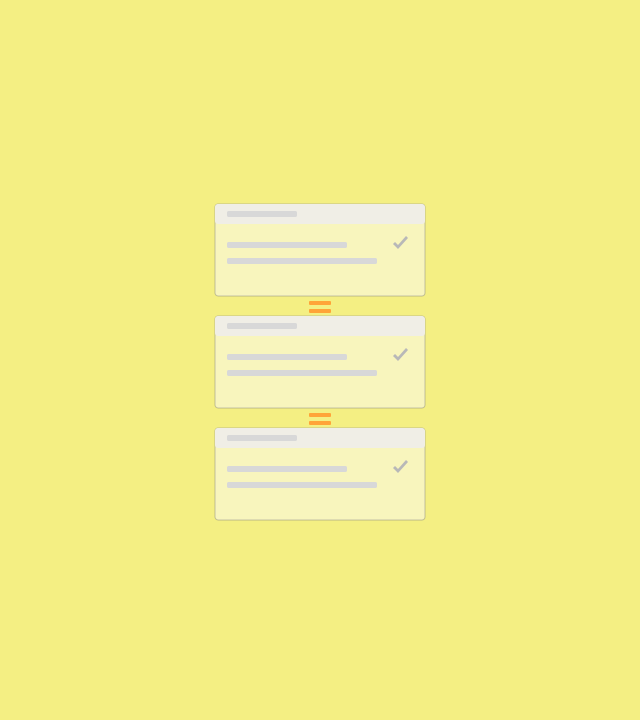
Every CCMS looks the same on paper. That's the problem.
A CCMS that doesn't fit doesn't fail loudly. It fails slowly. Writers drift back to Word for the tricky bits. Reuse stalls at 20 percent because the model is too fiddly. Translation costs stay high because the tool re-sends unchanged content. Two years in, you've paid for a platform and kept the problem. The usual regrets are always the same three: the tool needed skills the team didn't have, nobody set a baseline so the ROI was invisible at renewal, and the content got locked in. None of it shows up in a feature grid. All of it shows up in year two.
CMS vs CCMS vs knowledge base
CMS, CCMS, or knowledge base?
These three get used interchangeably. They're not the same thing, and getting the category right is your first filter.
If you're maintaining the same procedure in fifteen documents by copy-paste, a wiki won't fix it. That's the specific job a CCMS exists to do.

CMS
A CMS manages the output. Finished pages and documents. Great for a website. It won't help when the same content has to stay accurate across many documents.
CCMS
A CCMS manages the source. The reusable components documents are built from. Author once, assemble into many documents, formats and languages, and one update flows everywhere the component is used.
Knowledge Base
A knowledge base is a destination. A place to publish and search finished articles. Useful, but it's where content lands, not where it's authored.
10 QUESTIONS FOR VENDORS
The 10 questions to ask any vendor
Ask every vendor the same ten questions, and score the answers rather than just collecting them.
The full guide adds what a strong answer sounds like, and the red flags to listen for, under every one of these.
What problem are we actually solving?
If you can't state it in a sentence, no tool will fix it.
How does content reuse work in practice?
Reuse is where the ROI lives, and where fiddly tools quietly fail.
Will our writers need XML or DITA skills?
The biggest driver of whether adoption sticks.
How does translation work, and what does it cost per cycle?
Usually the biggest running cost for multilingual teams.
What do review, approval and audit trails look like?
In regulated work, the audit trail is the job.
What can it publish to, from one source?
Count the formats you actually need, including a structured format for AI.
How does it fit our existing systems?
A CCMS that can't talk to your PLM, ERP or translation vendors becomes another island.
Who does the implementation, and how long?
Most failed projects fail on information architecture, not software.
What support and expertise comes with it?
You're buying a relationship, not just a licence.
How will it scale as we grow?
Adding a language or product line shouldn't mean rebuilding.
3 KEY QUESTIONS
The 3 questions most buyers forget
Everyone compares features. Almost no one asks these three, and they're the ones that decide whether you're happy in two years.
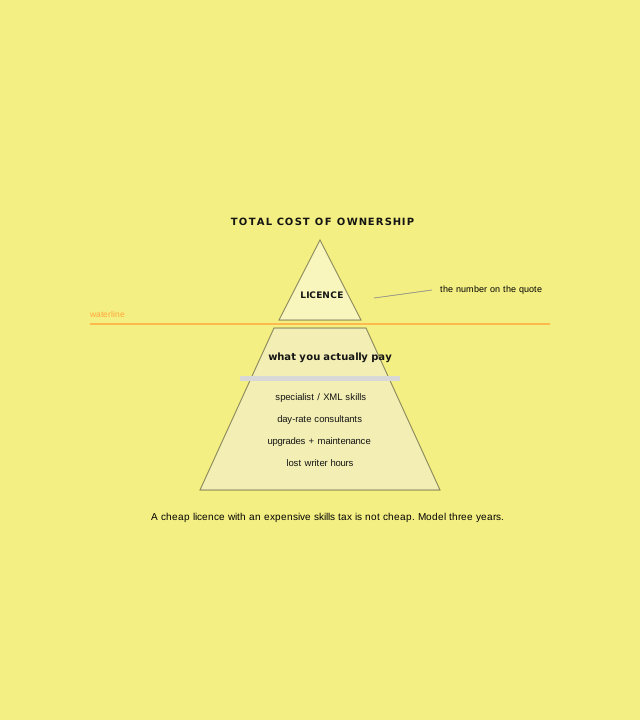
What's the 3-year cost, not the licence?
The licence is the visible number. The invisible ones are the specialist skills you hire or train for, the consultants a complex tool needs, upgrades and maintenance, and the writer hours lost to a clumsy workflow. A cheap licence with a skills tax isn't cheap.
Can we get our content back out?
Ask every vendor directly what your exit looks like. Content in an open, structured format is portable. Content locked in a proprietary store is a hostage. A vendor confident in their product won't flinch at the question.
Can an AI actually trust this content?
Your content is being read by AI systems now, not just people, and they're only as accurate as the content underneath them. If "AI-ready" means "we can export a text file", that isn't readiness.
WHAT ABOUT AI
Is your content AI-ready?
Here's the question no CCMS evaluation guide asked two years ago and every one should ask now: can the content this system produces be trusted by an AI?
AI systems don't reason, they retrieve. They answer from whatever content you point them at. Point them at unstructured PDFs and shared drives and you get confident, plausible, wrong answers. In a chatbot that's annoying. In a regulated procedure it's a compliance event.
STRUCTURE
AI works far better with content broken into clean, labelled components than with flat documents. That's exactly what a CCMS produces.
GOVERNANCE
Can the system guarantee that only approved content reaches the AI, so it never quotes an unreviewed draft? Most tools can't.
PROVENANCE
When the AI answers, can you trace it back to a specific approved source, with a record of when it changed and who touched it?
Most CCMS vendors are writing blog posts about AI.
Author-it publishes content in a form an AI consumes natively, through AION, governed by the same publishing gate as every other output, so only approved content reaches the answer.
DOWNLOAD THE FREE GUIDE
Get the full guide and scorecard
The full guide gives you model answers and red flags for all 10 questions, a straight take on when you actually need DITA (and when you're paying the XML tax for nothing), and a weighted scorecard, printable for your demos, to compare your shortlist side by side.


Built for ai
Explore AI foundation.
AI Content Foundation means different things depending on where you sit. If you're in IT, you want to know how AION integrates with your stack. If you're in documentation, you want to know what changes for your team (spoiler: not much). If you're making the business case, you want proof. Start wherever makes sense.
Structure challenge
Take the structured content challenge
Find the answer in a wall of text, then again using the structure you'd get from AION.
How it works
How Author-it is your AI Content Foundation
From authoring in Author-it to structured output powering your AI stack. The full value chain.
FOR AI LEaders
For engineering and AI leaders
API access, MCP integration, RAG pipeline guidance. What the architecture actually looks like.
Precise. accurate. compliant.
Make content your competitive advantage. And your AI’s source of truth.
Discover how Author-it helps your team reduce errors, accelerate workflows, and deliver accurate, compliant content at scale, and feed every AI you build with a source it can trust.

CCMS Evaluation Guide FAQ
AION output is optimised for Retrieval-Augmented Generation pipelines. Each content component includes rich metadata, clear hierarchy, and resolved text - making it easy for retrieval systems to find the right content and for language models to generate accurate, grounded responses. This reduces hallucination and improves answer quality.
AION publishes content from Author-it's Library as structured JSON that preserves the full hierarchy, metadata, and relationships of your content. Any Book in Author-it can be published to AION format - no special configuration required. The output includes resolved text in Markdown, object IDs, timestamps, authorship, and taxonomy data.
No. Any existing Book in Author-it can be published to AION format without special configuration. Because Author-it content is already structured with taxonomy, metadata, and component-level organisation, it's inherently ready for AI consumption. AION simply unlocks that value as a publishing output.
AION is Author-it's AI-ready publishing output. It converts structured, governed content into clean, metadata-rich JSON purpose-built for consumption by large language models, RAG pipelines, chatbots, AI agents, and enterprise knowledge systems.
AION output includes object IDs, descriptions, template types, timestamps, authorship information, folder paths, resolved variable values, and image alt text. This metadata gives AI systems the context they need to understand, categorise, and accurately use your content.
AION output is platform-agnostic and compatible with OpenAI GPT, Microsoft Copilot, Google Gemini, Anthropic Claude, AWS Bedrock, and any system that consumes structured JSON. It's designed to integrate into any AI pipeline - from internal knowledge bases to customer-facing chatbots.
AI systems produce more accurate, reliable results when they work with structured, well-organised content. Unstructured documents force AI to guess at meaning, context, and relationships - leading to hallucinations and errors. Structured content gives AI explicit signals about hierarchy, terminology, and intent, dramatically improving output quality.
AION preserves the full governance chain in its output - version history, approval status, and authorship are all included. This means AI systems consuming AION content can trace every piece of information back to its approved source, supporting accountability and compliance requirements.
Author-it's architecture - structured components, rich metadata, taxonomy, and single-source publishing - is exactly what AI systems need to work accurately. This wasn't designed for AI specifically, but the principles of structured authoring that Author-it has championed for 25+ years are now the foundation of effective AI content strategies.
Yes. AION is the first shipped AI capability in Author-it, and the company is actively investing in AI across the platform. The focus is on practical, governed AI features that help teams work more efficiently while maintaining the accuracy and compliance standards that regulated industries require.
A PDF export strips structure - the AI receives a wall of text with no content type information, no hierarchy signals, and no metadata. A Markdown export may retain some heading structure but loses provenance, authorship, content type, and the organisational hierarchy the content sits within. AION preserves all of it: content type and template, position in the content hierarchy, modification history, authorship, library folder path, and resolved variable values. The AI receives context alongside the text, not just the text.
AION produces standard structured JSON, which any system that ingests JSON can consume. This includes RAG pipelines, LLM fine-tuning workflows, AI chatbots and agents, internal knowledge bases, copilots, and content delivery platforms such as Fluid Topics and Zoomin. Author-it does not require a specific AI platform or vendor. If your system ingests structured JSON, it can ingest AION output.
RAG (retrieval-augmented generation) works by retrieving the most relevant chunks of content from a knowledge base before an LLM generates an answer. When content is chunked from a PDF, the splits are arbitrary. A paragraph might span two unrelated topics, or a key sentence might be cut across a chunk boundary. AION chunks at the topic level instead: each chunk is a meaningful, typed unit with its metadata attached. This produces more precise embeddings, better retrieval accuracy, and better-contextualised answers from the LLM. The effect compounds at scale. A support corpus split into arbitrary 500-token windows will surface fragments that read plausibly but answer the wrong question. The same corpus published through AION returns whole topics, each carrying its type, hierarchy, and identity, so the model retrieves a complete unit of meaning rather than half of one. Better inputs, fewer confident-but-wrong answers, and a retrieval step you can actually trace.
No. AION is a publish target, not a workflow change. Authors write in Author-it exactly as they always have. The structured authoring they already do - component reuse, topic types, variables, conditions - is precisely what produces AI-ready output. Publishing to AION requires a Library Administrator to set up a publishing profile once. After that, it appears alongside all other publish targets and requires no additional effort from authors.