Article
AI-ready content: who has actually shipped it?

Summary:
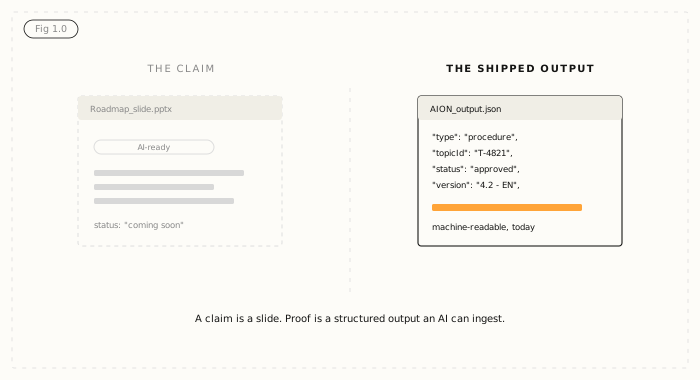
Almost every content platform now claims its content is AI-ready. Far fewer have shipped the thing that phrase should mean: a structured, governed output format that large language models and RAG pipelines can ingest directly. AI-ready content is content stored as discrete, typed components - each carrying metadata, resolved variables, and a clear source - then published as structured JSON an AI system retrieves without guessing. A PDF export or a Markdown dump is not that. The test is simple: can the vendor show you the actual machine-readable output today, not a roadmap slide? Author-it shipped exactly this as AION in its 2026.R1 release - structured JSON carrying content hierarchy, object IDs, timestamps, authorship, and resolved variables, gated so unapproved content never reaches the output. When you evaluate an AI-ready claim, ask to see the format. A shipped output beats a promise every time.
What AI-ready content actually means
AI-ready content is content an AI system can retrieve, read, and cite without a human cleaning it up first. That comes down to three things: the content is broken into discrete components rather than trapped in long documents, each component carries metadata an AI can filter on, and the whole set publishes to a structured, machine-readable format.
Most content fails at least one of those tests. A 200-page PDF manual is technically available to an AI, but the model has to guess where one procedure ends and the next begins, which version it is looking at, and whether the content was ever approved. That guesswork is where wrong answers come from. If you want the longer definition, we wrote a fuller piece on what AI-ready actually means for a CCMS. The short version: AI-ready is a property of the content, not a feature of the chatbot bolted on top of it. This is the idea behind the AI content foundation - the structured layer enterprise AI depends on to answer accurately.
The gap between the claim and the output
Here is the uncomfortable part: almost every vendor now has an AI page, and very few can show you the output. The claim is cheap. The output is the work.
Gartner predicts that at least 30% of generative AI projects will be abandoned after proof of concept by the end of 2025, naming poor data quality as one of the leading causes (Gartner, July 2024). Poor data quality is the polite phrase for content that was never structured for a machine to read. Feed a RAG pipeline unstructured exports and it retrieves the wrong passage, mixes up versions, or answers confidently from content nobody ever approved. The pilot demos beautifully, then falls over in production.
Structured content is what closes that gap - and it is worth benchmarking your own before you buy anyone's AI. The Structured Content Challenge walks you through where your content stands today.
Five questions that separate proof from marketing
When a vendor tells you their content is AI-ready, these five questions surface whether there is a shipped product underneath the claim. Ask them in order.
- Can you show me the actual output format, today? Not a slide - the real machine-readable file an AI would ingest. If the answer is a demo of a chatbot rather than the underlying output, the AI-readiness lives in the interface, not the content.
- Does the output carry component-level metadata? Type, version, language, and source IDs are what let an AI filter and cite. A flat text dump strips all of it.
- Is unapproved content provably kept out of the output? Governance only counts if it is architectural. Ask whether draft or rejected content can physically reach the AI output, or whether a publishing gate blocks it.
- Are variables and variants resolved in the output? If product names, regions, or conditional content are still unresolved placeholders, the AI will surface raw tokens or the wrong variant.
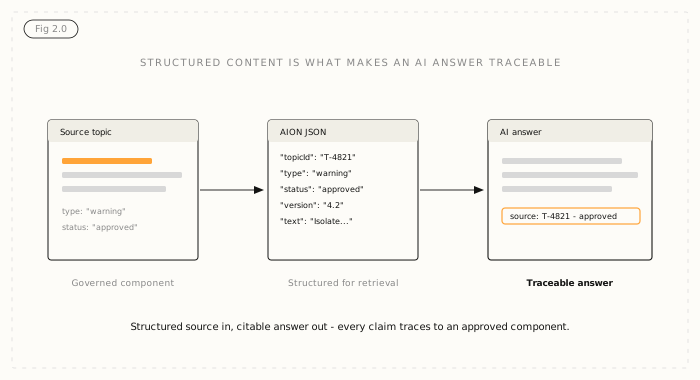
- Can every AI answer be traced back to a source component? Provenance is the difference between an answer you can stand behind in an audit and one you cannot.
Why structured content is what LLMs actually need
Large language models do not reason their way to the right document. In a RAG pipeline they retrieve the passages that look most relevant and generate an answer from them. If the source is a pile of unstructured files, retrieval is a coin toss - and a confident wrong answer is worse than no answer at all.
Structured content changes the inputs. Each component is a self-contained unit with a type and metadata, so retrieval pulls the right piece instead of a random paragraph that happens to share keywords. This is the same reason structured content outperforms unstructured content for AI, and why AI gives wrong product answers when it is grounded in documents rather than components. The model is only ever as good as what it retrieves.
What Author-it has shipped
Author-it shipped AION in its 2026.R1 release: a structured JSON output built for LLM and RAG ingestion, included in Cloud subscriptions at no extra cost. It carries the content hierarchy, topic and book IDs, template names, timestamps, authorship, source paths, and resolved variable values - the metadata an AI needs to retrieve and cite accurately. Crucially, it is governed by a publishing gate: unapproved content cannot reach the output. That constraint is architectural, not a setting, which is what makes the governance provable rather than promised.
This is not a roadmap claim. Author-it's structured content has already earned more than 2,000 Bing and Copilot citations since January 2026 - a first-party signal that structured, governed content gets cited by AI answer engines where unstructured content does not. For a technical comparison of the format itself, see AION structured JSON versus Markdown for AI, or explore what AION outputs in full. When the next vendor tells you their content is AI-ready, you now know the one question that settles it: show me the format.

AI-ready content FAQ
Q: What does AI-ready content mean?
A: AI-ready content is content an AI system can retrieve, read, and cite accurately without human cleanup first. In practice it is broken into discrete components, each carrying metadata such as type, version, and source, and published to a structured, machine-readable format like JSON. Long documents and flat exports are not AI-ready because the model has to guess at structure, version, and approval status.
Q: Is a PDF or Markdown export AI-ready?
A: Not on its own. A PDF or Markdown export is readable text, but it strips the component boundaries, metadata, and version information an AI needs to retrieve the right passage and cite it. An AI fed these formats can still produce confident wrong answers because it cannot tell which version it is reading or whether the content was approved.
Q: How can I tell if a CCMS has actually shipped AI-ready output?
A: Ask to see the actual output format today, not a roadmap. A genuine AI-ready output is a structured file - typically JSON - that carries component-level metadata, resolved variables, and source IDs, with a governance mechanism that keeps unapproved content out. If the vendor can only show a chatbot demo rather than the underlying output, the AI-readiness is in the interface, not the content.
Q: What is AION?
A: AION is Author-it's structured JSON output format for LLM and RAG pipeline ingestion, shipped in the 2026.R1 release and included in Cloud subscriptions at no extra cost. It outputs content hierarchy, topic and book IDs, template names, timestamps, authorship, source paths, and resolved variable values, and it is governed by a publishing gate so unapproved content cannot reach the output.
Q: Why do RAG pipelines give wrong answers?
A: RAG pipelines give wrong answers when their source content is unstructured, unversioned, or ungoverned. The model retrieves whatever passages look most relevant and generates an answer from them, so if the source is a pile of documents rather than typed components, retrieval pulls the wrong passage or an outdated version. Structuring and governing the source content fixes the problem at its origin.
Q: Does structured content reduce AI hallucinations?
A: Yes. Structured content reduces hallucination risk by giving the AI clean, typed, metadata-rich components to retrieve from instead of ambiguous documents. When each answer can be traced back to a specific approved component, the model has less room to invent or blend sources, and the organization can verify every answer against its source.
Q: What should I ask a vendor claiming their content is AI-ready?
A: Ask five things: show me the output format today; does it carry component-level metadata; is unapproved content provably kept out; are variables and variants resolved; and can every answer be traced to a source component. Shipped answers to those questions separate a real AI-ready product from a marketing claim.
Published on:
Author:
August 23, 2026
Quinn Wright
Head of Sales
Related Resources

Article
The CCMS reckoning: six priorities for the AI era
A response to the industry's CCMS reckoning: the six priorities content leaders now face, and an honest look at which are shipped versus roadmap.

Article
Field crew AI: when a wrong answer is a safety risk
Why safety-critical field operations can't run AI on ungoverned content - and what deterministic, traceable answers actually require.
Article
AI-ready content: who has actually shipped it?
A practical field guide to separating AI-ready content marketing from vendors who have actually shipped a structured, governed output for AI.