Article
Should you build your own knowledge infrastructure?

Summary:
Whether you should build your own knowledge infrastructure comes down to one question: is content management your core business, or a means to it? Building your own gives you total control and can look cheaper on day one, and for a small, stable, technical team it sometimes makes sense. But most organisations underestimate the real cost, which isn't the initial build - it's the maintenance forever. You own every upgrade, every integration that breaks, every departure that takes knowledge with it, and a roadmap of one. A bought platform spreads that cost across a vendor and every other customer, and comes with 25 years of decisions you would otherwise have to make yourself. The honest rule of thumb: build when your needs are genuinely unique and you can staff the upkeep indefinitely; buy when you want proven structure, governance, and AI-ready output without becoming a software team on the side. For most, buying the foundation and spending your build effort on what's actually differentiated wins.
What knowledge infrastructure means
Knowledge infrastructure is the system that holds your organisation's content and makes it usable - authoring, storage, version control, governance, and the outputs that feed your documents, portals, and now your AI. Some teams assemble it from open-source parts and internal code. Others buy a platform.
The build-versus-buy question is really about who carries the weight of running it over time. If the terms are new, our CCMS and AI glossary defines the moving parts. And if you want to put a number on the decision early, the content ROI calculator is a good place to start.
The real cost of building your own
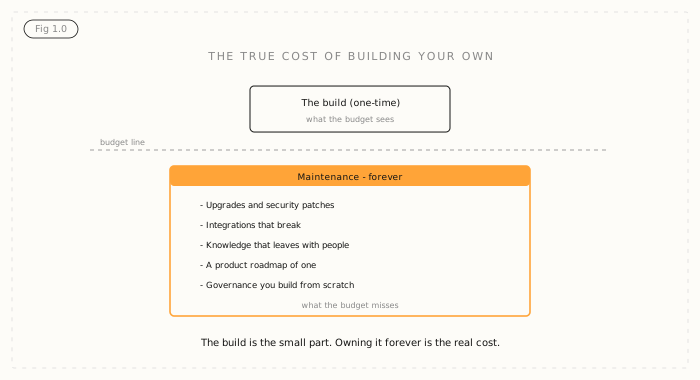
The build is the part everyone budgets for. The maintenance is the part that quietly costs more. When you build your own, you own every upgrade and security patch, every integration that breaks when a system on either side changes, and the knowledge in the heads of the two people who built it - until they leave.
You also own the roadmap, which is now a roadmap of one, competing with every other priority for engineering time. None of this shows up in the first proposal. It shows up in year two.
Build vs buy: an honest comparison
Neither answer is always right. Here is the trade-off laid out plainly.
Building makes sense when your requirements are genuinely unique, your team is technical and stable, and you can fund the upkeep indefinitely. Buying makes sense when you want proven structure and governance now, and you would rather spend engineering effort on what actually sets you apart.
The middle path most teams miss
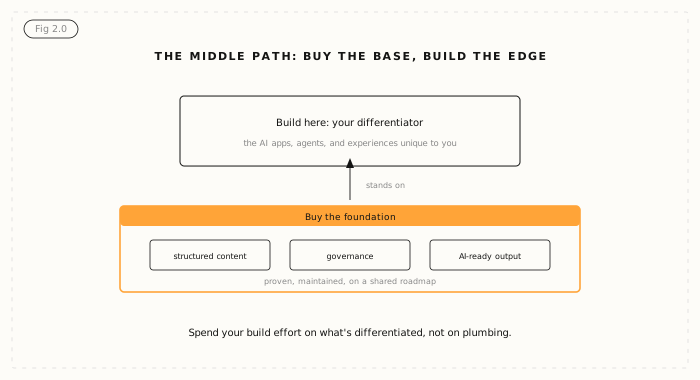
The framing is rarely all-or-nothing. The strongest move is usually to buy the foundation - structured content, governance, AI-ready output - and build the layer that is actually yours on top of it: the AI apps, agents, and experiences your customers see.
You get a maintained, roadmapped base without becoming a software vendor on the side, and you spend your build budget where it differentiates you. This is also the safest way to approach enterprise AI infrastructure, where the content layer is the part you least want to hand-roll.
Where Author-it fits
Author-it is the bought foundation in that middle path. It has provided structured authoring, single-source publishing, governance, and now AI-ready AION output for 25 years - which is 25 years of decisions you don't have to make or maintain yourself.
Implementation is services-led, so you are not handed empty software: our services team brings the information architecture and content strategy that in-house builds usually learn the hard way. Weigh it up with the Structured Content Challenge, and keep your engineers focused on your product, not your plumbing.

Build vs Buy FAQ
Q: Should you build your own knowledge infrastructure?
A: Build it only if content management is genuinely core to your business, your requirements are unique, and you can staff the maintenance indefinitely. For most organisations, buying a proven platform for the foundation and building only the differentiated layer on top is lower risk and lower total cost, because the real expense of building your own is owning it forever, not the initial build.
Q: What is knowledge infrastructure?
A: Knowledge infrastructure is the system that stores your organisation's content and makes it usable: authoring, version control, governance, and the outputs that feed documents, portals, and AI. It is the layer that decides whether your content is accurate, current, and safe to reuse across channels.
Q: What is the real cost of building your own content platform?
A: The visible cost is the initial build. The larger, hidden cost is ongoing: upgrades and security patches, integrations that break, knowledge lost when key people leave, and a product roadmap you fund alone. These recurring costs usually outweigh the build and appear in year two, not year one.
Q: When does building your own make sense?
A: Building makes sense when your requirements are genuinely unique, your team is technical and stable enough to maintain it for years, and content infrastructure is close to your core business. In that narrow case, the control you gain can outweigh the ongoing maintenance burden you take on.
Q: When should you buy instead of build?
A: Buy when you want proven structure, governance, and AI-ready output now, and would rather spend engineering effort on what differentiates you. A bought platform spreads maintenance and roadmap costs across a vendor and its customers, so you get years of accumulated decisions without having to make or maintain them yourself.
Q: What is the middle path between build and buy?
A: The middle path is to buy the foundation - structured content, governance, and AI-ready output - and build only the differentiated layer on top, such as your own AI apps and agents. You avoid becoming a software vendor for your own plumbing while still owning the parts customers actually experience.
Q: Is a CCMS cheaper than building in-house?
A: In most cases, yes, once you account for total cost of ownership. A Component Content Management System comes with structured authoring, governance, and AI-ready output already built and maintained, so you avoid the recurring cost of upgrades, integrations, and a roadmap of one that in-house builds carry indefinitely.
Published on:
Author:
September 23, 2026
Adrian Winks
CEO