Article
Why your AI gives wrong answers about your products

Summary:
Enterprise AI gives wrong answers about your products for one reason: the content feeding it is unstructured. Large language models and RAG pipelines retrieve text that looks similar to the question, not text that is correct - so a copilot confidently quotes a retired spec or the wrong safety limit. The fix isn't a smarter model. It's structured, governed, single-source content. Author-it's AION output turns approved content into clean JSON that AI systems retrieve accurately, with every answer traceable to its source.
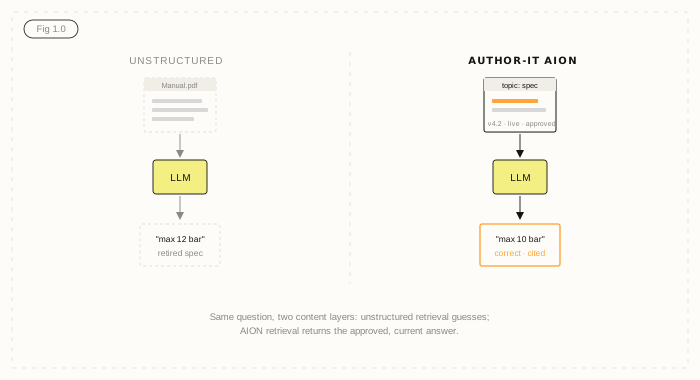
Your model isn't broken. Your content is.
Here's a scene that plays out in a lot of companies right now. You stand up an internal copilot or a customer support bot. Someone asks it a basic product question - the maximum operating pressure, the current API rate limit, whether a feature ships in the enterprise tier. The bot answers instantly, in a confident sentence. And it's wrong.
The instinct is to blame the model. Swap one model for another, tune the prompt, add a reranker. That rarely fixes it, because the model was never the problem. The problem is what you fed it. If you're reading this because your AI keeps getting your own products wrong, start with what an AI content foundation actually is, then come back.
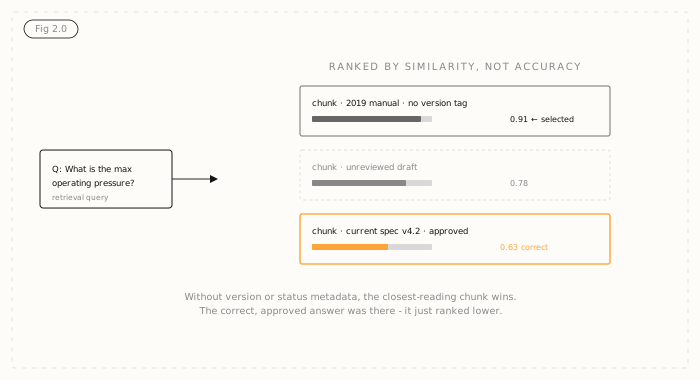
Unstructured documentation - PDFs, Word files, wiki pages, slide decks - has no topic boundaries, no metadata, and no version context. To a retrieval system, a paragraph from a 2019 manual and the current spec look almost identical. The AI can't tell which one is true, so it picks the one that reads closest to the question and states it as fact.
Why retrieval picks the wrong answer
Most enterprise AI works the same way under the hood. It retrieves chunks of your content that are semantically similar to the question, then asks a model to write an answer from those chunks. This is retrieval-augmented generation, or RAG. The quality of the answer is capped by the quality of what gets retrieved.
Retrieval matches on similarity, not accuracy. Feed it a folder of unstructured documents and it has no way to know that one file is approved and current while another is a superseded draft someone forgot to delete. There's no signal for version, status, or authority. Three files describe the same feature three different ways, and the AI averages across them or picks one at random.
This is where hallucination comes from in most enterprise settings. Not a rogue model inventing facts, but confident retrieval of the wrong source. We go deeper on the mechanics in why structured content makes AI accurate. The short version: if the source is ambiguous, the answer will be too.
What a wrong answer actually costs
A confidently wrong AI answer isn't a cosmetic bug. In support, it routes a customer to the wrong resolution, and they churn or escalate. In a regulated environment, it can surface a superseded procedure or an out-of-date limit, which is a compliance and safety exposure, not an inconvenience. Internally, it's slower and quieter: your engineers stop trusting the tool, go back to searching the wiki by hand, and the AI investment stalls.
The pattern is consistent across manufacturing, software, and utilities. The AI didn't fail. It faithfully reported ungoverned content. That's worth sitting with, because it tells you where to spend your effort.
The fix: structure and govern content before the AI sees it
You fix this upstream, at the content layer, not downstream at the model. Here's what good looks like, whether or not you ever use Author-it.
Break content into typed components. A procedure, a warning, a spec, and a concept are different things and should be stored as distinct, labelled topics, not buried in a 200-page document. Retrieval can then return a whole, correct unit instead of a stray paragraph.
Attach metadata to every component. Type, product, version, status, and audience turn a blob of text into something a machine can filter and trust. Consistent terminology matters too: if the same part has three names, retrieval fragments.
Keep one source. When a fact lives in one governed place and every output draws from it, a change propagates everywhere at once. No stale duplicates for the AI to trip over.
Gate what's publishable. Only approved content should ever reach the AI. If a draft can be retrieved, an unreviewed claim can become an AI answer.
Where Author-it fits
This is the job Author-it has done for 25+ years, now pointed at AI. Content is authored as reusable components in a single library, reviewed and approved through a built-in workflow, and published to multiple outputs from one source.
The piece that matters for AI is AION, Author-it's structured JSON output. It takes governed, single-source content and produces clean JSON built for LLMs and RAG pipelines, with content hierarchy, component metadata, resolved variables, and source paths included. Because of the publishing gate, unapproved content can't reach AION output at all. The governance isn't a setting you remember to switch on; it's how publishing works. So the AI retrieves current, approved, structured content, and every answer traces back to a source you can stand behind.
How to tell if your content is the problem
Five signs the content layer, not the model, is what's making your AI wrong:
- The same product fact appears differently in two or more documents.
- Nobody can say with confidence which version of a document is current.
- Your source content is mostly PDFs, Word files, and wiki pages with no metadata.
- A product change takes weeks to reach every downstream document.
- Approved and draft content live in the same place, with nothing stopping a draft from being used.
If three or more are true, a better model won't save you. Structured content will. The Structured Content Challenge is a quick way to benchmark where your content sits today.

AI Accuracy FAQ
Q: Why does our AI give wrong answers about our own products?
A: Because it retrieves from unstructured content. Large language models and RAG pipelines pull text that is semantically similar to the question, not text that is verified as correct. When your source documents have no version, status, or metadata, the AI can't tell a current spec from a retired one, so it confidently returns the wrong source. The fix is structured, governed content, not a different model.
Q: Is this a model problem or a content problem?
A: In most enterprise cases it's a content problem. Swapping models rarely fixes wrong answers, because every model is limited by the quality of what it retrieves. If the source content is ambiguous, duplicated, or ungoverned, the answer will be too. Fixing the content layer upstream is what improves accuracy.
Q: What is retrieval-augmented generation (RAG)?
A: RAG is the technique behind most enterprise AI. The system retrieves chunks of your content relevant to a question, then a language model writes an answer using those chunks. It grounds answers in your content instead of the model's training data, but only works well if the retrieved content is clean, structured, and current.
Q: How does structured content reduce AI hallucination?
A: Hallucination in enterprise settings usually comes from confident retrieval of the wrong source, not invented facts. Structured content gives each component a type, version, status, and consistent terminology, so retrieval can return a whole, correct, approved unit. That removes the ambiguity that causes wrong answers at the source.
Q: What is AION?
A: AION is Author-it's structured JSON output format, launched in 2026, designed for ingestion by LLMs, RAG pipelines, and AI agents. It turns governed, single-source content into clean JSON with content hierarchy, component metadata, resolved variables, and source paths. Because content must pass Author-it's publishing gate, unapproved content can't reach AION output.
Q: Can't we just point an AI tool at our existing documents?
A: You can, but it will be only as accurate as those documents. General-purpose AI tools scraping unstructured PDFs and wikis inherit every duplicate, stale version, and inconsistency in them. Structuring and governing the content first is what lets the AI return answers you can trust and trace.
Q: How do I know if my content is the problem, not the model?
A: Common signs include the same fact appearing differently across documents, uncertainty about which version is current, source content that is mostly unstructured files with no metadata, slow propagation of changes, and approved and draft content stored together. If several are true, the content layer is the constraint, not the model.
Published on:
Author:
July 8, 2026
Ben Harris
Marketing Lead
Related Resources
Article
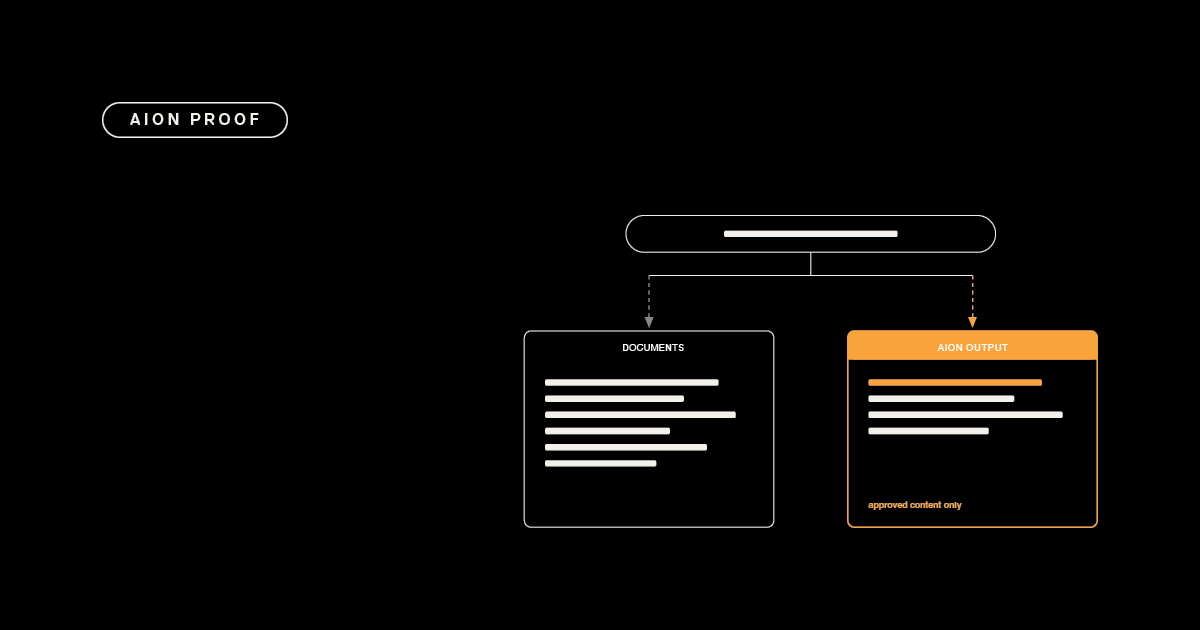
Author-it releases interactive AI grounding demonstration
Same question, two sources: why ungoverned documents give an AI three answers and governed content gives it one, with its source attached.
Article
Field crew AI: when a wrong answer is a safety risk
Why safety-critical field operations can't run AI on ungoverned content - and what deterministic, traceable answers actually require.

Article
Why your AI gives wrong answers about your products
When your copilot confidently states the wrong spec, the model isn't the culprit - your unstructured content is.