Article
Structured content vs unstructured: the 90-second test

Summary
Structured content is the difference between a reader (human or AI) finding what they need in 2 seconds or 60. We built a 90-second interactive challenge that lets you feel that gap in your own browser. This article is the why behind it - what structured content actually is, why your AI breaks without it, and what an AI-ready content foundation looks like. Skip ahead and take the challenge, or read on.
You can read 1,000 articles about structured content and not really get it.
Or you can spend 90 seconds trying to find an answer in a wall of prose, then doing the same task again with the same content structured properly, and feel exactly what the difference is in your own nervous system.
We built the second thing. It's called the Structured Content Challenge, and it's the fastest way we know to explain why every enterprise AI rollout currently in production is quietly failing on the same root cause.
This article is the why behind it. If you want the gist, take the challenge first - it'll save you about 5 minutes of reading.
What you'll actually feel in the challenge
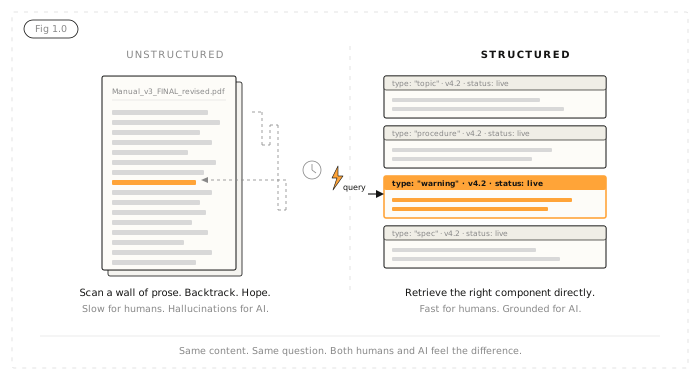
The setup is simple. We give you a paragraph of dense, unstructured prose - the kind of thing you'd find in any technical manual, internal policy, or SharePoint PDF - and ask you to find a specific piece of information. We time you.
Then we give you the exact same content, but structured: headings, components, hierarchy, scannable layout. Same question. We time you again.
The gap is usually somewhere between 3x and 10x faster on the structured version. Some people get a bit competitive about it. That's fine.
What you've just felt - the friction in round one, the relief in round two - is what your AI systems are experiencing every time they retrieve from your content. Except they don't get to feel relief. They just hallucinate.
Try the challenge before you keep reading →
Why structured content is now an AI question, not a docs question
For 30 years, structured content was a problem owned by technical writers. It was about reducing duplication, simplifying translation, and keeping documentation sane across product lines.
In 2026, it's a problem owned by anyone deploying enterprise AI.
Here's why. Every AI system that touches your company's knowledge - RAG pipelines, internal copilots, customer-facing chatbots, agents - does the same thing under the hood: it retrieves relevant chunks of your content, then asks a model to generate an answer from those chunks.
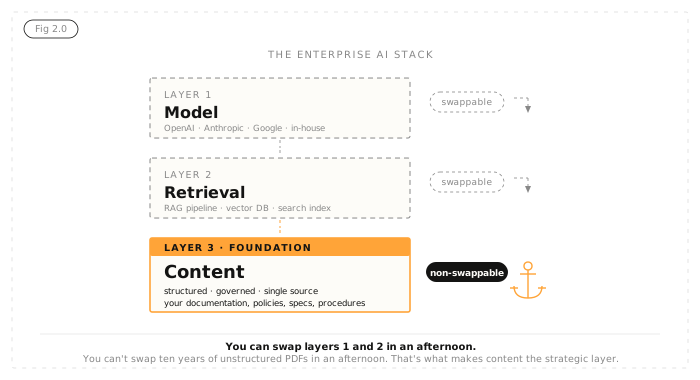
The model is mostly a commodity. The chunks are not.
When your content is structured, the system retrieves clean, labelled, contextual units. Each one is independently meaningful. The model has something solid to work with, and the answer is grounded.
When your content is unstructured, the system has to slice a wall of prose into arbitrary segments, hope the right information lands in the right slice, and hope the model can stitch context back together. That is a lot of hoping. Hoping is where hallucinations come from.
This is the unglamorous truth most AI vendors don't want to lead with: the substrate matters more than the model. You can swap your LLM in an afternoon. You can't restructure ten years of PDFs in an afternoon.
Structured vs unstructured content (in 30 seconds)
Skip this section if you already took the challenge - you've felt it. For everyone else:
Unstructured content is content stored as a document. A Word file. A PDF. A long page of prose with no semantic markup. Information lives somewhere inside the document, and you (or your AI) have to read top-to-bottom to find it.
Structured content is content broken into components - topics, procedures, warnings, parameters, definitions - each with metadata attached, each independently retrievable, all governed from a single source.
The one-line version: unstructured content is a story you read. Structured content is a database you query.
Both have a place. Only one of them is a foundation for AI.
What an AI content foundation actually contains
If you strip away the marketing language, an AI content foundation has five non-negotiable properties. If your content doesn't have all five, it's not yet a foundation - it's a pile.
1. Componentisation
Content authored as components, not documents. Each component is independently retrievable, reusable, and updatable. A topic, a procedure, a warning, a spec - each one a clean, addressable unit.
2. Single source of truth
One canonical version of each component, governed in one place. No duplicate copies in shared drives waiting to drift apart. When the source changes, every output changes with it.
3. Component-level metadata
Authorship, approval status, product, region, version, release state - attached to the component itself. Not living in a filename, not living in someone's head, not living in a separate spreadsheet.
4. Multi-format publishing - including AI-ready output
The same component can be published as a PDF, HTML help page, eLearning module, print manual, or structured JSON payload for an AI system. One source, many outputs. No reformatting.
5. Governance you can audit
You can trace any component back to who wrote it, who approved it, when it changed, and which version any downstream system is consuming. Regulated industries already know they need this. Everyone else is about to find out, usually right after an AI confidently outputs the wrong policy version.
A quick self-diagnosis
You don't need a six-week audit to work this out. Five questions:
- Can you point to a single source of truth for any given product, procedure, or policy - or are there at least three copies in three different formats?
- If you change a warning or a spec, does it update everywhere automatically, or do you go on a hunt-and-replace expedition across PDFs?
- Does your content have component-level metadata - author, version, approval status - or does that information only live in someone's head?
- Can your content be published, today, as anything other than a PDF or a Word doc?
- If you handed your content library to an engineer and said "feed this to an LLM," how many months of cleanup would they quote you?
If you answered "uh" to more than one of these, your AI roadmap has a content problem long before it has a model problem.
The good news: it's solvable. The better news: you don't have to migrate everything at once. Structured content is a posture, not a one-shot project.
Where Author-it fits (briefly, then we'll stop)
We've been doing this since 1999. Before "AI Content Foundation" was a phrase, before LLMs were a category, before half the AI tooling vendors had registered their domains.
Author-it is built on a relational database, not a pile of files. Every piece of content is a component. Every component has metadata. Every output - including AION, our AI-native JSON publishing format - comes from the same governed single source.
If you already author in Author-it, your content is already AI-ready. You don't need to migrate, restructure, or rebuild. You just publish to a new format.
That's not a marketing claim. It's a consequence of having built the architecture the right way 25 years before anyone needed it. Bit lucky, honestly.
Now go take the challenge
You read the article. Good. Now go feel it.
The Structured Content Challenge takes about 90 seconds. It's slightly competitive. It'll show you in your own browser exactly what your AI systems are dealing with every time they try to answer a question from your docs.
It may also annoy you about your current documentation in a productive way. That's part of the point.
Take the Structured Content Challenge →
Related reading
- Structured content for AI: how LLMs read your documentation
- Why structured content makes AI accurate (and useful)
- AION - Author-it's AI-native JSON publishing format
- ROI Calculator - what structured content is worth on your numbers
Or if you're ready for an actual conversation: book a 20-minute call. No 60-slide deck. We'll look at what you've got and tell you honestly what it would take to turn it into a foundation.

Structured Content FAQ
Q: What is the difference between structured and unstructured content?
A: Unstructured content is content stored as a document - a Word file, PDF, or prose page where information lives somewhere inside and you have to read top to bottom to find it. Structured content is content broken into components - topics, procedures, warnings, definitions - each with metadata, each independently retrievable, all governed from a single source. The one-line version: unstructured content is a story you read; structured content is a database you can query.
Q: Why does structured content matter for AI?
A: AI systems retrieve specific pieces of information before generating answers. When content is unstructured, retrieval is a guessing game and the AI fills the gaps with hallucinations. When content is structured, each component is independently retrievable with metadata attached, so the AI gets clean, contextual chunks and produces more accurate answers.
Q: What is an AI content foundation?
A: An AI content foundation is the layer of structured, governed, single-source content that an enterprise's AI systems (LLMs, RAG pipelines, copilots, agents) retrieve from. It sits beneath the model and the retrieval pipeline and determines the quality of every answer those systems produce.
Q: Is structured content the same as a CCMS?
A: Not exactly. Structured content is the practice. A CCMS (Component Content Management System) is the platform that makes the practice manageable at scale - storing components, governing versions, applying metadata, and publishing to multiple outputs. You can do small-scale structured authoring without a CCMS, but enterprises typically need one.
Q: Do I need DITA or XML knowledge to do structured content?
A: No. DITA and XML are one way to structure content, but they are not the only way. Author-it provides full structured authoring benefits - components, reuse, single source, multi-format publishing, AI-ready output - without requiring authors to learn DITA or write XML.
Q: How does structured content reduce AI hallucinations?
A: Hallucinations happen when an AI does not have a clean, retrievable source for an answer and fills in the gap. Structured content provides labelled, versioned components with metadata, so the AI retrieves the right unit of information instead of guessing from a wall of prose. It does not eliminate hallucinations entirely, but it removes the biggest cause of them.
Q: How do I know if my content is AI-ready?
A: Quick test - can you point to a single source of truth for each piece of content, does every component have metadata, and can you publish it to formats other than PDF or Word without manual reformatting? If the answer to any of those is no, your content is not yet AI-ready. The Structured Content Challenge on author-it.com gives you a 90-second feel for the difference.
Q: What is AION?
A: AION is Author-it's AI-native structured JSON publishing format, launched in 2026.R1. It exports content from the Author-it CCMS as metadata-rich JSON designed for ingestion by LLMs, RAG pipelines, vector databases, and AI agents. It is included with every Author-it subscription at no extra cost. More at author-it.com/aion.
Published on:
Author:
May 20, 2026
Ben Harris
Marketing Lead
Related Resources

Article
The CCMS reckoning: six priorities for the AI era
A response to the industry's CCMS reckoning: the six priorities content leaders now face, and an honest look at which are shipped versus roadmap.

Article
AI-ready content: who has actually shipped it?
A practical field guide to separating AI-ready content marketing from vendors who have actually shipped a structured, governed output for AI.
Webinar
Author-it 2026.R3 Release Webinar - What's New
The full Author-it 2026.R3 release webinar recording, with the biggest New Word update yet, richer AION output, and the R3 go-live dates.