Article
AION and why structured JSON beats Markdown for AI

Summary:
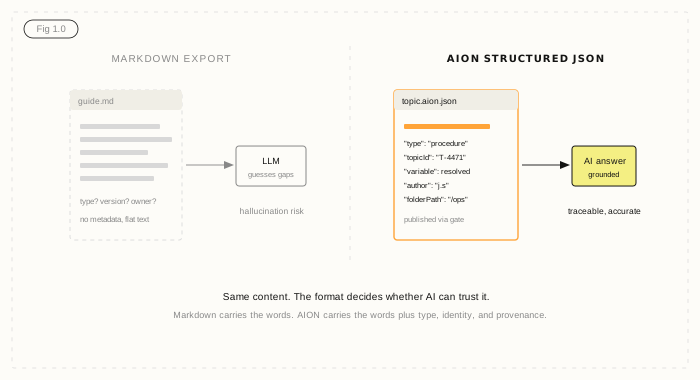
AION is Author-it's structured JSON output format for AI, shipped in 2026.R1. A Markdown export hands a language model the words in your content. AION hands it the words plus the structure around them - what each component is, where it sits in the hierarchy, who last touched it, and which variables were resolved at publish time. That difference is what separates an AI answer you can trust from one you have to double-check. Here is the practical case for structured JSON over a flat Markdown export, and exactly what AION carries today.
What AION is
AION is the structured JSON publishing format built into Author-it. It takes content from the Library - topics, books, and the relationships between them - and publishes it as a JSON object designed to be read by machines: large language models, RAG pipelines, vector databases, and AI agents. It shipped in 2026.R1 as a standard output, alongside the PDF, HTML5, Word, and eLearning formats Author-it has always produced from a single source.
The key word is publishing. AION is not a database dump or a one-off export script. It is a published output, which means it only contains content that has passed through Author-it's review and approval workflow. More on why that matters below.
It also is not a conversion layer bolted onto an existing XML format. It is a purpose-built output that carries the full structure of an Author-it library. To see the format in context, the AION overview walks through what it produces.
Markdown is good - and that is the catch
Let's be fair to Markdown, because the case for AION is stronger once you see where Markdown genuinely wins.
Modern language models are trained heavily on Markdown. It is close to a native format for them. It is compact, so it uses fewer tokens than HTML or verbose XML. And its headings give you a natural way to chunk content - split on the H2s and H3s and each chunk carries a little of its own context. For prose, for a quickstart guide, for a blog post feeding a simple chatbot, Markdown is often the right tool.
The catch is what Markdown is not. Markdown describes how text should look - a heading, a list, a bold run. It says nothing about what the text is. A safety warning and a marketing sentence are identical to a model if both are just paragraphs. A deprecated procedure looks exactly like the current one if neither carries a version. Markdown is presentation, not meaning, and AI systems that need to be accurate are asking for meaning.
What a Markdown export leaves out
When you flatten structured content to Markdown for an AI pipeline, four things fall on the floor.
Type
Every component in a well-structured library has a type - a procedure, a concept, a reference, a warning. That type tells a retrieval system what kind of answer it is looking at. Flatten to Markdown and the type is gone. The model has to infer it from the words, and inference is where hallucination starts.
Identity and relationships
A topic is not an island. It belongs to a book, sits under a parent section, and relates to other topics. Those relationships are what let an AI system retrieve the right component for the right context instead of a plausible-looking neighbour. A Markdown file is a flat string with no stable identity and no map of what connects to what.
Resolved variables
Structured content uses variables - product names, version numbers, region-specific values - resolved at publish time. A raw export can leave you with unresolved placeholders or, worse, the wrong value for the audience. AION resolves them before the AI ever sees them.
Provenance and governance
This is the big one. Markdown carries no record of who wrote the content, when it was last changed, where it lives, or whether it was ever approved. For a casual chatbot that is fine. For an AI answering a regulated question, content with no provenance is content you cannot defend.
What an AION object actually carries
Here is what AION includes today - the fields you can rely on, not a roadmap wish list.
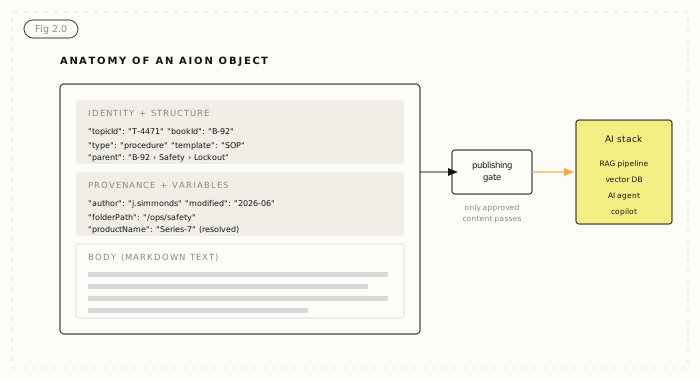
Each AION object carries the content hierarchy: books, sub-books, and topics, with the relationships between them intact. It carries the body content as Markdown text, so you keep everything good about Markdown for the prose itself. And it wraps that body in structured metadata: the topic and book IDs, the template name, timestamps and last-modified dates, the authoring metadata, the source folder path, the description, and the resolved values of every variable.
In other words, AION does not throw Markdown away. It keeps the Markdown body and adds the layer Markdown never had - type, identity, hierarchy, and provenance - as first-class data the AI can read directly. That is the whole argument in one sentence: structured JSON beats a Markdown export because it carries the body and the context, not just the body.
One honesty note, because it matters to technical buyers: richer metadata in the output - things like full version history, approval state, and reuse relationships embedded in the JSON itself - is on the roadmap, not in the output today. We would rather tell you exactly what ships now than oversell it.
Why this changes retrieval and RAG
RAG works by retrieving relevant chunks of content and handing them to a model as context. The quality of the answer depends almost entirely on the quality of those chunks. The history of content formats shows the same pattern every decade: a new consumer arrives and the old format cannot serve it. The language model is that new consumer.
Feed a RAG pipeline unstructured Markdown and you get chunks with no reliable labels. The retriever cannot filter by product, audience, or version because that data is not there. Feed it AION and every chunk arrives typed, identified, and version-anchored. The retriever can filter to the right product line, exclude deprecated content, and rank by relevance using real metadata instead of guesswork. Cleaner retrieval means fewer irrelevant results and, in practice, lower token spend - because you are not stuffing the context window with content the model has to sift through. For the deeper version of this argument, see how an AI-ready CCMS is built from the architecture up.
Governance: the part Markdown cannot fake
AI outputs are only as trustworthy as the content behind them. Author-it enforces this at the publishing gate: content that has not passed review and approval cannot be published to AION. The gate is the governance layer. It is not a setting you can switch off - it is how publishing works.
The practical effect is that your AI systems are grounded in content a human signed off on, not in a draft someone left in a folder. For regulated industries - manufacturing, utilities, life sciences - that is the difference between an AI answer you can stand behind in front of an auditor and one you cannot. Author-it has spent 25+ years building exactly this kind of governed, structured content for industries where accuracy is a compliance requirement, and the AI content foundation is that same discipline pointed at the AI stack.
Where to start
If you are grounding an LLM, a copilot, or a RAG pipeline in your own content, the format you feed it is not a detail - it is the difference between accurate and approximate. Markdown is a fine place to start for simple prose. Structured JSON is what you want when the answer has to be right, attributable, and current.
AION ships as standard in Author-it, at no extra cost. The fastest way to see whether your content is ready for it is to look at how it is structured today. Start with the AION overview to see the output format, then map it against the content you would want your AI to answer from.

AION FAQ
Q: What is AION?
A: AION is Author-it's structured JSON publishing format for AI, shipped in 2026.R1. It exports content from the Author-it Library - topics, books, and their relationships - as a JSON object that large language models, RAG pipelines, vector databases, and AI agents can read directly. It is included as standard in Author-it at no extra cost.
Q: Is structured JSON really better than Markdown for AI?
A: For accurate, traceable enterprise AI, yes. Markdown carries the words in your content but nothing about what they are - no type, no identity, no version, no provenance. Structured JSON like AION carries the Markdown body plus that surrounding context as machine-readable data, so an AI system can filter, rank, and attribute content instead of guessing. For simple prose chatbots, Markdown alone can be enough.
Q: What does an AION object contain?
A: An AION object contains the content hierarchy (books, sub-books, topics) with their relationships, the body content as Markdown text, and structured metadata: topic and book IDs, template name, timestamps and last-modified dates, authoring metadata, source folder path, description, and resolved variable values. Richer metadata such as full version history and approval state in the output is on the roadmap.
Q: Why can't I just feed Markdown to a RAG pipeline?
A: You can, but retrieval quality suffers. Markdown chunks have no reliable labels, so the retriever cannot filter by product, audience, or version - that data is not in the file. The result is more irrelevant retrievals and higher token use. Structured content like AION gives the retriever typed, identified, version-anchored chunks it can filter and rank accurately.
Q: How does AION handle governance for AI outputs?
A: Governance is enforced at the publishing gate. Content that has not passed Author-it's review and approval workflow cannot be published to AION. This means AI systems consuming AION are grounded in content a human approved, not in unreviewed drafts. The publishing gate is architectural, not an optional setting.
Q: Does AION replace Markdown?
A: No. AION keeps the Markdown body for the prose content and wraps it in structured metadata. You get everything good about Markdown - readability and token efficiency for the text itself - plus the type, identity, hierarchy, and provenance that Markdown alone cannot carry.
Q: Is AION an extra cost?
A: No. AION ships as a standard output format in Author-it, included at no additional cost alongside PDF, HTML5, Word, and eLearning publishing from the same single source.
Published on:
Author:
June 16, 2026
Osmar Silva
CTO
Related Resources

Article
The CCMS reckoning: six priorities for the AI era
A response to the industry's CCMS reckoning: the six priorities content leaders now face, and an honest look at which are shipped versus roadmap.
Article
AI-ready content: who has actually shipped it?
A practical field guide to separating AI-ready content marketing from vendors who have actually shipped a structured, governed output for AI.
Webinar
Author-it 2026.R3 Release Webinar - What's New
The full Author-it 2026.R3 release webinar recording, with the biggest New Word update yet, richer AION output, and the R3 go-live dates.