Article
MCP vs RAG: why they are not competitors

Summary:
MCP and RAG are not competing ways to connect AI to your content. Retrieval-augmented generation (RAG) searches a copy of your content that was exported, chunked and indexed in advance. Model Context Protocol (MCP) lets an AI agent ask the source system directly, at the moment of the question, with the request carrying who is asking. RAG is strongest on breadth, speed and semantic search over large collections; MCP is strongest on freshness and permissions that follow the user. Most content organisations that get this right run both, and decide which one is authoritative for each kind of question.
What is the difference between MCP and RAG?
RAG works on a copy. MCP works on the source.
Retrieval-augmented generation is a pattern: before a model answers, the system retrieves relevant passages from an index built earlier and puts them in front of the model as context. Model Context Protocol is a standard: an open way for an AI application to connect to an external system and ask it for something, live.
The confusion starts because both end with your content in front of a model. That is where the similarity stops. One is a search technique over an index you built last week. The other is a connection to the system your content actually lives in. The most common mistake in this area is treating MCP as a replacement for RAG. They solve different problems, and the teams that get this right usually end up running both.
How RAG works: retrieval over a copy
In a RAG pipeline, content is exported from wherever it is written, split into chunks, converted into embeddings and stored in a vector database. When a question arrives, the system finds the chunks that are semantically closest to it and hands them to the model.
It is fast, it scales, and it works over enormous collections. It is also very good at one thing that is genuinely hard: finding the passage that relates to a concept even when it uses completely different words. If you want the full mechanics, our explainer on what RAG is and how it works walks through them step by step.
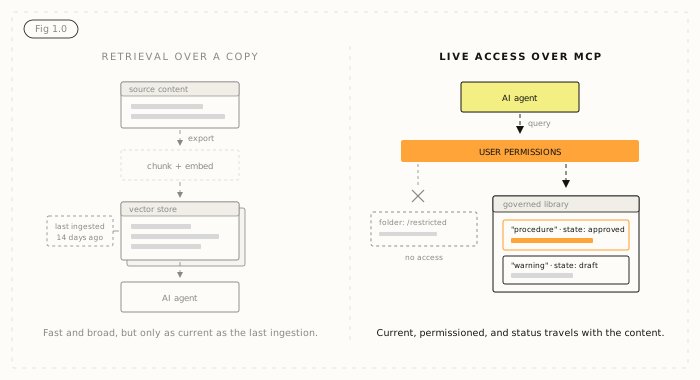
The catch is in the word copy. The index is only as fresh as the last ingestion. Permissions are whatever the vector store enforces, which is usually coarse, because the content has left the system that knew who was allowed to see what. And when a procedure is withdrawn at the source, the copy keeps serving it, with complete confidence, until somebody re-ingests. That failure mode is why so many RAG pipelines fail on enterprise documentation.
How MCP works: live access to the source
Model Context Protocol is an open standard for connecting AI applications to external systems. A system exposes what it can do through an MCP server. An AI application connects to it as an MCP client. Before MCP, every pairing of AI application and data source needed its own integration. With MCP, the integration is written once per system.
For content, the important change is timing. The agent asks the system directly, at the moment of the question. Nothing was copied, so nothing is stale. And because the request can carry identity, the source system can decide what to return based on who is asking.
What MCP does not do
MCP is a transport and a shape. It is not a permission model, it is not a content strategy and it is not quality control. It defines how an AI application asks a system for something and how the system answers. Whether the answer is any good depends entirely on the system on the other end.
An MCP server in front of a folder of files gives an AI agent live access to ungoverned content. That is worse than a stale export, not better.
MCP vs RAG compared
Here is how the trade-offs land for a content organisation, row by row.
Three rows matter most. Freshness: retrieval is as current as the last ingestion, live access is current at the moment of the question. Permissions: retrieval enforces whatever the store enforces, live access can enforce whatever the source enforces, down to the individual user. Failure mode: retrieval confidently serves content that has been withdrawn, live access depends on the source being available. Neither is free of risk. They just fail in different places.
Why most content teams run both
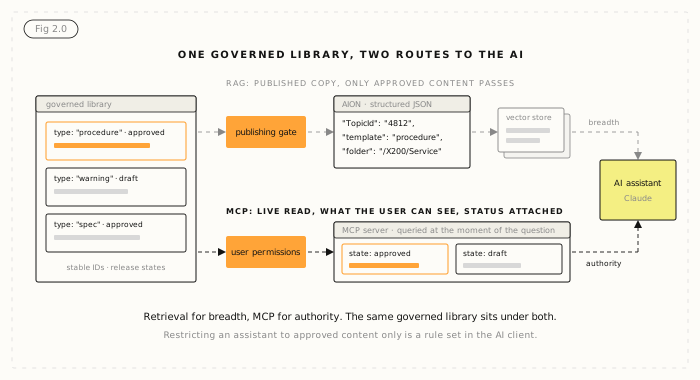
The pattern that works for most content organisations is retrieval for breadth and MCP for authority.
- Use retrieval to find candidate material across a large body of content, especially when the question is phrased differently from the content that answers it.
- Use live access when the answer has to be current, when the request needs to respect who is asking, or when the agent is doing something interactive rather than answering a one-shot question.
In practice that splits along the kind of question. "Which of our manuals discuss filter maintenance?" is a breadth question, and retrieval handles it well. "What is the current procedure for replacing the filter cartridge on the X200?" is an authority question, and you want it answered from the source. "Which books are still in draft since the review started?" is an interactive question that needs live content with its status attached, which no index built last Tuesday can give you.
Choosing the authoritative source is a content decision
The question is never "MCP or RAG". It is "which of these should be authoritative for this class of question". That is a content governance decision, which is why it tends to land on the documentation lead's desk rather than the architect's.
Three questions settle most cases:
- What does it cost if this answer is a week out of date? If the answer is a safety, compliance or support incident, use live access.
- Does the right answer depend on who is asking? If different people should see different content, the permissions need to travel with the request.
- Does the agent need to know whether something is approved? If it does, the content has to arrive with its status, not as anonymous text.
A no to all three usually means retrieval is enough. Either way, neither approach fixes the content underneath it. Unstructured, ungoverned content produces wrong answers through a vector store and through a live connection alike, which is the root of most wrong AI answers about products.
How Author-it supports both
Author-it stores content as discrete, governed objects in one library, each with a stable identifier, a folder path, a template type, resolved variables and a release state. The same library reaches AI in two ways, one for each half of this article.
MCP for the live half
Author-it's MCP server shipped in 2026.R3 and is standard on Author-it Cloud. The connection carries the logged-in user's own permissions, so an agent sees exactly what that person can see in the library, no more. There is no shared service account quietly widening access. Content arrives with its properties attached, including release state, so the agent can tell a draft from approved content. If the user can read a draft, so can the agent acting for them; restricting an assistant to approved content only is a rule you set in the AI client. Reading is the focus, and actions that change content are built individually rather than exposed by default. It has been built and tested with Claude.
AION for the retrieval half
AION is Author-it's structured JSON publishing output, live since 2026.R1 and standard on all deployments. It publishes the content hierarchy with template type, resolved variable values, source folder, stable topic and book identifiers, description and last-modified detail. That is what you load into a retrieval pipeline or a vector store. Because AION is a published output, content has to pass the release-state gate to reach it, so unapproved content cannot reach AION output.
Note the difference, because it catches people out. AION is published, so the publishing gate governs it. MCP is a live read, so the user's permissions govern it. Same library, two mechanisms, deliberately different behaviour.
See what AION output looks like. If you are on Author-it Cloud and want to try the live half with Claude, talk to your account manager.

MCP vs RAG FAQ
Q: What is the difference between MCP and RAG?
A: RAG retrieves relevant passages from a copy of your content that was exported, chunked and indexed in advance. MCP is an open standard that lets an AI agent query the source system directly at the moment of the question, with the request carrying who is asking. RAG is strongest for breadth and semantic search; MCP is strongest for current, permission-aware answers.
Q: Does MCP replace RAG?
A: No. They solve different problems and most content organisations run both. The pattern that works is retrieval for breadth and MCP for authority: retrieval finds candidate material across a large body of content, and live access answers questions that must be current, must respect who is asking, or are interactive.
Q: Is MCP more accurate than RAG?
A: Not by itself. MCP is a transport, not quality control. It changes how fresh the content is and whose permissions apply, but the answer is only as good as the system on the other end. An MCP server in front of a folder of ungoverned files gives an agent live access to ungoverned content.
Q: When should I use RAG instead of MCP?
A: Use RAG when you need semantic search across a large collection, when questions are phrased differently from the content that answers them, or when speed at scale matters more than currency. If an answer that is a week out of date would not cause a problem, retrieval over a copy is usually enough.
Q: Can MCP enforce document permissions?
A: It can if the system behind the MCP server does. MCP lets a request carry identity, so the source can decide what to return. In practice there are three designs: the requesting user's own permissions, a shared service account's permissions, or none. Author-it's MCP server uses the logged-in user's own permissions.
Q: What is an MCP server for documentation?
A: An MCP server for documentation exposes a content system to AI applications over Model Context Protocol, so an AI agent can read topics, procedures and other content live instead of from an exported copy. For documentation, most of the value is in reading. Any ability to change content is a separate decision with its own approvals.
Q: Can Author-it support both RAG and MCP?
A: Yes. AION, Author-it's structured JSON publishing output, feeds retrieval pipelines and vector stores, and only content that passes the release-state gate can reach it. Author-it's MCP server, standard on Author-it Cloud, gives AI agents live access to the same library with the logged-in user's own permissions, and returns content with its release state attached. It has been tested with Claude.
Published on:
Author:
October 19, 2026
Related Resources

Article
Connect an AI agent to your documentation: 7 questions
An MCP server in front of a folder of files gives an AI agent live access to ungoverned content. Seven questions to settle first.

Article
MCP vs RAG: why they are not competitors
RAG searches a copy of your content and MCP asks the source directly. They answer different questions, which is why most teams need both.

Article
AI service assistants for manufacturing field techs
What it takes to put an AI service assistant in a manufacturing field tech's hands without risking a wrong, outdated, or unsafe answer.