Article
What is RAG? Retrieval-augmented generation explained

Summary:
Retrieval-augmented generation (RAG) is a technique where an AI model retrieves relevant content from a knowledge base before it answers, instead of relying only on what it learned during training. When you ask a question, a RAG system searches your source content, pulls the most relevant pieces, and feeds them to the language model as context. The model then generates an answer grounded in that retrieved content rather than guessing from memory. This makes answers more accurate, more current, and traceable back to a source - which is why RAG has become the default pattern for enterprise AI. But RAG is only as good as the content it retrieves. Feed it messy, unstructured documents and it retrieves messy, unstructured chunks, which produces vague or wrong answers. Feed it structured, governed content and retrieval gets precise. That content layer is where accuracy is won or lost.
What is RAG, in plain terms?
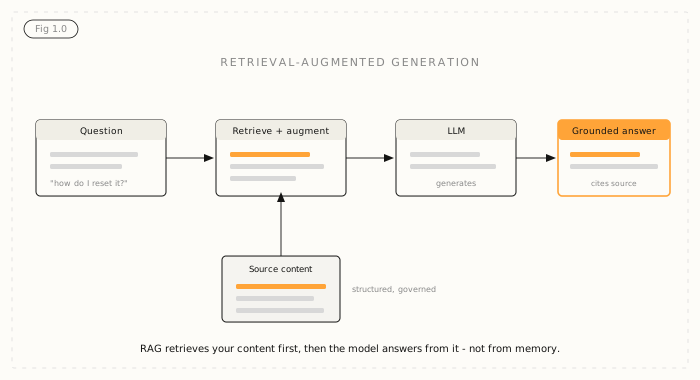
A large language model on its own answers from patterns it picked up during training. It has never seen your product manuals, your policies, or last week's release notes - so when it doesn't know, it fills the gap with a confident guess. Retrieval-augmented generation fixes that by adding a lookup step. Before the model answers, the system retrieves relevant content from a source you control and hands it over as context.
The answer is then built on your content, not the model's memory. The name spells out the method: retrieval (find the right content), augmented (add it to the prompt), and generation (write the answer). If you want the one-line version, our CCMS and AI glossary keeps a short definition alongside the other terms in this space.
How RAG works, step by step
A RAG pipeline runs in four stages, and each one depends on the quality of the content underneath it.
- Ingestion - your source content is split into chunks and turned into numerical embeddings stored in a vector database.
- Retrieval - the question is matched against those embeddings to find the most relevant chunks.
- Augmentation - the retrieved chunks are added to the prompt as supporting context.
- Generation - the model writes an answer grounded in that context, ideally with a citation back to the source.
Notice that the model only shows up at the last step. Most of the accuracy is decided before it ever runs. If retrieval pulls the wrong chunk, the model will answer the wrong question perfectly.
Why enterprises use RAG
Three things make RAG the default choice for enterprise AI. It stays current - update the source content and the next answer reflects the change, with no model retraining. It is grounded - answers trace back to a specific source, which matters when a wrong answer carries a compliance cost. And it is cheaper and faster to stand up than fine-tuning a model on your own data.
For regulated teams, that traceability is the whole point. We go deeper on it in choosing a CMS for RAG in regulated industries.
Why RAG answers still go wrong
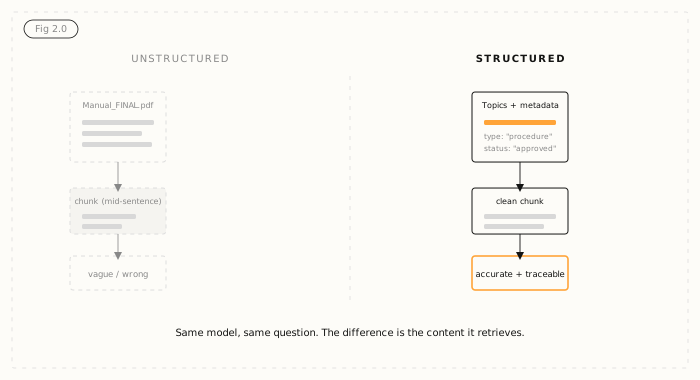
RAG is not magic. It inherits every weakness in the content it retrieves, and unstructured files are the usual culprit. A long PDF gets chunked by character count, so a warning gets split from the step it belongs to and the model retrieves half a thought.
Content with no version control lets the pipeline retrieve last year's procedure with total confidence. And with no governance, an unapproved draft is just as retrievable as the signed-off source. This is the same root cause behind most wrong AI answers about products: the model is fine, the content underneath it isn't.
What makes content RAG-ready
RAG-ready content has three properties. It is structured, so it chunks along real boundaries - a procedure stays whole and a warning stays attached to its step. It is single-source, so there is one current version to retrieve rather than five near-duplicates. And it is governed, so only approved content can ever reach the pipeline.
This is what an AI content foundation means in practice: the structured, governed layer that decides whether retrieval is precise or noisy. The contrast is stark once you see it side by side.
There is more on why format drives accuracy in why structured content makes AI accurate.
Where Author-it fits
Author-it has managed structured, single-source content for regulated industries for 25 years, which turns out to be exactly the input a RAG pipeline wants. Content is authored as reusable components with metadata, reviewed and approved before it goes anywhere, then published to AION - a structured JSON output built for LLM and RAG ingestion, not a PDF export bolted onto an AI feature.
Because of the publishing gate, unapproved content provably cannot reach that output. See how Author-it powers AI content for the full pipeline. If you want to know whether your own content is ready to retrieve against, the Structured Content Challenge is a fast way to find out.

RAG FAQ
Q: What is retrieval-augmented generation (RAG)?
A: Retrieval-augmented generation is an AI technique where a model retrieves relevant content from a knowledge base and uses it to answer, instead of relying only on what it learned in training. It grounds answers in a source you control, which makes them more accurate, more current, and traceable back to that source.
Q: What is the difference between RAG and fine-tuning?
A: Fine-tuning retrains a model on your data so the knowledge is baked into its weights; it is slow, costly, and goes stale when your content changes. RAG leaves the model alone and looks up fresh content at question time. For content that changes often, RAG is usually cheaper and stays current without retraining.
Q: Does RAG stop AI hallucinations?
A: RAG reduces hallucinations but does not eliminate them. Grounding answers in retrieved source content gives the model facts to work from instead of guessing. If retrieval returns the wrong or outdated content, the model can still produce a confident, wrong answer, which is why the quality of the source content matters as much as the pipeline.
Q: What content works best for RAG?
A: Structured, single-source, governed content works best. Structured content chunks along real boundaries so meaning stays intact, single-source content means there is one current version to retrieve, and governance ensures only approved content reaches the pipeline. Unstructured files chunk badly and retrieve fragments out of context.
Q: Do you need a vector database for RAG?
A: Most RAG systems use a vector database to store embeddings and find the most relevant chunks by semantic similarity. It is the standard retrieval method, but it is only as useful as the content indexed in it. A vector database full of messy, unversioned content still retrieves messy, unversioned answers.
Q: How does structured content improve RAG accuracy?
A: Structured content is broken into typed components with metadata, so retrieval can pull a whole procedure or a specific warning instead of a random slice of a page. Clean boundaries mean cleaner chunks, and metadata like status and version lets the pipeline retrieve only current, approved content.
Q: Is RAG suitable for regulated industries?
A: RAG suits regulated industries well because answers can be traced back to an approved source, which is essential where a wrong answer carries a compliance or safety cost. The requirement is that the underlying content is governed and versioned, so every retrieved answer comes from content that has passed review.
Published on:
Author:
August 14, 2026
Osmar Silva
CTO