Article
AI service assistants for manufacturing field techs

Summary:
Manufacturers are handing field technicians AI service assistants - copilots that answer how do I fix this on a phone or tablet, at the machine. The risk is simple: a field tech acts on the answer. If the assistant is grounded in outdated manuals or ungoverned content, a confident wrong answer becomes a wrong repair, a voided warranty, or a safety incident. Making field AI safe is less about the model and more about the content underneath it - structured, current, approved, and traceable. That is what turns an impressive demo into something a service team can trust on the floor.
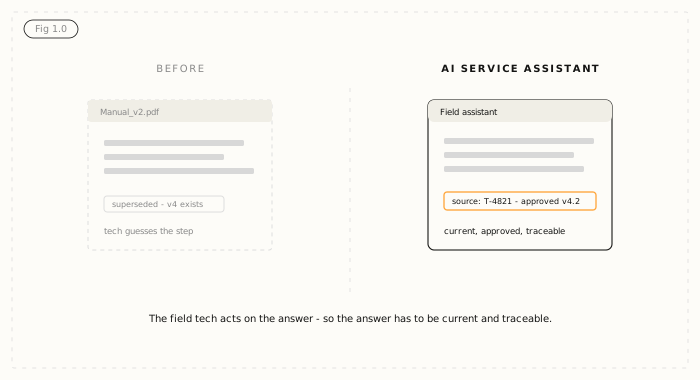
The field today: a torn manual and a good guess
Picture the technician at the machine. The fault code is unfamiliar, the printed manual in the truck is two revisions old, and the newer procedure lives in a system they cannot reach from the plant floor. So they do what good technicians do: they make an educated guess. Most of the time it works. Occasionally it does not, and the cost of the miss is measured in downtime, a return visit, or a safety near-miss.
This is the gap AI is supposed to close, and it is a real one - especially as experienced technicians retire and newer hires lean on documentation they did not write. But dropping an AI assistant onto the same disconnected, outdated content just makes the guess faster, not safer. We covered the underlying problem in what happens when field service runs on outdated manuals.
What good looks like: an assistant that only knows approved content
A safe field assistant has one defining property: it can only answer from content that is current and approved. Ask it how to isolate a unit before a repair and it returns the exact procedure for that model and revision, with the source named, not a plausible-sounding blend of three manuals. When the procedure changes, the assistant changes with it, because it draws from the same single source the documentation team publishes from.
That is not a model capability. It is a content capability - the same structured foundation that powers accurate manufacturing content across every output. If you want to see where your own content stands, the Structured Content Challenge is a fast way to benchmark it.
What changes in between: structure, governance, provenance
Three controls turn a demo into something safe to put in a technician's hand.
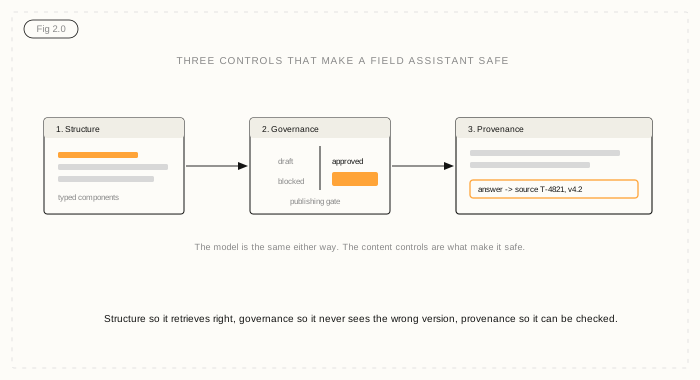
Structure comes first. Content stored as typed components - a procedure, a warning, a specification - lets the assistant retrieve the exact unit instead of a paragraph that merely shares keywords. Governance comes next. A publishing gate keeps unapproved or superseded content out of the assistant entirely, so a draft revision physically cannot be the answer a technician acts on. Provenance closes the loop. Every answer names the approved source and version, so the technician - and later an auditor - can verify it rather than trust it blindly.
Why the model is the easy part
The large language model behind these assistants is largely interchangeable, and it is improving on its own. What it cannot fix is the content it retrieves from. Point a capable model at ungoverned PDFs and it will still surface the wrong revision with total confidence - the same failure behind documentation for AI agents that returns unreliable answers. Point the same model at structured, governed content published through AION, Author-it's structured JSON output, and it retrieves the right component with its metadata intact. The intelligence was never the constraint. The content was.
Rolling it out without betting the floor on it
You do not need to solve every document at once. Start with the highest-risk procedures - the ones where a wrong answer has a safety or warranty cost - and get those structured, approved, and governed first. Prove the assistant answers those correctly, with provenance, before widening scope. This is the same readiness work behind AI-ready field service documentation: the assistant is only ever as safe as the content you let it see. Get the content right, and the field tech gets an answer they can act on without second-guessing it.

Field AI FAQ
Q: How do you make an AI service assistant safe for field technicians?
A: You make an AI service assistant safe for field technicians by controlling the content it answers from, not just the model it runs on. A field assistant is only as trustworthy as its source: if it retrieves outdated manuals or unapproved drafts, it will give confident, wrong instructions that a technician then acts on. Three controls make it safe. First, ground the assistant in structured, component-level content so it retrieves the exact procedure rather than a lookalike paragraph. Second, put governance upstream, so unapproved or superseded content cannot reach the assistant - Author-it's publishing gate does this architecturally. Third, keep provenance, so every answer names the approved source and version a technician can verify on the spot. Together these turn a plausible answer into a traceable one. The model matters far less than whether the content feeding it is current, approved, and structured for retrieval.
Q: What is an AI service assistant in manufacturing?
A: An AI service assistant is a copilot that helps a field or service technician diagnose faults and follow procedures by answering natural-language questions at the point of work. It retrieves from a knowledge source and generates an answer, so its accuracy depends entirely on whether that source content is structured, current, and approved.
Q: Why is a wrong answer from a field assistant so risky?
A: Because a field technician acts on the answer physically, often on live equipment. A wrong or outdated instruction can cause a bad repair, a voided warranty, equipment damage, or a safety incident. Unlike an office chatbot, there is no screen between the answer and the consequence, which is why the source content must be governed.
Q: Does a better AI model fix the accuracy problem?
A: No. A more capable model still retrieves from whatever content it is given. If that content is ungoverned or outdated, the model will surface the wrong revision confidently. The fix is upstream: structure the content into components, govern it so only approved content is reachable, and keep provenance so answers can be verified.
Q: How does structured content make a field assistant more accurate?
A: Structured content stores each procedure, warning, and specification as a typed component with metadata. That lets the assistant retrieve the exact unit for the right model and revision instead of a paragraph that merely shares keywords. Metadata like version and source also lets the assistant cite where the answer came from.
Q: What is the publishing gate and why does it matter for field AI?
A: The publishing gate is Author-it's architectural rule that unapproved content cannot reach any published output, including the AION format an AI assistant ingests. For field AI it matters because it makes governance provable: a draft or superseded revision physically cannot become the answer a technician acts on.
Q: Where should a manufacturer start with a field service assistant?
A: Start with the highest-risk procedures - the ones where a wrong answer carries a safety or warranty cost. Structure, approve, and govern those first, confirm the assistant answers them correctly with provenance, then widen scope. This limits risk while proving the content foundation before scaling across the full library.
Published on:
Author:
August 13, 2026
Osmar Silva
CTO
Related Resources

Article
Field crew AI: when a wrong answer is a safety risk
Why safety-critical field operations can't run AI on ungoverned content - and what deterministic, traceable answers actually require.

Article
AI service assistants for manufacturing field techs
What it takes to put an AI service assistant in a manufacturing field tech's hands without risking a wrong, outdated, or unsafe answer.
Article
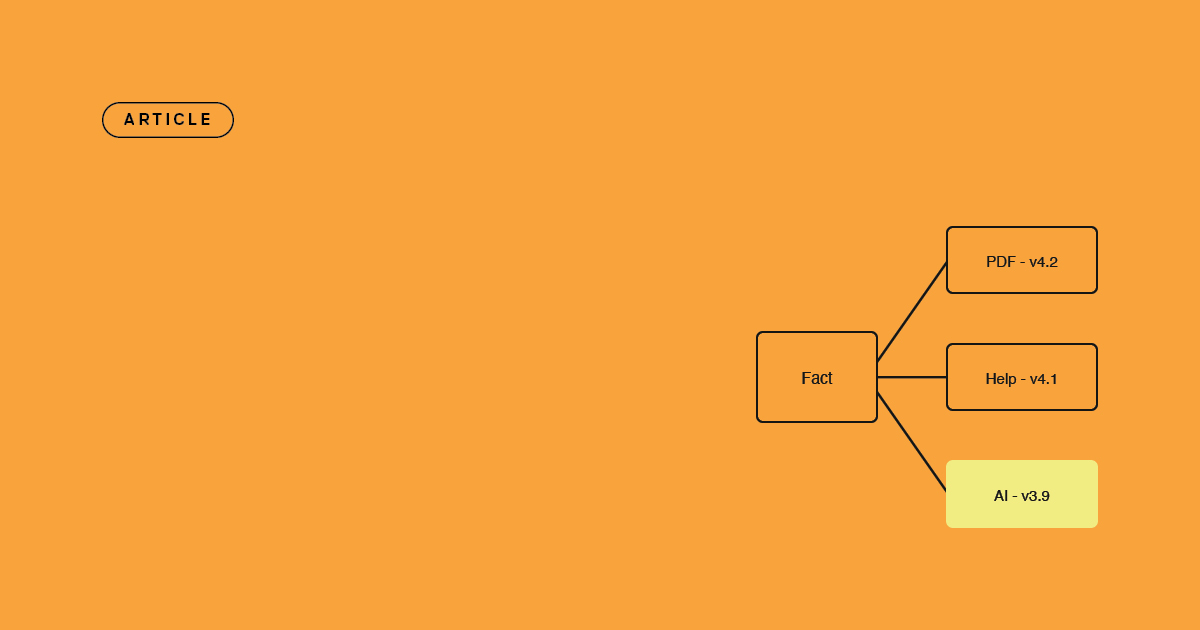
Content drift: what it is and how to prevent it
Why your PDF, help centre, and AI assistant give different answers - and how single-sourcing prevents content drift for good.