Article
What ISO 9001 actually requires from your doc team

Summary:
ISO 9001 doesn't just require good documentation - it requires controlled documentation. Clause 7.5 places specific obligations on technical documentation teams that go well beyond writing clear procedures. Understanding exactly what the standard asks for helps documentation teams design processes that satisfy auditors, not just readers. This article translates the formal language of Clause 7.5 into practical requirements your team needs to meet.
What Clause 7.5 actually asks
ISO 9001:2015 Clause 7.5 uses the term documented information to cover what older versions of the standard split into documents and records. Your team is responsible for both - the living documents that describe how things should be done, and the records that prove they were done that way.
The standard requires that documented information be available, suitable for use, and adequately protected. It requires that you control how documents are created, updated, approved, distributed, and retired. For a technical documentation team in manufacturing, that's a comprehensive mandate that touches every part of your workflow.
The four categories your team owns
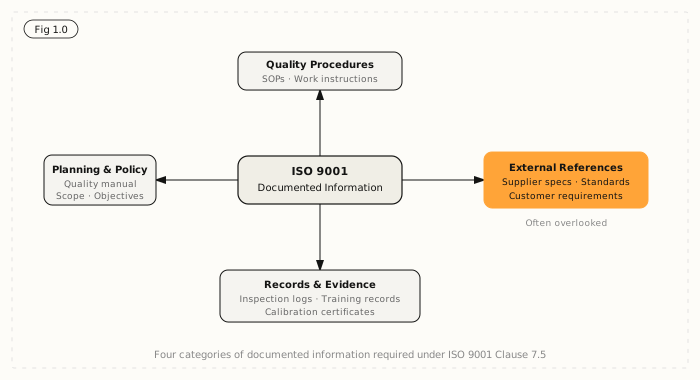
Most technical documentation teams in manufacturing are responsible for content across four distinct categories, each with its own Clause 7.5 implications.
Quality procedures - SOPs, work instructions, assembly procedures, quality plans - are the core of what most doc teams think about. These must be approved before issue, versioned, available at point of use, and protected from obsolete versions remaining in circulation.
Records and evidence - inspection logs, calibration records, training records, non-conformance reports - capture what actually happened. Unlike procedures, records aren't updated after the fact. They need to be legible, retrievable, and retained for defined periods. The challenge for doc teams is often that records are owned by different functions and only partially managed through the QMS.
Planning and policy documents - the quality manual, quality objectives, scope statements - are often owned by quality management rather than technical publications, but documentation teams typically handle the format, version control, and distribution. These have the same Clause 7.5 requirements as operational documents.
External references - supplier specifications, regulatory standards, customer requirements - are often overlooked. ISO 9001 requires that external documents of external origin that are relevant to the QMS be identified and controlled. Your team doesn't write them, but you're responsible for tracking which ones are in use and ensuring they're current. See how manufacturing documentation teams manage this in practice.
Approval is a requirement, not a formality
Clause 7.5 requires that documented information be approved for adequacy before issue. This means a named person or role has reviewed the content and explicitly signed off that it's fit for purpose. It doesn't mean a manager glanced at it and nodded - it means a traceable, recoverable record that the approval happened.
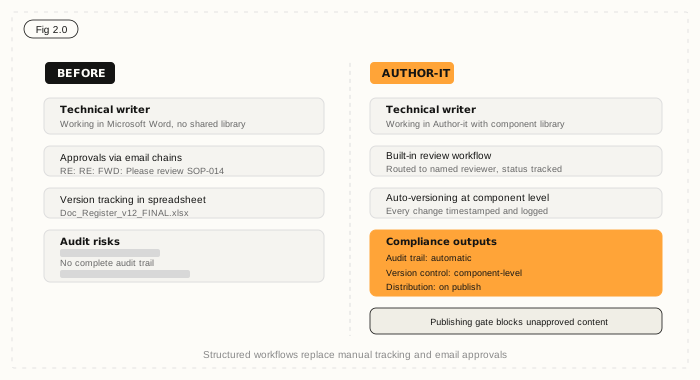
In practice, many documentation teams handle approvals through email. The problem isn't that email is invalid - it's that email is fragile. Threads get deleted, inboxes get archived, people leave the organisation. If an auditor asks for the approval history on a procedure updated 18 months ago and the approver is no longer with the company, you need the record to exist somewhere other than their Outlook.
Built-in approval workflows - where sign-off is recorded in the document management system alongside the content - solve this permanently. The trail is in the system, not in someone's inbox. Author-it's Review and Approve module was built for exactly this requirement.
Version control at the right level
Most documentation teams track versions at the document level - version 1, version 2, version 3. ISO 9001 requires that you be able to identify the revision status of documents and ensure current versions are available. Document-level version control is sufficient for that requirement.
The problem is that document-level version control doesn't handle shared content well. If the same specification or warning appears in twelve different work instructions, and that specification changes, you have to update twelve documents and increment twelve version numbers. Each update is an approval event. Each approval is a potential gap in your trail.
Component-based version control - where shared content exists as a single component referenced by multiple documents - reduces this to one update, one approval, and one version increment. Every document that references the component automatically reflects the change. The version number for the shared specification changes once. This is the structured authoring approach, and it's particularly valuable for manufacturers with high content reuse across product lines. Use the Structured Content Challenge to benchmark your current reuse level.
Protection against unintended use of obsolete versions
This is the Clause 7.5 requirement that documentation teams most commonly struggle with. The standard requires measures to prevent the unintended use of obsolete documented information. In a shared drive environment, that typically means labelling old versions as OBSOLETE and hoping no one uses them anyway.
The architectural solution is a publishing gate - a system control that prevents any content that hasn't been through the approval workflow from reaching any published output. In Author-it, unapproved content cannot be published, regardless of what someone tries to do. Obsolete versions aren't accessible for publication because the system prevents it, not because someone remembered to label them.
What good looks like for a technical documentation team
An ISO 9001-compliant documentation team in manufacturing has: a clear scope of what's controlled and who owns it, a consistent approval process with a recoverable trail, version control that scales with the complexity of your product lines, a distribution mechanism that doesn't rely on human memory, and a publishing gate that makes obsolete-version protection automatic rather than procedural.
Most teams can get most of this right most of the time with manual processes. ISO 9001 requires all of it, right, all of the time. That's the gap a structured content management system closes. The ROI calculator can help quantify the cost of the manual overhead your team is currently carrying to approximate this level of control.

ISO 9001 tech documentation FAQ
Q: What does ISO 9001 Clause 7.5 require from a technical documentation team?
A: ISO 9001 Clause 7.5 requires technical documentation teams to create, approve, version, distribute, and retire documented information in a controlled way. Specifically: all documents must be approved before issue, changes must be reviewed and re-approved, current versions must be available at point of use, obsolete versions must be prevented from unintended use, and external documents must be identified and controlled. It applies to procedures, work instructions, records, policy documents, and relevant external references.
Q: What is the difference between documents and records in ISO 9001?
A: ISO 9001:2015 uses the term documented information for both. Documents describe how things should be done - SOPs, work instructions, quality plans. Records prove that they were done - inspection logs, training records, calibration certificates. Documents are updated over time and need version control and approval workflows. Records capture a point-in-time state and need retention, protection from alteration, and retrievability. Both are controlled under Clause 7.5.
Q: Does ISO 9001 require a technical documentation team to control external documents?
A: Yes. ISO 9001 Clause 7.5 requires that external documents of external origin - supplier specifications, regulatory standards, customer requirements - that are relevant to the quality management system be identified and controlled. This means your team needs to track which external documents are referenced in your QMS, monitor for changes, and ensure internal documentation is updated when external sources change.
Q: How should a documentation team handle document approvals to satisfy ISO 9001?
A: ISO 9001 requires that documented information be approved for adequacy before issue and re-approved after updates. The approval must be traceable - you need to be able to demonstrate who approved a document and when. Email approvals can satisfy this if the trail is reliably preserved. The most robust approach is a built-in approval workflow in a document management system where sign-off is recorded against the document, not in someone's inbox. This makes the approval trail independent of individual employees and email retention policies.
Q: What does version control mean for a technical documentation team under ISO 9001?
A: ISO 9001 requires that you identify the current revision status of documents and ensure current versions are available at point of use. At minimum, this means each document has a clear version identifier, you can demonstrate what the current version is, and previous versions are not accessible for operational use. In practice, most manufacturing teams also track change history - what changed between versions and why - as this is often checked during audits.
Q: How does a CCMS help technical documentation teams meet ISO 9001 requirements?
A: A Component Content Management System addresses every Clause 7.5 requirement: built-in approval workflows with complete audit trails, component-level version control that scales with complex product lines, single-source publishing that makes current versions always available without manual distribution, a publishing gate that prevents obsolete or unapproved content from being published, and role-based access that controls who can create, edit, approve, and view content. The result is ISO compliance that's architectural rather than procedural.
Q: What is the most common ISO 9001 finding for technical documentation teams?
A: The most common findings involve Clause 7.5 document control: outdated versions in use at point of use, missing or unverifiable approval trails for recent revisions, external documents referenced in the QMS but not formally tracked, and obsolete versions accessible in shared systems. These findings are rarely deliberate - they're the result of manual processes that work most of the time but don't have the systematic controls to guarantee compliance consistently.
Published on:
Author:
May 12, 2026
Jamie Simmonds
Documentation Manager
Related Resources
Article
Field crew AI: when a wrong answer is a safety risk
Why safety-critical field operations can't run AI on ungoverned content - and what deterministic, traceable answers actually require.

Article
AI service assistants for manufacturing field techs
What it takes to put an AI service assistant in a manufacturing field tech's hands without risking a wrong, outdated, or unsafe answer.
Article
AI-ready content: who has actually shipped it?
A practical field guide to separating AI-ready content marketing from vendors who have actually shipped a structured, governed output for AI.