Article
Future-proof your content for an AI stack that changes

Summary:
You future-proof content for AI by owning the layer that lasts and staying loose on the layers that churn. Models, retrieval tools, vector databases, and agent frameworks all get replaced - often within a year or two - so betting your content's future on any one of them is risky. The durable asset is your content itself, held in an open, structured format you own: typed components, clean hierarchy, resolved variables, and provenance, published as JSON that any AI system can read. When the model or tool changes, you point the same content at the new one instead of re-exporting or re-platforming. Governance has to travel with it, so only approved content reaches the output and every answer traces to a source. Author-it's AION output is built for exactly this: your governed content as open structured JSON, portable across whatever AI stack you run now or adopt next.

Why your AI stack won't sit still
Look at how fast the AI layer moves. The leading model changes every few months. The retrieval tool or vector database you standardise on gets acquired, repriced, or outgrown. A new agent framework arrives and your team wants in. None of this is a criticism of the tools - it is just the pace of a young, fast-moving category.
The risk is betting your content's future on any one of them. If your content only works because it is wired into a specific model, hosted in a specific platform, or shaped for a specific tool, then every change in that layer becomes a migration project. You end up redoing content work every time the technology underneath moves - which, right now, is constantly.
The layer that lasts vs the layers that churn
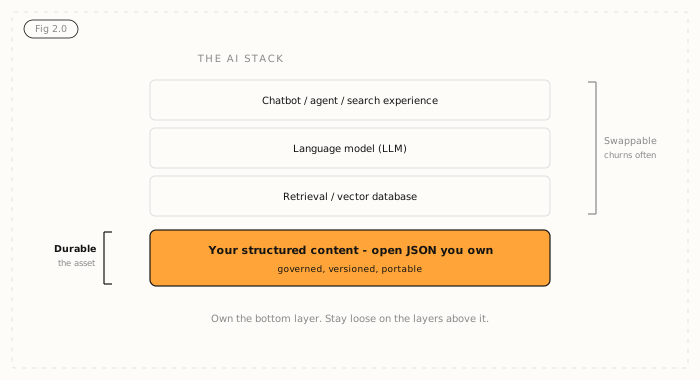
Think of your AI setup as a stack. Near the top are the parts that change often: the chatbot or agent experience, the language model, the retrieval and vector database layer. Near the bottom is the part that should not have to change at all: your content.
Future-proofing is mostly a matter of getting this division right. Own the durable layer - your content, in an open format you control - and stay deliberately loose on the swappable layers above it. When a better model or tool appears, you adopt it by pointing it at the same content, not by rebuilding your content for it.
The mistake most teams make is inverting this: they let a tool own their content, then discover the content only lives inside that tool. For a related take on that trap, see why you should own your AI output rather than rent a delivery hub.
What "portable" actually means for content
Portable does not just mean "we can export it." Almost anything can produce a file. The question is whether that file is useful to the next AI system without a rebuild.
Two common exports fall short. A pile of Markdown or PDFs is readable but flat - it loses the structure, typing, and relationships an AI needs to retrieve the right piece, so accuracy suffers. And content locked inside a hosted AI hub is not portable at all - it moves with the hub, not with you.
Genuinely portable content is open and structured: typed components, clear hierarchy, resolved variables, identifiers, and provenance, in a format any AI pipeline can read. That is the difference between content that survives a tool change and content that has to be recreated for it. We cover the format side in detail in why structured JSON beats Markdown for AI.
Governance has to travel with the content
Portability without governance is a liability. If your content can flow into any AI tool but half of it is unapproved, out of date, or wrong, you have just made it easy to spread bad answers faster.
Future-proof content carries its governance with it. Only approved content should reach the AI-ready output, and every answer should trace back to a source you can stand behind. In Author-it, that is enforced at the source: content passes through Draft, In Review, and Approved states, and unapproved content cannot reach AION output. The control is part of the content layer, so it holds no matter which model or tool sits on top. This matters most in regulated settings, where an AI answer may have to be defended in an audit - see what your LLMs actually need.
A practical way to future-proof your content
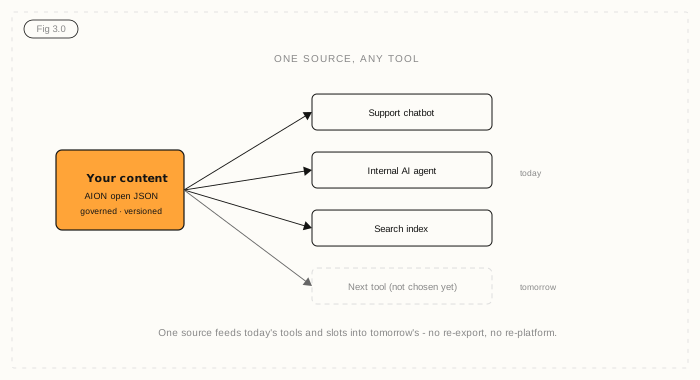
You do not need to predict which model or tool wins. You need to make your content indifferent to the answer. Four moves get you most of the way there.
- Separate content from tools. Author and store content in a structured system, not inside the AI product you happen to use this quarter.
- Hold it in an open, structured format. Typed components with hierarchy, variables, and provenance - not flat Markdown or a proprietary hub export.
- Govern at the source. Make approval a gate the content passes through before it is ever published to an AI-ready output.
- Keep the output portable. Ensure the same content can feed a second and third system without re-work, so adopting a new tool is a connection, not a project.
Do these and a model change becomes a config change. Skip them and every shift in the AI layer bills you again in content work.
Where Author-it fits
Author-it has spent 25 years keeping content structured, single-source, and governed for regulated industries - long before AI made it urgent. AION extends that to the AI layer: your approved content published as open structured JSON, owned by you, ready for whatever model, retrieval tool, or agent you run now or adopt next.
Put differently, Author-it is the durable layer. The tools on top can change as often as the market does; your content foundation stays yours. Explore the approach on the Author-it AI hub, or benchmark your current content with the Structured Content Challenge.

Future-proof content FAQ
Q: How do you future-proof content for AI?
A: Own the layer that lasts and stay loose on the layers that churn. Hold your content in an open, structured format you control - typed components, hierarchy, variables, and provenance - so it can feed any model or tool. Govern it at the source so only approved content is published. Then a model or tool change becomes a connection, not a migration.
Q: Why will my AI stack change?
A: Because the category is young and moving fast. Leading models are superseded every few months, retrieval tools and vector databases get acquired or repriced, and new agent frameworks keep arriving. Any content wired to a specific tool turns each of those shifts into a rebuild.
Q: Does exporting to Markdown make my content future-proof?
A: Not really. Markdown or PDF exports are readable but flat - they lose the structure, typing, and relationships an AI needs to retrieve the right component, so accuracy suffers. Future-proof content keeps its structure: typed components, hierarchy, resolved variables, and provenance in a format any AI pipeline can read.
Q: What does portable content actually mean?
A: Portable content can feed the next AI system without a rebuild. That rules out content locked inside a hosted hub, which moves with the hub rather than with you, and flat exports that drop structure. Genuinely portable content is open, structured, and owned by you, so the same source drops into any pipeline.
Q: How does governance fit into future-proofing?
A: Portability without governance just spreads bad answers faster. Future-proof content carries its governance with it: only approved content reaches the AI-ready output, and every answer traces to a source. In Author-it this is enforced at the source, so the control holds no matter which model or tool sits on top.
Q: Isn't it easier to just use one AI platform's tools?
A: It is faster to start, but it ties your content's usefulness to that one platform. When you want a second system, a different model, or a better price, your content has to be extracted and re-platformed. Owning your content as open output keeps that switch cheap and keeps your options open.
Q: What is AION and how does it help?
A: AION is Author-it's structured JSON output format for AI and LLM ingestion, shipped in 2026.R1. It publishes your governed content with hierarchy, text, identifiers, and metadata as an open output you own - the durable layer that stays constant while the models and tools on top of it change.
Published on:
Author:
July 24, 2026
Adrian Winks
CEO
Related Resources

Article
The CCMS reckoning: six priorities for the AI era
A response to the industry's CCMS reckoning: the six priorities content leaders now face, and an honest look at which are shipped versus roadmap.

Article
Field crew AI: when a wrong answer is a safety risk
Why safety-critical field operations can't run AI on ungoverned content - and what deterministic, traceable answers actually require.
Article
AI-ready content: who has actually shipped it?
A practical field guide to separating AI-ready content marketing from vendors who have actually shipped a structured, governed output for AI.