Article
AI content delivery: own your output, not a hub

Summary:
An AI content delivery platform is a hosted hub that indexes your content and delivers AI search, chat, and retrieval from it. It works, but it puts a vendor's layer between your content and every AI answer - you consume that layer rather than own it. There is another model: open structured output. Instead of routing your content through one hub, your CCMS publishes it as governed, structured JSON you own outright, ready to feed any retrieval system, chatbot, or agent you build or buy. The distinction matters because your AI stack will change - models, vendors, and tools all churn - and content locked inside a delivery hub moves with the hub, not with you. Author-it's AION output is that open layer: approved content as structured JSON, portable across any AI pipeline. Own the layer that outlives the tools sitting on top of it.
What an AI content delivery platform actually is
An AI content delivery platform is a hosted service that indexes your content and serves AI features from it - semantic search, a chatbot, retrieval for a language model, and increasingly a standard connection so external AI agents can query it. Point it at your existing documentation and it handles the classification, indexing, and delivery.
It is genuinely useful. If you want AI search over your content next quarter and you do not want to build a pipeline yourself, a hub gets you there fast.
The catch is structural, not technical. The hub becomes the layer between your content and every AI answer. Your content is hosted and indexed inside it, and the AI is delivered out of it. You are not buying an output you own - you are subscribing to a delivery layer you consume. That is fine until you want to feed a second system, move to a different model, or leave. For the deeper trade-off, see how structured JSON compares to Markdown for AI.
Two models: a hub you consume vs output you own
There are two ways to make your content AI-ready, and they lead to very different places.
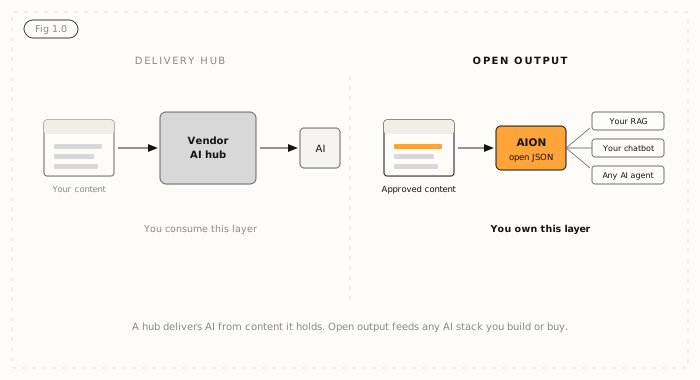
The first is the delivery hub: one platform holds your content and delivers AI from it. The second is open structured output: your content management system publishes your approved content as structured JSON that you own outright - a portable file, not a hosted service. That output drops straight into any retrieval system, vector database, chatbot, or agent, whether you built it or bought it.
Author-it takes the second path. Its AION output turns governed content into structured JSON built for AI ingestion. You are not routing your content through an Author-it hub to reach an AI - you are getting the content itself in a form any AI can read.
Here is how the two models compare.
Why owning the layer matters
Your AI stack will not sit still. The model you pick this year gets superseded. The retrieval tool you standardise on gets acquired or repriced. A new agent framework shows up that your team wants to use. Every one of those changes is easy if you own your content as open output, and a project if your content is locked inside a delivery hub.
Ownership comes down to three things: portability, exit cost, and reach. Open output is portable - the same JSON feeds a support chatbot, an internal agent, and a search index at once. Its exit cost is near zero - there is nothing to migrate because you already hold the file. And its reach is unlimited - you are not restricted to the AI features one vendor chose to ship. A hub inverts all three: your content's usefulness is bounded by the hub, and leaving means extracting and re-platforming everything.
This is the same lock-in math buyers already know from content tooling - it has just moved up to the AI layer. See who has actually shipped AI-ready content for where the category stands today.
Governance: who decides what the AI sees
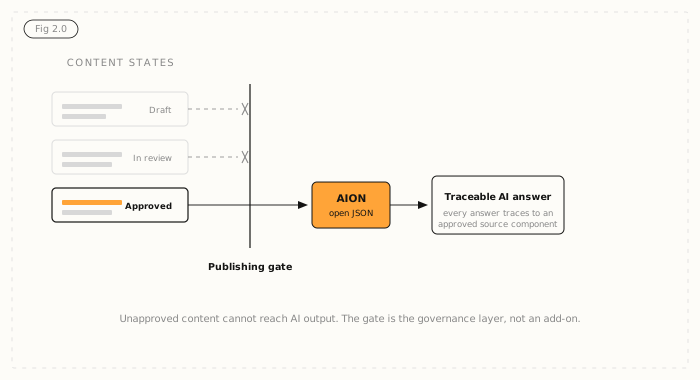
Owning the output only helps if the output is trustworthy. The risk with any AI over your content is that half-finished, wrong, or unapproved material reaches an answer.
Author-it handles this at the source with a publishing gate. Content moves through Draft, In Review, and Approved states, and unapproved content cannot reach AION output. This is architectural, not a setting - the gate is the governance layer. Every AI answer built on that output traces back to an approved source component, which is exactly what regulated teams need when an answer has to be defensible.
A hub can add permissions and review on top, but the governance still lives in the vendor's layer. With open, governed output, the control travels with the content wherever it goes. Read what an AI-ready CCMS actually means for the full picture.
Where Author-it fits
Author-it has managed structured, single-source content for regulated industries for 25 years. AION applies that same discipline to AI: your approved content, published as open structured JSON, owned by you, ready for whatever you build on top.
You can still put a chatbot or search experience in front of it. The difference is that the content layer underneath stays yours - so when the tools on top change, and they will, your foundation does not have to. Explore the approach on the Author-it AI hub.
How to evaluate the two approaches
If you are weighing an AI content platform, four questions cut to the core.
Do you own the AI-ready output, or only access it inside the vendor's platform? Can the same content feed a second or third AI system without re-work? What does leaving cost - is your content portable, or does exit mean migration? And where does governance live - in your content, or in the vendor's hub?
Answer those honestly and the choice between renting a delivery layer and owning an open one gets clear. To pressure-test how AI-ready your current content is, try the Structured Content Challenge.

AI content delivery FAQ
Q: What is an AI content delivery platform?
A: An AI content delivery platform is a hosted hub that indexes your content and serves AI features from it - semantic search, a chatbot, and retrieval for language models or external agents. Content lives inside the platform and the AI is delivered out of it, so you consume the vendor's delivery layer rather than owning a portable output.
Q: What is the difference between an AI delivery hub and open structured output?
A: A delivery hub hosts your content and delivers AI from it, so your content's AI usefulness is bounded by that one platform. Open structured output publishes your approved content as JSON you own outright, which can feed any retrieval system, chatbot, or agent you build or buy. One is a service you subscribe to; the other is an asset you hold.
Q: Why does owning your AI content layer matter?
A: Because your AI stack changes. Models, retrieval tools, and agent frameworks all get replaced over time. If your content is open output you own, swapping tools is trivial and feeding several systems at once is free. If it is locked in a hub, every change means extraction and re-platforming, and your reach is limited to the features that vendor ships.
Q: Does Author-it replace my chatbot or search tool?
A: No. Author-it produces the content layer underneath them. AION publishes your approved content as structured JSON, and you put whatever chatbot, search, or agent you like on top. The point is that the foundation stays yours when the tools on top change.
Q: How does structured output keep AI answers accurate?
A: Accuracy starts with governed source content. Author-it's publishing gate means unapproved content cannot reach AION output, so answers are built only on approved components and each answer traces back to its source. Structured JSON also carries the hierarchy and metadata that help a model retrieve the right component instead of guessing.
Q: What is AION?
A: AION is Author-it's structured JSON output format for AI and LLM ingestion, shipped in 2026.R1 as standard. It publishes your content with its hierarchy, Markdown text, identifiers, and metadata in a form built for RAG pipelines, vector databases, and AI agents - an open output you own, not a hosted layer you rent.
Published on:
Author:
August 13, 2026
Quinn Wright
Head of Sales
Related Resources

Article
The CCMS reckoning: six priorities for the AI era
A response to the industry's CCMS reckoning: the six priorities content leaders now face, and an honest look at which are shipped versus roadmap.
Article
AI-ready content: who has actually shipped it?
A practical field guide to separating AI-ready content marketing from vendors who have actually shipped a structured, governed output for AI.
Article
How to prevent AI hallucinations in enterprise content
A practical five-step playbook to prevent AI hallucinations in enterprise content - by fixing the content your AI reads, not the model.