Guide
AI content foundation guide: what your LLMs actually need

Summary:
AI tools don't hallucinate because the models are broken. They hallucinate because the content underneath is. Most organisations are bolting LLMs, RAG pipelines, and AI agents on top of scattered PDFs, duplicated help articles, and SharePoint sprawl - then blaming the model. The fix isn't a better model. It's an AI content foundation: one source, structured, governed, machine-readable. That's what a CCMS has been doing for 25+ years. The market just caught up to the problem.
By Adrian Winks, CEO, Author-it
What an AI content foundation actually is
An AI content foundation is the layer of structured, governed, single-sourced content that sits underneath every AI system your organisation runs - your internal Copilots, your RAG pipelines, your customer-facing chatbots, your agents.
It is not a model. It is not a chatbot. It is not a documentation site.
It is the content itself - made machine-readable by design, not by afterthought.
If the model is the engine, the foundation is the fuel. And most organisations are running premium models on garbage-tier fuel, then wondering why the output is unreliable.
Why the conversation has shifted from "AI features" to "AI foundation"
For the last two years, every vendor in the content space has shipped "AI features." Writing assistants. Summarisers. Chatbots bolted onto help centres. Some of them are genuinely useful. Most of them are surface-level polish on the same unstructured content underneath.
The market has noticed. Research published in 2025 showed inaccuracy is now the top-ranked risk associated with AI content generation - above job displacement, above cybersecurity. Companies have started rehiring the very roles they cut, just to clean up AI-generated errors.
That has reframed the buying conversation. The question in 2026 isn't "does your platform have AI?" It's: "can your platform give our AI content that's actually trustworthy?" That's a foundation question. Not a feature question. We made the related argument recently in why your AI content strategy needs a source of truth (not just more tools) - this guide takes it one layer deeper.
Documentation-layer tools vs. the content foundation
Tools like Mintlify have done a smart job of solving one specific part of the AI content problem: making developer documentation machine-readable at the output layer. llms.txt files. Markdown exports. MCP servers. If you're a developer-tools company and your docs are your product's interface, that matters a lot.
But the output layer is one step in a longer chain. It only works if the content going into that layer is already clean, structured, single-sourced, governed, and trustworthy. If it isn't, all the llms.txt files in the world will just serve your sprawl faster.
Here's the uncomfortable truth about enterprise content in 2026:
- Your product information is split across ten systems
- Your help articles were written by four different teams using three different styles
- Your regulatory content lives in a version-controlled CCMS but your marketing content lives in SharePoint
- Your multilingual content is out of sync by at least one release cycle
- Nobody is entirely sure which version of the warranty document is the current one
No output format fixes that. No chatbot fixes that. No amount of llms.txt fixes that. The fix is the foundation underneath.
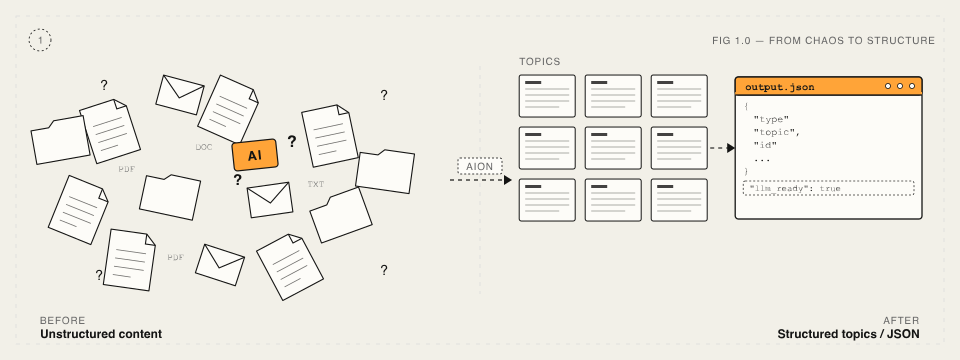
The five pillars of an AI content foundation
This is what your AI stack actually needs from the content layer. If any of these are missing, the AI output above it degrades - usually silently, often for months before anyone notices.
1. Single source
One record of truth for every piece of content your organisation produces. Not "a SharePoint folder everyone agrees to use." A single, governed, version-controlled repository where every update propagates to every surface automatically.
If a safety warning changes, it changes once. If a product spec is updated, every output that references it updates with it - the PDF, the help site, the in-app tooltip, the LLM's knowledge base. Single-sourcing isn't a nice-to-have. It's the only way to keep AI answers in sync with reality. A global manufacturer using this approach cut translation costs by 90% and saved over $3M a year - because they were no longer paying to process the same content in multiple places.
2. Structure
Content broken into reusable, tagged components - topics, sections, variables - rather than trapped inside monolithic documents. Structured content gives LLMs the signals they actually need: clear headings, logical hierarchy, predictable chunking boundaries, explicit relationships between pieces.
Unstructured content forces the model to guess. Guessing is where hallucinations come from. We covered the mechanics of this in why structured content makes AI accurate (and useful).
3. Governance
Formal review and approval. Audit trails. Release states. Role-based access. Proof that the content your AI is serving has been checked by a human who is accountable for it.
This is non-negotiable in regulated industries - utilities, manufacturing, medical devices, financial services - and it's rapidly becoming table stakes everywhere else. If your AI agent quotes an outdated compliance statement to a customer, you can't blame the model. The model did exactly what the content told it to do.
4. Metadata and taxonomy
Tags. Controlled vocabularies. Explicit relationships between topics. The stuff that turns a pile of text into a map an AI can actually navigate.
Metadata is how an LLM understands that your "installation guide" for Product A is related to the "safety warning" for Product A is related to the "service manual" for Product A - even when those words don't appear together in any one document. Without it, retrieval-augmented generation pipelines end up pulling the wrong chunks and stitching together confident-sounding nonsense. The structured authoring and content reuse handbook goes deeper on how metadata and component reuse work together.
5. Machine-readable output
Structured JSON, clean Markdown, resolved variables - whatever format your downstream AI systems actually want to consume. Not HTML with a nav bar and a JavaScript sidebar stripped out. Proper machine-first outputs that mirror the hierarchy and metadata of the source.
This is the layer tools like Mintlify handle well for developer docs. It's also what Author-it's own AION format does for the full enterprise content library - publishing a book to AI-ready JSON with all metadata, variables, and structure intact. The output layer matters. It just can't save you if the other four pillars are broken.
The hidden cost of skipping the foundation
Organisations that rush an AI initiative on top of an unstructured content layer don't usually fail loudly. They fail quietly, in ways that are expensive to unwind.
- Hallucinations nobody catches for months. The internal Copilot cheerfully tells staff the wrong product specs. Nobody notices until a customer does.
- Compliance drift. A regulation changes. The official documentation is updated. The AI agent keeps quoting the old version from a PDF ingested six months ago.
- Translation debt compounds. AI is asked questions in languages where the source content was last translated two releases ago. The model fills in the gaps with guesses.
- Retraining costs escalate. Every time the sprawl gets worse, the embeddings need to be rebuilt. At enterprise scale, that's a real line item.
- Loss of audit defensibility. Something goes wrong. Legal asks where the answer came from. There's no provenance trail - just a vector store and a hopeful shrug.
None of these are model problems. All of them are content foundation problems. And no amount of prompt engineering fixes them.
How to audit your own content foundation
If you're about to invest in AI - or if you're already running it and the outputs feel unreliable - it's worth spending 30 minutes on the layer underneath. Ask honestly:
- Can we name the single source of truth for our customer-facing product content? If two people in the room give different answers, you don't have one.
- Is the content structured, or is it locked inside documents? If "updating a safety warning" means opening a Word file, you're in document-land, not component-land.
- Who signed off on the content our AI is using? If the answer is "nobody recently," that's your biggest risk.
- Are our tags, metadata, and taxonomy consistent - or did each team invent their own?
- Can we publish a book, module, or product's worth of content into a machine-readable format (structured JSON, clean Markdown with resolved variables, or similar) without manual cleanup?
- When regulation changes, how long does it take for that change to reach every AI surface we own?
If any of those answers feel uncomfortable, your foundation has gaps. That's fixable - but it's the work that needs doing before the AI layer above it can deliver real value.
Where Author-it fits
Author-it is a CCMS. It was built 25+ years ago to solve exactly this foundation problem - long before anyone was calling it an AI problem. Single source. Structured, component-based content. Built-in Review & Approve workflows. Proper taxonomy and metadata. Granular version control and audit trails. Enterprise-grade governance for regulated industries.
In 2026 we shipped AION - an AI-ready JSON output format that publishes the full content hierarchy, metadata, variables, and structure directly into a format LLMs, RAG pipelines, and AI agents can consume without an intermediate translation layer.
None of this is a pivot. It's what a serious CCMS has always done. The terminology just caught up. The market is now asking the question Author-it was built to answer: what does your AI run on?
If the answer is a pile of PDFs and a hope, it's worth a conversation. Book a 15-minute call and we'll show you what a proper AI content foundation looks like - and how the content you already have (structured or not) could be powering your AI strategy inside a quarter. If you want to run the numbers first, the ROI calculator gives you a realistic estimate in under two minutes.

Published on 17 April 2026
AI Foundation FAQ
Q: What is an AI content foundation?
A: An AI content foundation is the layer of structured, single-sourced, governed, machine-readable content that sits underneath an organisation's AI systems - LLMs, RAG pipelines, agents, and internal Copilots. It's the content itself, prepared so AI can use it accurately. It's not a model, a chatbot, or a documentation site.
Q: Why do AI tools hallucinate on enterprise content?
A: Most hallucinations are content problems, not model problems. When AI systems are fed unstructured, duplicated, or out-of-sync content - SharePoint sprawl, conflicting PDFs, outdated help articles - they generate confident answers stitched from the wrong sources. Structured, governed, single-sourced content gives the model the signals it needs to stay accurate.
Q: Is a CCMS the same as an AI content foundation?
A: A well-implemented CCMS is the closest thing most enterprises have to an AI content foundation. Structured authoring, component reuse, single-source publishing, governance, and metadata are exactly the capabilities AI systems need from the content layer. The only thing a CCMS needs to add for AI is a machine-readable output format - which is what Author-it's AION publishes.
Q: How is this different from what Mintlify does?
A: Mintlify solves the output layer for developer documentation - llms.txt files, Markdown exports, MCP servers. That's valuable if your docs are your product's interface. A CCMS operates one layer deeper: it manages the source content that any output format depends on, across every type of content an enterprise produces, with governance and reuse built in. The two layers work together - the foundation feeds the output.
Q: What are the five pillars of an AI content foundation?
A: Single source, structure, governance, metadata and taxonomy, and machine-readable output. Single source keeps everything in sync. Structure gives AI the chunks and hierarchy it needs. Governance provides the accountability and audit trail. Metadata and taxonomy make relationships explicit. Machine-readable output delivers the content into AI systems without manual cleanup.
Q: How do I know if my organisation has an AI content foundation problem?
A: Run a six-question audit. Can you name the single source of truth for customer-facing content? Is it structured or stuck in documents? Who signed off on it recently? Is metadata consistent? Can you publish to machine-readable formats cleanly? How fast does a regulation change reach every AI surface? If any answer is uncomfortable, there are gaps.
Q: What is AION?
A: AION is Author-it's AI-ready JSON output format, shipped in 2026.R1. It publishes a full Author-it book - sub-books, topics, metadata, resolved variables, and hierarchy - directly into structured JSON optimised for LLMs, RAG pipelines, AI agents, and document retrieval systems. It's an output format, not a feature bolted on.
Q: Do I need a CCMS to have an AI content foundation?
A: You need the capabilities a CCMS provides - single source, structured authoring, governance, metadata, and machine-readable output. In practice, that's very hard to build outside of a purpose-built CCMS. A wiki, a shared drive, or a document management system can get you some of the way, but not all the way - and the gaps are where AI accuracy breaks down.
Published on:
Author:
April 16, 2026
Adrian Winks
CEO
Related Resources

Article
The CCMS reckoning: six priorities for the AI era
A response to the industry's CCMS reckoning: the six priorities content leaders now face, and an honest look at which are shipped versus roadmap.
Article
AI-ready content: who has actually shipped it?
A practical field guide to separating AI-ready content marketing from vendors who have actually shipped a structured, governed output for AI.
Article
Should you build your own knowledge infrastructure?
The real cost of building your own knowledge infrastructure isn't the build - it's owning it forever. An honest build-vs-buy guide.