Article
CCMS evaluation criteria for financial services

Summary:
Financial services firms evaluating a Component Content Management System (CCMS) should weigh six criteria: content governance and audit trails, security and data residency, structured single-source publishing, translation and versioning control, AI-ready output, and integration with existing systems. In regulated finance, the real risk is not disorganised content - it is content you cannot prove is current, approved, and traceable. A CCMS built for financial services enforces approval before anything publishes, keeps a full audit trail on every component, and produces structured output an examiner or an AI system can trust. Author-it has done this in regulated industries for over 25 years, with component-level version control, built-in review and approval, and AION structured JSON output for AI. The right evaluation framework scores each platform on how well it reduces compliance risk and how cleanly it feeds accurate content to the AI tools your teams are already adopting.
Why evaluating a CCMS for financial services is different
Most CCMS buying guides are written for technical documentation teams. Financial services buys on a different basis. The content is regulated, the audit stakes are high, and increasingly the decision lands on IT, risk, or architecture teams who inherited it - not on a technical writing lead.
In finance, a documentation error is not an inconvenience. A stale disclosure, an out-of-date procedure, or an unapproved product term can become a compliance finding, a customer remediation, or a fine. So the criteria that matter are not about authoring comfort - they are about whether you can prove, at any moment, that the content in front of a customer, an auditor, or an AI system is the current, approved version.
The same principles apply across other regulated sectors - see how we frame a CCMS for regulated industries - but finance adds its own weight on data residency, disclosure control, and multi-jurisdiction rules.
The six criteria that matter
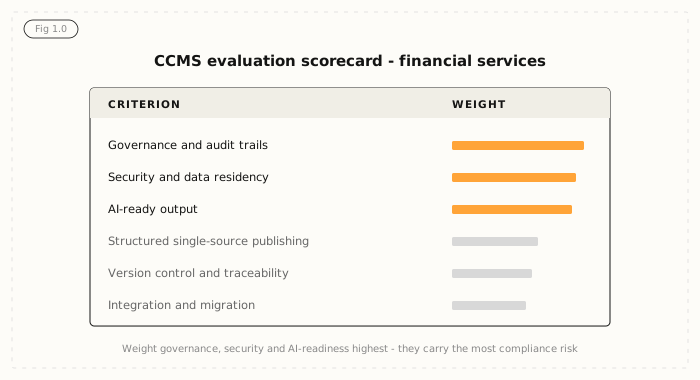
Score every platform on your shortlist against six criteria. Weight them for your own risk profile, but do not drop any of them. The table below maps each criterion to what to look for and why it matters in financial services. These six criteria are the sector-specific ones. For the full vendor scorecard covering cost, lock-in and AI-readiness, use the CCMS evaluation guide.
If you want a ready-made scoring sheet, our CCMS vendor evaluation checklist puts these into a format you can take straight into vendor demos.
Governance, approval and audit trails come first
In financial services, governance is not a feature - it is the point. Ask one question of every platform: can unapproved content ever reach a published output? If the answer is "it depends on configuration", that is a risk.
The stronger model is architectural. In Author-it, content has to pass through review and approval before it can publish anywhere - the publishing gate is the governance layer, not a setting someone can switch off. Every component carries a full audit trail: who changed it, when, and what was approved.
For an examiner, that is the difference between "we think this is current" and "here is the approval record".
Security, access control and data residency
Regulated finance has non-negotiables: role-based access control, single sign-on, encryption, and clear answers on where data is hosted and how it is segregated. Put these in the RFP early - they eliminate platforms faster than any feature gap.
Ask for specifics: which roles can approve versus publish, how access is logged, and whether hosting meets your jurisdiction's requirements. A modern cloud CCMS should answer these without hesitation.
AI-ready output: the criterion most 2026 shortlists miss
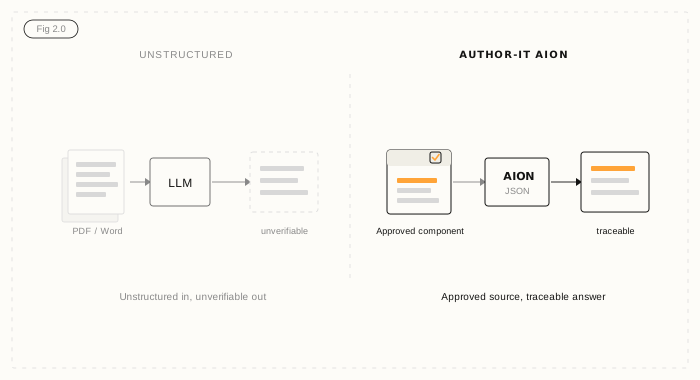
Here is the criterion most financial services shortlists still leave off. Your firm is already piloting AI - support copilots, adviser assistants, internal knowledge bots. Every one of them is only as accurate as the content feeding it. Feed an AI unstructured PDFs and you get confident, unverifiable answers. That is a compliance problem wearing a productivity badge.
An AI-ready CCMS produces structured output an AI system can consume with provenance intact. Author-it's AION structured JSON output ships this as standard - content hierarchy, resolved variables, authorship, and timestamps - and because of the publishing gate, only approved content ever reaches it. When an AI answer can be traced back to an approved source component, you can defend it.
Ask every vendor a blunt question: what structured, AI-ready output do you ship today, not on a roadmap?
How to run the evaluation
Turn the six criteria into a weighted scorecard. Give governance, security, and AI-readiness the heaviest weights - they carry the most compliance risk. Then run the same three scenarios through every shortlisted platform: publish a change to a regulated procedure, produce an audit trail for a single component, and export content for an AI pipeline.
The platform that makes those three things boring is the one to trust. Regulated content is not where you want surprises.
Two practical notes. Ask hard about migration - moving from Word, SharePoint, or a legacy system is usually the real project, and an experienced services team matters more than a slick demo. And model the cost: high content reuse is where a CCMS pays back, so run your numbers through a content ROI calculation before you commit.

Financial Services CCMS FAQ
Q: What is a CCMS and why do financial services firms need one?
A: A Component Content Management System (CCMS) manages content as reusable components - individual procedures, disclosures, and product terms - rather than whole documents. Financial services firms need one because the same regulated content is reused across products, markets, and channels, and every version has to be current, approved, and traceable. A CCMS updates content once and publishes everywhere, with an audit trail on every change.
Q: What are the most important CCMS evaluation criteria for financial services?
A: Six criteria matter most: content governance and audit trails, security and data residency, structured single-source publishing, version control and change traceability, AI-ready output, and integration with existing systems. Weight governance, security, and AI-readiness highest - they carry the most compliance risk in regulated finance.
Q: How does a CCMS help with financial services compliance and audits?
A: A CCMS enforces review and approval before content publishes and keeps a full audit trail on every component - who changed it, when, and what was approved. In Author-it, unapproved content cannot reach a published output because the publishing gate is architectural. For an audit, that turns "we think this is current" into a documented approval record.
Q: Does a CCMS need to be AI-ready for financial services?
A: Yes. Financial services firms are deploying AI copilots and knowledge bots, and those tools are only as accurate as the content behind them. An AI-ready CCMS produces structured output with provenance so AI answers can be traced to approved sources. Author-it ships AION structured JSON output as standard, and only approved content reaches it.
Q: Is a general document management system enough for regulated financial content?
A: Usually not. General document management and collaboration tools store whole files but do not manage content at the component level, enforce approval before publishing, or produce structured AI-ready output. For regulated financial content, the gaps show up exactly where the compliance risk is - version control, approval, and traceability.
Q: Can a CCMS handle multi-jurisdiction and multi-language financial content?
A: Yes. A CCMS manages regional and language variants from a single source, so a change to a shared component updates every jurisdiction's output without rewriting. Translation reuse means only new or changed content is sent for translation, which cuts cost and keeps every market in sync.
Q: How long does migrating financial services content to a CCMS take?
A: It depends on content volume and how structured the source already is, but most migrations from Word, SharePoint, or legacy systems complete within about 90 days with an experienced services team. The migration is usually the real project - weight implementation support heavily in your evaluation.
Published on:
Author:
August 4, 2026
Adrian Winks
CEO
Related Resources

Article
Field crew AI: when a wrong answer is a safety risk
Why safety-critical field operations can't run AI on ungoverned content - and what deterministic, traceable answers actually require.

Article
AI-ready content: who has actually shipped it?
A practical field guide to separating AI-ready content marketing from vendors who have actually shipped a structured, governed output for AI.

Article
Future-proof your content for an AI stack that changes
Models and tools churn constantly. Future-proof content for AI by owning the one layer that lasts - your content, as open structured JSON.