Guide
CCMS evaluation checklist: 17 questions to ask

Summary:
Choosing a Component Content Management System is a multi-year decision, and most vendor demos are built to show strengths and skip gaps. This CCMS evaluation checklist gives you 17 questions to ask every vendor, grouped by what actually matters: content reuse, AI output, compliance, translation, publishing, implementation, and total cost. The questions are written so answers are comparable across vendors, and so the easy-to-skip ones - like what format your AI output uses - get asked. Author-it answers all 17 directly, including the AI output question many CCMS platforms can't yet answer.
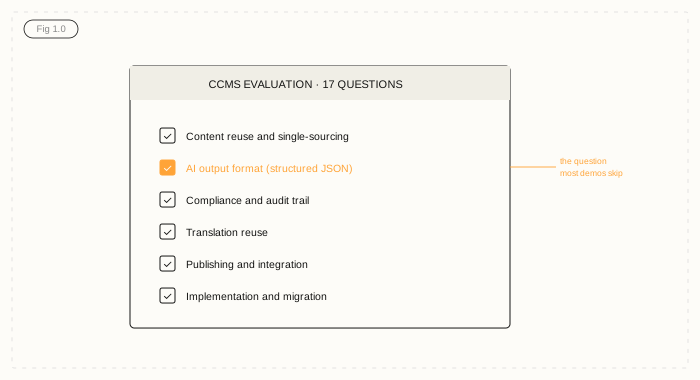
How to use this checklist
Score each vendor's answer to each question from 0 to 3, then weight the categories that matter most to you. A vendor that demos beautifully but scores 0 on AI output or audit trail is a bigger risk than one that scores 2 across the board.
New to the category and want the basics first? Start with what a CCMS is, then come back. If you're building the internal business case alongside the evaluation, the Author-it ROI calculator gives you the cost side in a few minutes. Now, the questions.
Content reuse and single-sourcing
This is the core job of a CCMS. If reuse is weak, everything downstream - translation cost, consistency, AI accuracy - suffers.
- Can we write a component once and reuse it across multiple documents, products, and markets, and does the system track everywhere it's used?
- When we change a shared component, does every document using it update automatically, or do we update copies by hand?
- Does the system surface reuse opportunities as we write, or do authors have to remember what already exists?
AI output and readiness
This is the question most evaluations miss, and the one that will matter most over the next few years. Ask it plainly and watch how specific the answer is.
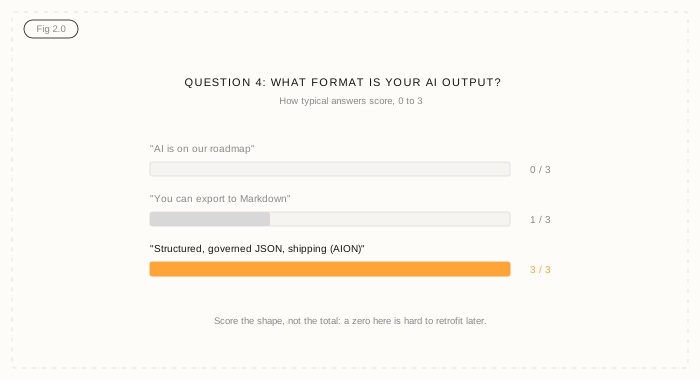
- What format does your AI output use? Is there a structured, machine-readable output built for LLMs and RAG pipelines, and is it shipping today or on a roadmap?
- Can unapproved or draft content reach that AI output, or is there a governance gate that blocks it?
- Does the AI output preserve component metadata, hierarchy, and source paths, or is it flat text an LLM has to guess at?
A vague answer here - "we're exploring AI" or "you can export to Markdown" - is a gap. A structured JSON output like Author-it's AION, with a publishing gate that stops unapproved content reaching it, is what "AI-ready" actually means.
Compliance and governance
If you're in a regulated industry, these three questions are non-negotiable. If you're not yet, you may be sooner than you think.
- Is there a built-in review and approval workflow with a full audit trail, or is approval a bolt-on you have to assemble?
- Can you prove which version of a document was current on a given date?
- Is access role-based, and is every change logged?
Translation and localisation
Translation is where content reuse turns directly into money. The wrong model means paying to translate the same sentence many times.
- When content changes, do we translate only the new or changed components, or re-translate whole documents?
- How many languages are supported, and is translated content reused across every output?
Publishing and integration
Content is only useful where your audience is. Check the system can reach every channel without rework.
- Can we publish the same source to every channel we actually use - PDF, HTML, help, eLearning, and AI-ready output - without reformatting each time?
- Does it integrate with our existing systems, such as PLM, ERP, and downstream tools, via API?
Implementation, migration and support
Most CCMS projects that fail don't fail on the software. They fail on migration, information architecture, and training. Ask who actually does that work.
- What does migration from our current tools actually look like, and who does the work - us or you?
- Is implementation services-led, with content strategy and information architecture support, or self-serve only?
- What's a realistic time to our first published output, and to full rollout?
Total cost of ownership
Sticker price is the smallest part of the number. Ask for the three-year picture.
- What's the total cost over three years, including implementation, training, per-seat pricing at our scale, and the translation savings that offset it?
The checklist gets you through the demo. If you're building a formal shortlist, the 2026 CCMS evaluation guide adds the scorecard and the cost, lock-in and AI-readiness questions most buyers miss.
Scoring the answers
Add up each vendor's scores, then look at the shape, not just the total. A high average with a zero on compliance or AI output is a false comfort - those zeros are the ones that hurt in year two. The questions here are deliberately weighted toward the things that are hard to retrofit: reuse depth, a real governance gate, structured AI output, and services-led implementation.
Author-it has answered these questions for regulated industries for 25+ years, and answers the AI output question with a shipping, structured JSON format rather than a roadmap. To pressure-test your own content before you even shortlist, try the Structured Content Challenge.

CCMS Evaluation FAQ
Q: What should I ask a CCMS vendor before buying?
A: Ask questions that make vendors comparable and expose gaps a demo hides: whether content is genuinely reused and tracked, whether changes propagate automatically, what format the AI output uses and whether it ships today, whether there's a governance gate and full audit trail, how translation reuse works, what channels it publishes to, who does the migration, and the three-year total cost. Weight the answers by what's hard to retrofit later.
Q: What is the most overlooked question in a CCMS evaluation?
A: What format the AI output uses. Many CCMS platforms can describe an AI roadmap but can't show a structured, machine-readable output that's shipping today. Ask whether the system produces structured JSON built for LLMs and RAG pipelines, whether it preserves metadata and hierarchy, and whether unapproved content can reach it. This is the capability that's hardest to add later.
Q: How many CCMS vendors should I evaluate?
A: Three to five is typical. Fewer and you lack a basis for comparison; more and the evaluation stalls. Use a consistent scored checklist across all of them so you're comparing like for like rather than reacting to whichever demo was most polished.
Q: How do I compare CCMS total cost of ownership?
A: Look at three years, not the annual licence. Include implementation and information-architecture work, training, per-seat pricing at your real scale, and the offsetting savings from content reuse and reduced translation. A higher licence with strong reuse often costs less over three years than a cheap tool that leaves you translating duplicate content.
Q: What does "AI-ready" actually mean for a CCMS?
A: It means the system produces structured, governed content that AI can retrieve accurately - not just that it has an AI feature. Concretely: a structured output format built for LLMs and RAG pipelines, metadata and hierarchy preserved, and a governance gate so only approved content reaches the AI. Author-it's AION is an example of a shipping structured JSON output that meets this bar.
Q: Should our CCMS be built on DITA?
A: Not necessarily. DITA gives you a standard and an ecosystem but requires XML expertise and adds toolchain complexity. Structured authoring without DITA can deliver the same reuse and single-sourcing benefits with lower overhead and easier authoring for non-technical contributors. Ask what expertise each approach demands from your team before deciding.
Published on:
Author:
June 28, 2026
Quinn Wright
Head of Sales
Related Resources

Article
Field crew AI: when a wrong answer is a safety risk
Why safety-critical field operations can't run AI on ungoverned content - and what deterministic, traceable answers actually require.
Article
AI-ready content: who has actually shipped it?
A practical field guide to separating AI-ready content marketing from vendors who have actually shipped a structured, governed output for AI.
Article
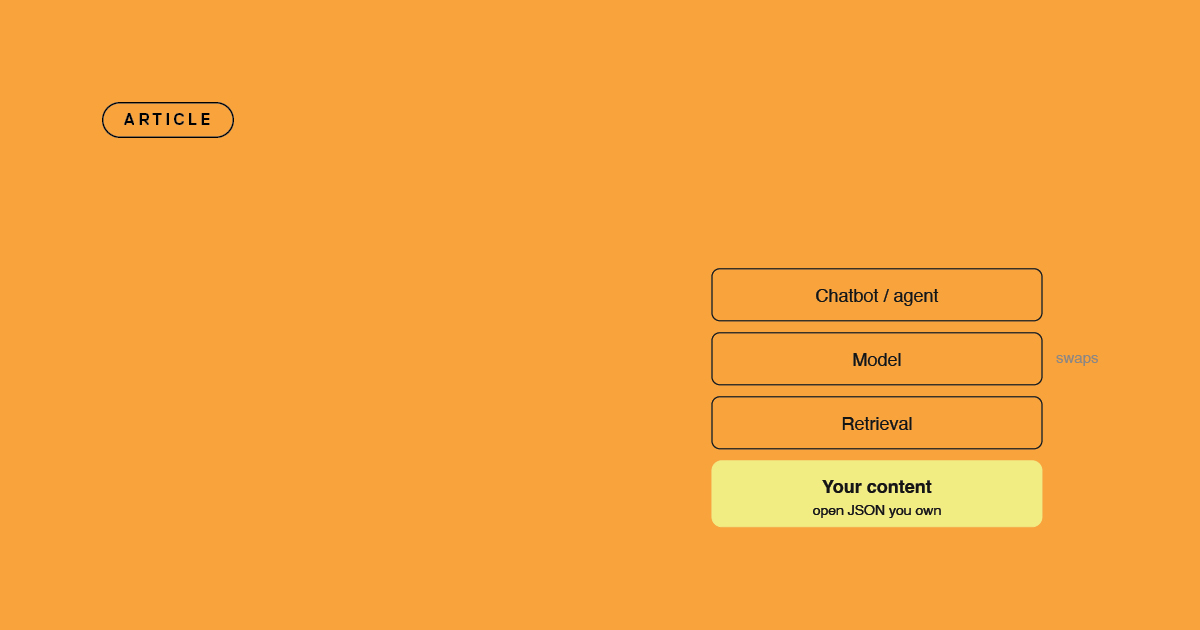
Future-proof your content for an AI stack that changes
Models and tools churn constantly. Future-proof content for AI by owning the one layer that lasts - your content, as open structured JSON.