Article
Content drift: what it is and how to prevent it

Summary:
Content drift is what happens when copies of the same information slowly diverge until no two versions agree - the PDF says one thing, the help centre says another, and the AI assistant confidently repeats a third. It creeps in whenever content is duplicated instead of reused: someone updates one copy, misses the others, and the versions quietly pull apart over months. In an AI world the problem gets worse, because every channel an assistant, a chatbot, or an agent draws from is another place a stale version can live and be served as fact. You prevent content drift by removing the duplicates, not by chasing them. Single-source the content so there is one master version, reuse it everywhere instead of copying, and govern changes so an update flows to every output at once. When there is only one source, there is nothing to drift against - the website, the manual, and the AI all read from the same place.
What is content drift?
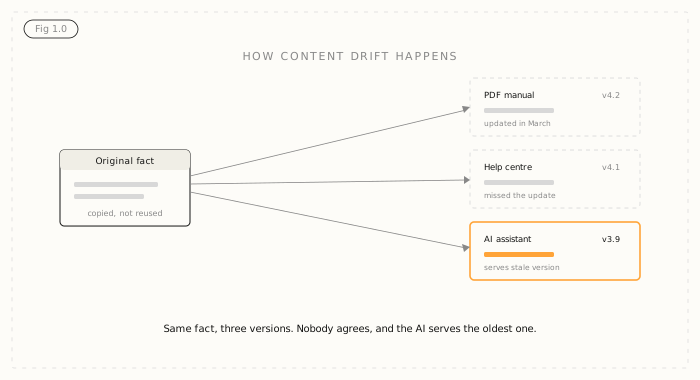
Content drift is the slow divergence of duplicated content. You write something once, copy it into a few places, and over time each copy gets edited on its own. Six months later the PDF, the help centre, and the training deck all say something slightly different, and no one is sure which is right.
It is rarely one big mistake. It is dozens of small, reasonable edits that never made it back to the other copies. Our CCMS and AI glossary lists it next to its close cousins, version soup and documentation debt.
Why content drift is worse in the AI era
Drift used to be a human problem: a customer reads the wrong page, someone spots it, someone corrects it. AI removes that human check. An assistant, a chatbot, or an agent pulls from whatever content it was pointed at, and if that is a stale copy, it repeats the old answer with total confidence - at scale, to everyone who asks.
Worse, each AI channel is one more place a copy can live and drift. This is the content-layer problem behind most enterprise AI infrastructure failures: the model is fine, but it is reading a version that drifted.
How to prevent content drift
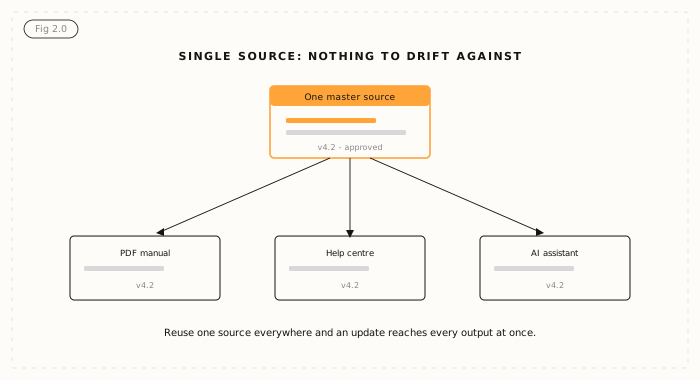
You don't prevent drift by chasing copies. You prevent it by not having copies. Three moves do it.
- Single-source the content - keep one master version of every fact, procedure, and warning.
- Reuse instead of copy - pull the same component into every document and channel rather than pasting a duplicate.
- Govern the change - route edits through review so an approved update flows to every output at once.
When there is one source and everything else references it, an update lands everywhere the moment it is approved. There is nothing left to drift against. This is the practical difference between structured and unstructured content.
Spotting drift before it spreads
A few signs tell you drift is already happening, and each points to the same root cause.
If any of these sound familiar, the fix is structural, not another manual audit. Governance is what keeps it fixed - there is more on that in AI content governance and source of truth.
Where Author-it fits
Author-it is built around single-sourcing, which is the same thing as being built against drift. Content lives once in the Library as a reusable component, gets pulled into every book and output that needs it, and passes through Review and Approve before it publishes.
Update the component and every deliverable that uses it updates too - the PDF, the help site, and the AION output your AI reads from. Because unapproved changes can't publish, your AI can't serve a version you never signed off. See how ready your content is with the Structured Content Challenge.

Content Drift FAQ
Q: What is content drift?
A: Content drift is what happens when copies of the same information slowly diverge over time until no two versions agree. It usually starts when content is duplicated across documents and channels, then each copy is edited separately, so the PDF, the help centre, and the AI assistant end up saying different things.
Q: What causes content drift?
A: The root cause is duplication. When the same content is copied into multiple places instead of reused from one source, every copy becomes something that has to be updated separately. Someone changes one, misses the others, and the versions pull apart - not through one big error but through many small, unsynced edits.
Q: Why is content drift a bigger problem with AI?
A: AI removes the human check that used to catch drift. An assistant or agent repeats whatever content it was given, so a stale copy becomes a confident wrong answer served at scale. Each AI channel is also another place a copy can live and drift away from the source.
Q: How do you prevent content drift?
A: Prevent it by removing duplicates rather than chasing them. Single-source every fact so there is one master version, reuse that source everywhere instead of copying it, and govern changes so an approved update flows to every output at once. With one source, there is nothing left to drift against.
Q: What is the difference between content drift and documentation debt?
A: Content drift is versions of the same content diverging until they disagree. Documentation debt is the accumulated backlog of outdated, missing, or duplicated content you owe time to fix. Drift is one of the main ways documentation debt builds up, but the terms are not identical.
Q: How does single-sourcing stop content drift?
A: Single-sourcing keeps one master version of each component and references it everywhere it is used, instead of copying it. Because there is only one source, an approved change updates every document and channel at once, so copies can never fall out of sync in the first place.
Q: How do you detect content drift?
A: Watch for the signs: two teams citing different numbers, an AI answer that doesn't match the manual, uncertainty over which document is current, or a fix that has to be made in five places. Each points to duplicated content edited separately rather than a single reused source.
Published on:
Author:
July 15, 2026
Jamie Simmonds
Documentation Manager