Article
Agentic AI for documentation: a practical guide

Summary:
Agentic AI for documentation is the use of AI agents that don't just answer questions from your content - they take actions with it, like resolving a support ticket, walking a technician through a repair, or completing a task across several systems. Unlike a simple chatbot that returns a passage, an agent chains steps together and makes decisions along the way, which means it needs content it can trust at every step. That raises the stakes on your documentation. An agent acting on a wrong or outdated procedure doesn't just give a bad answer - it takes a wrong action. For agents to work safely, your content has to be structured so they can retrieve the exact step they need, versioned so they always act on the current one, and governed so they never act on an unapproved draft. Agentic AI doesn't lower the bar for documentation. It raises it.
What is agentic AI for documentation?
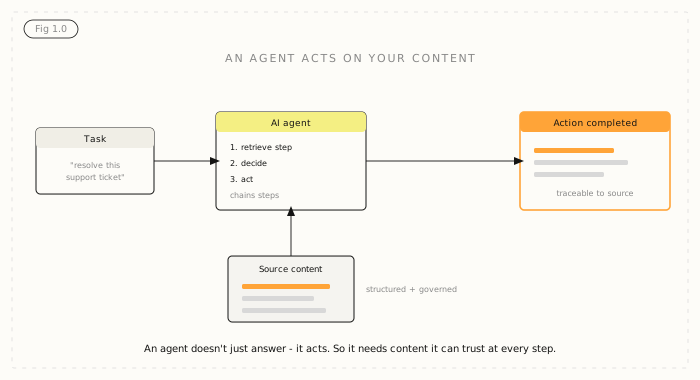
Agentic AI describes AI systems that don't stop at answering - they take actions to complete a goal. Point one at your documentation and it becomes an agent that can resolve a ticket, guide a repair, or update a record, using your content as its instructions.
The difference from a chatbot is doing versus telling. A chatbot retrieves a passage and hands it to a person. An agent reads the same content, decides what to do, and does it - often across several systems. The term is new enough that it barely appears on most vendors' sites, but the shift is real. Our CCMS and AI glossary has the short definition if you want it.
How AI agents use documentation
An agent works through a task in a loop, and your content sits at the centre of it.
- It breaks the goal into steps.
- For each step, it retrieves the relevant content - a procedure, a spec, a rule.
- It decides what to do based on what it retrieved.
- It acts, checks the result, and moves to the next step.
The agent repeats that loop until the task is done. Every pass depends on retrieving the right content, which is the same requirement behind retrieval-augmented generation - just with higher stakes, because the agent acts on what it finds.
Why agents raise the bar on content
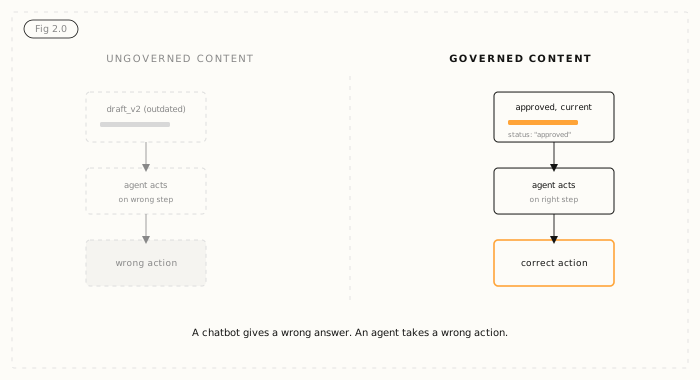
With a chatbot, a wrong answer is annoying and a human can catch it. With an agent, a wrong answer becomes a wrong action - a mis-configured setting, a skipped safety step, a customer told to do the wrong thing. The content requirements get stricter as a result.
This is also why agents belong in the wider enterprise AI infrastructure conversation: they expose a weak content layer faster than anything else.
What agent-ready documentation looks like
Agent-ready content has four properties. It is structured, so an agent can retrieve the exact step rather than a whole document. It is versioned, so it always acts on the current procedure. It is governed, so it never acts on an unapproved draft. And it carries provenance, so every action can be traced back to the source it came from.
Without provenance, you can't audit what the agent did or why - which is a hard stop in any regulated setting. There is more on machine-readable structure in structured content for AI and LLM documentation.
Where Author-it fits
Author-it produces exactly this kind of content. Topics are authored as structured components with metadata, reviewed and approved, then published to AION as structured JSON an agent can query directly - with the object IDs, timestamps, and authorship that give each action its provenance.
The publishing gate means an agent can never reach unapproved content, which is the safety property agentic systems need. See how Author-it powers AI content, or benchmark your own content with the Structured Content Challenge.

Agentic AI FAQ
Q: What is agentic AI for documentation?
A: Agentic AI for documentation is the use of AI agents that take actions using your content, rather than just answering questions from it. An agent can resolve a ticket, guide a repair, or update a record by reading your documentation as instructions, deciding what to do, and doing it - often across several systems.
Q: How is an AI agent different from a chatbot?
A: A chatbot retrieves a passage and hands it to a person to act on. An agent reads the same content, decides what to do, and performs the action itself, often chaining several steps together. That shift from telling to doing is what makes content accuracy far more important for agents.
Q: How do AI agents use documentation?
A: An agent breaks a goal into steps, retrieves the relevant content for each step, decides what to do, acts, then checks the result and moves on. It repeats that loop until the task is complete. Every pass depends on retrieving the correct, current content.
Q: What could go wrong with agentic AI and documentation?
A: If an agent retrieves outdated or unapproved content, it doesn't just give a wrong answer - it takes a wrong action, such as a mis-configured setting or a skipped safety step. Because agents act autonomously, content errors turn into operational errors, which is why governance and versioning matter.
Q: What makes documentation ready for AI agents?
A: Agent-ready documentation is structured so the agent can retrieve the exact step, versioned so it acts on the current procedure, governed so it never uses an unapproved draft, and traceable so every action links back to its source. A Component Content Management System provides all four.
Q: Why do AI agents need content provenance?
A: Provenance lets you audit what an agent did and why by tracing each action back to the specific content it used. Without it, an autonomous action is unexplainable, which is unacceptable in regulated industries. Structured output with object IDs, timestamps, and authorship provides that trail.
Q: Can agentic AI work with PDFs and wikis?
A: It can read them, but PDFs and wikis make agents risky. They chunk badly, rarely carry version or approval status, and offer no provenance, so an agent can act on the wrong or outdated content with confidence. Structured, governed content is far safer for autonomous action.
Published on:
Author:
July 25, 2026
Ben Harris
Marketing Lead