Article
Structured content for AI: how LLMs read your documentation

Summary:
Most enterprise documentation was written for humans - but today, AI agents, RAG pipelines, and internal chatbots read your content before any human does. Unstructured content (Word docs, PDFs, SharePoint folders) makes AI systems hallucinate or fail. Structured content - the kind built with a CCMS - gives machines what they actually need: clean topics, metadata, and consistent formatting that makes retrieval accurate and answers trustworthy. Read more on how Author-it fits into your enterprise AI plans.
The audience nobody planned for
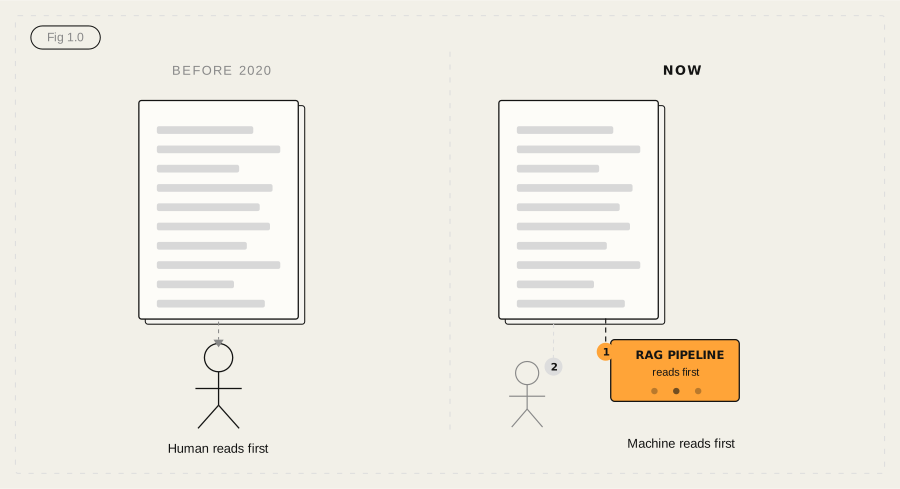
When your technical writers sat down to write a product manual in 2010, they had one audience in mind. Someone would open the document, read it from top to bottom (or search-and-scroll until they found what they needed), and do the thing. Human reader. Human judgment. Job done.
That assumption is broken now.
Before a single employee, customer, or support agent reads your documentation, a machine reads it first. Your internal AI assistant. Your customer-facing chatbot. Your RAG pipeline grounding a Copilot or Claude deployment. All of them need to retrieve, parse, and interpret your content - and they do it completely differently from humans.
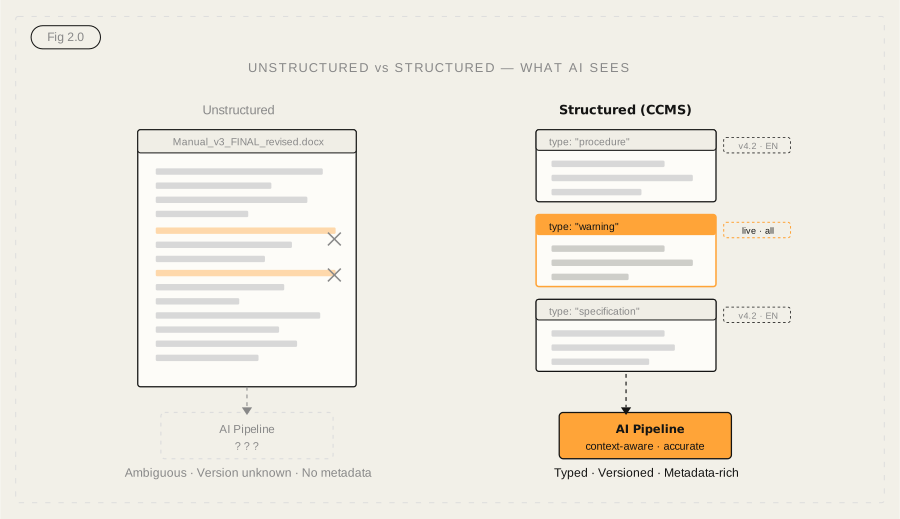
Humans are good at inference. They can read a poorly organised document, skip the boilerplate, find the relevant bit, and make sense of it in context. Machines are not good at inference. They need the content to be clean, labelled, consistently structured, and unambiguous - or they return the wrong answer with complete confidence.
This is the hallucination problem. And for most organisations, the root cause is not the AI model. It is the content.
Most so-called LLM hallucinations inside companies stem from outdated, inconsistent, or poorly structured enterprise content - not from defective models.
That reframe matters. Because it means the fix is not a better model. It is better content.
What machines actually need from content
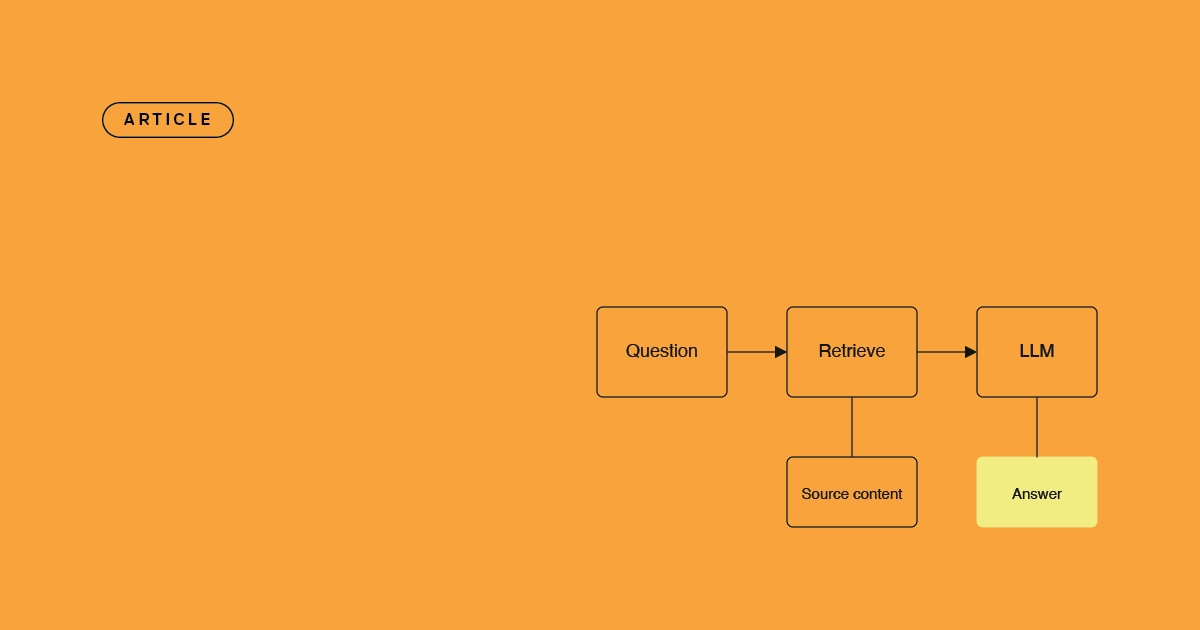
Think about how a RAG pipeline works. A user asks a question. The system searches a vector database of your content, retrieves the most relevant chunks, and passes them to a language model to synthesise an answer. The quality of that answer depends entirely on what gets retrieved - and what gets retrieved depends on how well your content is structured and labelled.
Here is what trips most RAG systems up:
- Version ambiguity - multiple documents covering the same topic with no clear indication of which is current
- Context loss - content pulled out of a larger document loses all its surrounding structure and meaning
- Implicit relationships - a human reader understands that step 3 follows step 2, but a retrieval system sees two separate chunks with no explicit connection
- Inconsistent terminology - the same concept referred to by three different names across three different documents
- Missing metadata - no topic type, no product version, no audience tag, nothing to help the retrieval layer decide what is relevant
Structured content solves all of these problems - not because it was designed for AI, but because these are exactly the problems it was designed to solve for human content operations at scale.
A CCMS enforces consistent topic types. It maintains explicit version state. It stores components with metadata. It maintains relationships between pieces of content. It prevents the same concept from existing in five slightly different forms across five different documents.
In other words: structured content gives machines what they need to work accurately.
The companies that are already ahead
Here is the uncomfortable truth for most organisations evaluating AI right now: the companies with the best content infrastructure for AI are not the ones that started an AI strategy in 2024. They are the ones that invested in structured, governed content operations five, ten, or twenty years ago.
They did not do it for AI. They did it because managing thousands of documents across multiple product lines, multiple languages, and multiple regulatory regimes required a system. They built that system. And now - without any additional work - their content is in significantly better shape for AI retrieval than organisations that have been living with unstructured document chaos.
This matters enormously for the organisations now trying to build RAG pipelines, deploy Copilot, or stand up an internal AI knowledge base. If your content foundation is SharePoint folders and Word documents with no version control, no metadata, and no consistent structure, you are not going to get reliable AI output. You are going to get hallucinations that erode trust, and a rollout that stalls.
The fix is not prompt engineering. It is content engineering.
What structured actually means in practice
Structured content is often misunderstood as writing in XML or using DITA. Those are implementation choices. The underlying concept is simpler.
Structured content means:
- Content is broken into discrete, typed components (a warning, a procedure, a specification, a concept) rather than written as continuous prose inside a document template
- Each component has metadata - what it is about, which product version it applies to, what audience it is for, what its review status is
- Components live in a single source and are assembled into outputs - not copied and pasted into separate documents
- Relationships between components are explicit, not implicit - the system knows that this warning applies to these procedures
- Version state is managed - you always know which version of a component is current, approved, and published
None of this is exotic. It is how every mature content operation runs. And it maps almost perfectly to what LLMs and RAG systems need to function accurately.
AION: structured content that ships AI-ready
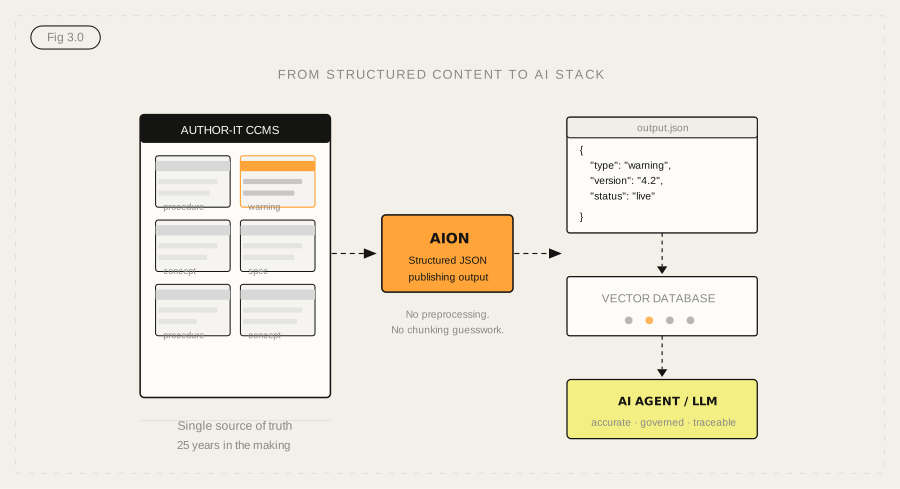
Author-it has spent 25 years building a CCMS on this principle. Single source. Structured components. Governed workflows. And in 2026, that infrastructure got a new output channel: AION.
AION is Author-it's structured JSON publishing format - designed specifically for LLM and RAG ingestion. Instead of generating a PDF or HTML page, it generates a JSON output that preserves the component hierarchy, metadata, version state, and topic relationships that make retrieval accurate.
If you are building an internal AI knowledge base, feeding a RAG pipeline, or deploying an AI agent that needs to draw on technical documentation - AION is the output format that makes that work from day one. You can read more at author-it.com/aion.
What this means if your content is not structured yet
Most organisations are not starting from a place of perfect structured content. A few honest recommendations:
- Start with the content your AI systems will use most - support documentation, product manuals, compliance procedures
- Fix the version problem first - if your AI can retrieve outdated content, it will
- Add metadata before you add AI - even basic topic type and product version tags improve retrieval precision significantly
- Think in components, not documents - that shift unlocks reuse, governance, and AI readiness simultaneously
The Author-it resources section has a growing set of guides on making the transition.

Structured Content FAQ
Q: What is structured content?
A: Structured content is content broken into discrete, reusable components - topics, warnings, procedures, specifications - each with its own metadata. Components live in a single source and are assembled into outputs rather than copied between documents. This makes content consistent, versionable, and machine-readable.
Q: Why does structured content matter for AI?
A: AI systems like RAG pipelines and internal chatbots retrieve content before generating answers. If that content is unstructured - inconsistent terminology, no metadata, no version control, no clear boundaries between topics - retrieval quality drops and hallucinations increase. Structured content gives AI the clean, labelled, bounded chunks it needs to retrieve accurately and answer reliably.
Q: What causes AI hallucinations in enterprise documentation?
A: Most enterprise AI hallucinations are not caused by the model - they are caused by the content it retrieves. Common culprits include multiple versions of the same document with no clear currency indicator, inconsistent terminology across documents, content that loses meaning when extracted from its original context, and missing metadata that prevents the retrieval layer from filtering accurately.
Q: What is a CCMS and how does it help with AI?
A: A CCMS (Component Content Management System) is a platform for authoring, managing, and publishing structured content at scale. It enforces consistent topic types, maintains version state, stores metadata at the component level, and manages relationships between content pieces. These are exactly the properties that make content AI-readable.
Q: What is AION?
A: AION is Author-it's structured JSON publishing output, launched in 2026.R1. It generates a machine-readable JSON export of structured content that preserves component hierarchy, metadata, version state, and topic relationships - designed for direct ingestion into RAG pipelines, LLMs, and AI agents.
Q: Do I need DITA or XML to create structured content?
A: No. Structured authoring principles - typed components, single source, reuse, metadata, version control - do not require DITA or XML. Author-it delivers structured authoring without requiring writers to learn XML or DITA. The structure is enforced by the platform component architecture, not by a markup language.
Q: How do I start making my content AI-ready?
A: Start with the content your AI systems will use most. Fix version ambiguity first. Add basic metadata before adding AI. Then think in components rather than documents - that shift unlocks reuse, governance, and AI readiness at the same time.
Published on:
Author:
April 22, 2026
Osmar Silva
CTO
Related Resources
Article
What is RAG? Retrieval-augmented generation explained
A plain-English guide to retrieval-augmented generation - how RAG grounds AI answers in your content, and what makes that content accurate.
Article
Best CMS for RAG in regulated industries
Why 'best CMS for RAG' lists miss regulated teams - and what governance, provenance, and structured output add to retrieval accuracy.
Guide
How to structure documentation for RAG pipelines
Your RAG pipeline's ceiling isn't the model or the vector database - it's how your source content is structured.