Article
What is enterprise AI infrastructure?

Summary:
Enterprise AI infrastructure is the full stack of systems an organisation needs to run AI reliably at scale: the compute and models, the data and vector stores, the orchestration and security layers, and - most overlooked - the content layer that feeds the models. Most teams picture infrastructure as GPUs, models, and pipelines. But an AI system's answers are only ever as good as the content it can retrieve, and that content layer is where most enterprise AI projects quietly fail. If your source content is unstructured, unversioned, and ungoverned, no amount of compute fixes the output. Enterprise AI infrastructure, done properly, treats content as a first-class part of the stack: structured, single-source, and governed, so every model, agent, and pipeline draws from an accurate, traceable foundation. Think of it as plumbing. The models are the taps, but the content is the water - and nobody notices the pipes until the water runs dirty.
What is enterprise AI infrastructure?
Enterprise AI infrastructure is everything an organisation needs to run AI reliably beyond a single chatbot demo. It spans compute and models, the data stores and retrieval systems that feed them, the orchestration that ties services together, the security and governance that keep it safe, and the content that the models actually answer from.
The mistake most teams make is treating infrastructure as a hardware and model problem. In practice the hardest part is rarely the model - it is getting trustworthy content into it. For a quick primer on the pieces, our CCMS and AI glossary defines the common terms.
The layers of the AI stack
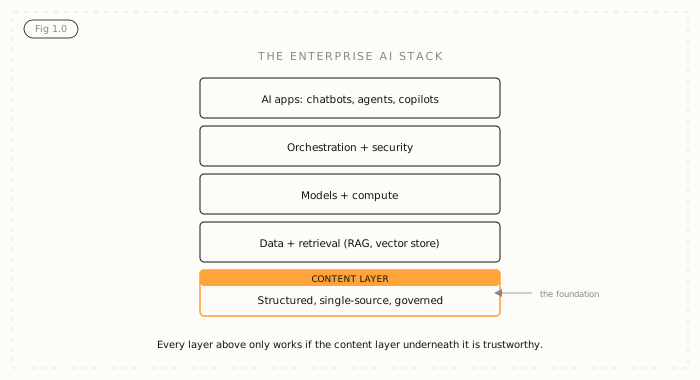
It helps to see the stack as distinct layers, each doing one job.
Every layer matters, but they fail differently. A weak model gives you a slightly worse answer. A weak content layer gives you a confident, wrong one - and often no way to tell it apart from a right one.
The layer everyone forgets: content
Compute is a purchasing decision. Models are largely a commodity you can swap out as better ones ship. The content layer is the part you actually own, and the part that decides whether the whole system can be trusted.
When an AI answers a customer, an internal agent, or an auditor, it is repeating your content back - structured or not, current or not, approved or not. That is why we describe structured content as the AI content foundation: the grounding layer the rest of the stack depends on. It connects directly to what RAG is and why retrieval only works with good content.
Why AI projects stall on the content layer
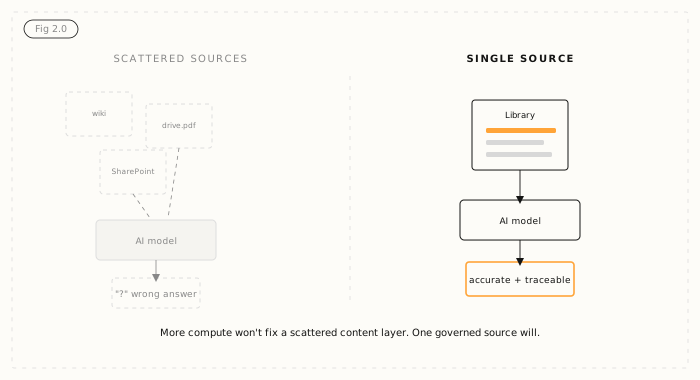
Most stalled enterprise AI projects trace back to the same place. The content is scattered across wikis, shared drives, and PDFs, so there is no single source to point the system at. Versions have drifted, so the system can't tell which answer is current. And nothing is governed, so an unapproved draft is as visible to the AI as the signed-off truth.
We unpack the governance side in AI content strategy and source of truth. Buying more compute does not fix any of it.
What good looks like
A healthy content layer has three traits. It is structured, so machines can parse and retrieve it precisely. It is single-source, so there is exactly one current version of anything. And it is governed, so only approved content ever reaches a model.
Get those right and the rest of the stack has something solid to stand on. Get them wrong and you are automating the delivery of bad answers. The same structure powers your taxonomy and knowledge graph work, which is how machines understand how your content fits together.
Where Author-it fits
Author-it is a Component Content Management System that has treated content as structured, single-source, and governed for 25 years - long before it was an AI requirement. Content is authored as reusable components, reviewed and approved, then published to AION, a structured JSON output built for direct ingestion by models, RAG pipelines, and agents.
The publishing gate means unapproved content provably cannot reach that output, so the content layer of your AI stack is trustworthy by design. See the AI content foundation overview for the bigger picture, or run the Structured Content Challenge to see how ready your content layer is today.

AI Infrastructure FAQ
Q: What is enterprise AI infrastructure?
A: Enterprise AI infrastructure is the full stack of systems needed to run AI reliably at scale: compute and models, data and retrieval systems, orchestration, security and governance, and the content layer the models answer from. Its purpose is to make AI outputs accurate, secure, and traceable across the organisation.
Q: What are the layers of an enterprise AI stack?
A: A typical stack has five layers: AI applications like chatbots and agents at the top, orchestration and security, the models and compute, the data and retrieval systems such as vector databases, and the content layer underneath. Each layer depends on the quality of the one below it.
Q: Why do enterprise AI projects fail?
A: Most fail on the content layer, not the model. Source content is scattered across systems, versions have drifted so nothing is clearly current, and nothing is governed, so unapproved drafts are as visible to the AI as approved content. The result is confident, wrong answers that more compute cannot fix.
Q: Is content part of AI infrastructure?
A: Yes. Content is the layer the models actually answer from, which makes it as much a part of the infrastructure as compute or storage. An AI system repeats your content back to the user, so if that content is unstructured, unversioned, or ungoverned, the whole stack produces untrustworthy output.
Q: What is the content layer in AI?
A: The content layer is the source material an AI system retrieves from and answers with. In a well-built stack it is structured, single-source, and governed, so retrieval is precise and every answer traces back to approved content. Author-it calls this the AI content foundation.
Q: How do you make content ready for enterprise AI?
A: Make it structured so machines can parse and retrieve it, single-source so there is one current version, and governed so only approved content reaches a model. A Component Content Management System does this by design, authoring content as reusable components with review and approval before publishing.
Q: Do you need new infrastructure to adopt AI?
A: Not necessarily new compute or models - those are increasingly commodities. What most organisations are missing is the content layer: a single, structured, governed source the AI can draw from. Fixing that is usually higher impact than adding hardware, because it is what determines answer quality.
Published on:
Author:
August 4, 2026
Adrian Winks
CEO