Article
When does a company need a CCMS? Five triggers

Summary:
A lot of teams sense they've outgrown documents-in-folders but can't point to the moment it became true. This guide gives you five specific triggers, with thresholds, that signal it's time for a CCMS, and what each one costs if you ignore it. One trigger is a watch item; two or more usually means the case makes itself. The common thread is the same: content that has to reuse, scale, comply, and now feed AI needs a system, not a shared drive.
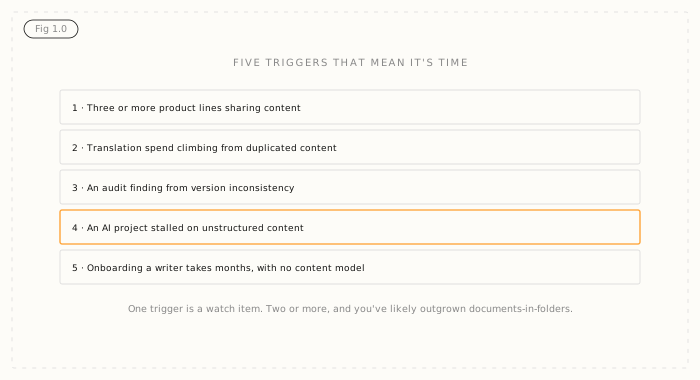
The five triggers
If you're already comparing systems, the CCMS evaluation checklist pairs well with the triggers below. Here's what to look for.
Trigger one: you manage three or more product lines that share content. Once the same warning, spec, or procedure lives in multiple product docs, copy-paste maintenance becomes a tax you pay forever.
Trigger two: translation spend is climbing because you re-translate duplicated content. If you're paying to translate the same sentence for every product and market, reuse would cut that directly.
Trigger three: you've had an audit finding, or a near miss, from version inconsistency. If you can't prove which version was current, that's not a paperwork problem - it's a compliance exposure.
Trigger four: an AI project has stalled because your content isn't machine-readable. If your chatbot or copilot returns wrong or inconsistent answers, the content layer is usually why.
Trigger five: onboarding a new writer takes months because there's no content model. If productivity depends on tribal knowledge, you don't have a system, you have a habit.
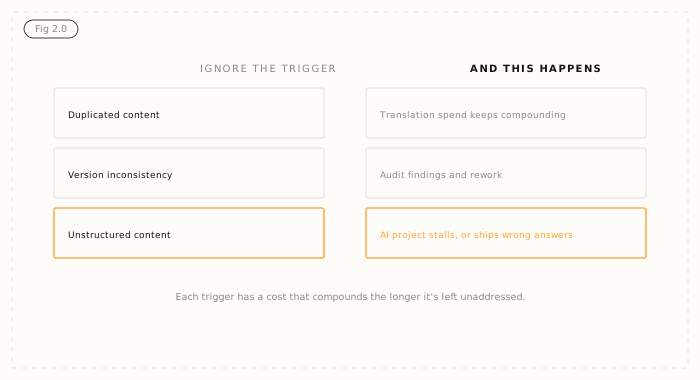
What it costs to ignore them
None of these triggers is fatal on its own, which is exactly why they get deferred. The cost is that each one compounds. Duplicated content makes translation more expensive every release. Version inconsistency turns one audit finding into a pattern. A stalled AI project either burns budget or ships wrong answers to customers. The longer the trigger sits, the more expensive the eventual fix.
How to act on it
If one trigger applies, put it on the watch list and quantify it. If two or more apply, it's worth building the business case now rather than after the next audit or failed AI pilot. Turning vague unease into specific questions is the first step. The 2026 CCMS evaluation guide is the second - it scores vendors on the questions that actually decide the fit.
Where Author-it fits
Author-it addresses all five triggers with the same foundation: component reuse and single-sourcing (triggers one and two), version control and a built-in audit trail (trigger three), a structured AI output via AION (trigger four), and a clear content model with services-led onboarding (trigger five). It has done this in regulated industries for 25+ years. To see how far your content is from that, run the Structured Content Challenge.

CCMS Triggers FAQ
Q: When does a company need a CCMS?
A: When specific triggers appear: three or more product lines sharing content, translation spend climbing from duplication, an audit finding from version inconsistency, an AI project stalled on unstructured content, or writer onboarding that takes months for lack of a content model. One trigger is a watch item; two or more usually means the business case makes itself.
Q: What are the signs you've outgrown shared-drive documentation?
A: The same content copy-pasted across product docs, translation costs rising from duplicated content, uncertainty about which version is current, AI initiatives returning inconsistent answers, and new writers taking months to become productive. These are the points at which documents-in-folders becomes a tax rather than a tool.
Q: How many triggers mean it's time for a CCMS?
A: One trigger is worth watching and quantifying. Two or more applying at once is usually the point to build the business case, because the triggers compound each other - duplicated content raises translation cost and version risk together, for example - and the eventual fix gets more expensive the longer you wait.
Q: What does it cost to delay adopting a CCMS?
A: Each trigger compounds. Duplicated content makes every translation cycle more expensive, version inconsistency turns one audit finding into a pattern, and a stalled AI project either burns budget or ships wrong answers to customers. The cost isn't a cliff, it's a slope that steepens the longer the triggers go unaddressed.
Q: Does needing a CCMS mean adopting DITA?
A: No. Needing a CCMS is about reuse, governance, and scale, not about a specific standard. Structured authoring without DITA delivers the same reuse and single-sourcing benefits without requiring XML expertise. Whether DITA is right for you is a separate question from whether the triggers say you need a CCMS.
Q: How does a CCMS address these triggers?
A: One foundation covers all five: component reuse and single-sourcing address multiple product lines and translation cost, version control and an audit trail address version inconsistency, a structured AI output like AION addresses stalled AI projects, and a clear content model with guided onboarding addresses slow writer ramp-up.
Published on:
Author:
June 20, 2026
Ben Harris
Marketing Lead
Related Resources

Article
The CCMS reckoning: six priorities for the AI era
A response to the industry's CCMS reckoning: the six priorities content leaders now face, and an honest look at which are shipped versus roadmap.

Article
Content lock-in: the exit tax nobody budgets for
The cost of leaving a content platform rarely makes the business case - until you try to switch. Here is the exit tax, and how open output removes it.

Article
The real cost of DITA - and when you don't need it
The cost of DITA is mostly staffing and process. Here is where it hides - and how to get topic reuse and single-source publishing without XML.