Article
Content lock-in: the exit tax nobody budgets for

Summary:
Content vendor lock-in is the cost of leaving a platform when your content only truly lives inside it. That cost is real and rarely budgeted. When content is held in a proprietary format or a hosted hub, exit means exporting it, rebuilding structure the export dropped, re-tagging and re-linking, retraining the team, and running two systems while you migrate. Those costs do not appear on the invoice, so they are easy to ignore until you want to switch - at which point they quietly keep you where you are. Lock-in has also moved up a level: the same trap now applies to AI, where content tied to one vendor's delivery hub cannot easily feed another. The hedge is ownership. Content held in an open, structured format you control - portable JSON, not a proprietary export - has a near-zero exit cost, because there is nothing to migrate. Author-it's AION output is built to keep that option open.
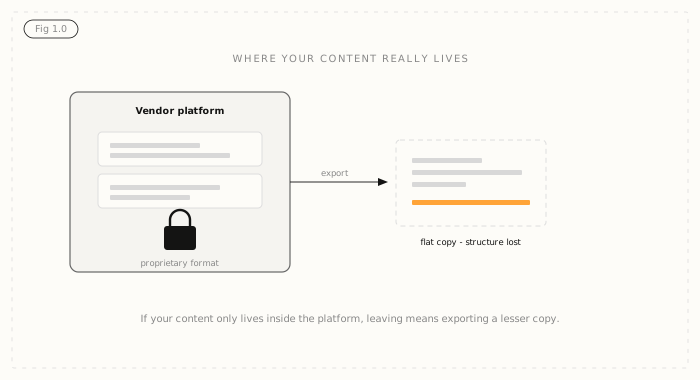
What content lock-in actually is
Content vendor lock-in is what happens when your content only truly lives inside one platform. On paper you own the content. In practice, the version that is structured, tagged, linked, and usable exists only inside the vendor's system, in the vendor's format. Getting a clean, equivalent copy out is harder than anyone expects.
This is not the same as a bad vendor. A platform can be excellent and still lock you in - lock-in is about the format and the exit path, not the quality of the software. The test is simple: if you had to leave tomorrow, how much of your content's value would survive the move?
Where the exit tax hides
The reason lock-in persists is that its cost is invisible until you try to leave. None of it shows up on the annual invoice, so it rarely makes the business case. Here is where it actually lands.
Add these up and "we'll switch later" quietly becomes "we can't afford to switch." That is the exit tax - and it is highest exactly when you most want out. For a related hidden-cost trap, see our guide on build versus buy for a CCMS.
Lock-in just moved up to the AI layer
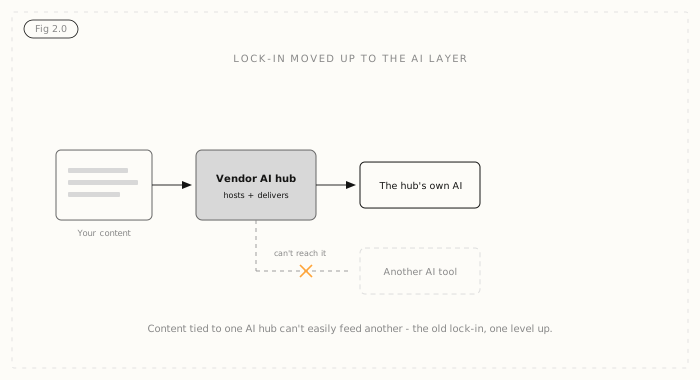
The same trap has reappeared one level up, around AI. A growing number of platforms will host your content and deliver AI from it - search, chat, retrieval. Useful, but the content's AI value now lives inside that hub. Feeding a second AI tool, switching models, or leaving means the same extraction and rebuild you would face with any proprietary system.
So the lock-in question is no longer just "can we move our documents." It is "can our content feed any AI we choose." If the answer depends on one vendor's hub, you have re-created the old problem in a new place. We unpack that specific case in own your AI output, don't rent a delivery hub.
How open output changes the math

Ownership is the hedge, and it is more concrete than it sounds. If your content is held in an open, structured format you control - portable JSON with its hierarchy, typing, and provenance intact - then leaving is not a migration. There is nothing to extract, because you already hold the usable copy. Switching tools becomes a connection, not a project.
That single property changes how you buy. When exit cost is near zero, you are never trapped by a repricing, an acquisition, or a better option appearing. You keep leverage with your vendor and optionality for your roadmap. It is also what keeps your content future-proof as your AI stack changes.
How to check your lock-in exposure
You can gauge your exposure in a few honest questions.
- If you left tomorrow, what format does your content come out in - and how much structure survives the export?
- Can your content feed a second system or AI tool today, or only the one you bought it in?
- Where does the governed, usable version live - in a format you hold, or only inside the vendor?
- What would exit actually cost in people, time, and parallel running - and is that number in any plan?
If those answers make you uncomfortable, that discomfort is the exit tax you have not priced yet.
Where Author-it fits
Author-it is a CCMS, so your content is structured and single-source by design - but the lock-in answer is in the output. AION publishes your governed content as open structured JSON that you own outright, portable across any system or AI tool. The usable, structured copy is yours, not trapped in a format only Author-it can read.
That is a deliberate stance: earn the renewal on the product, not on the difficulty of leaving. To put real numbers on a switch, use the ROI calculator, or benchmark your current setup with the Structured Content Challenge.

Content lock-in FAQ
Q: What does vendor lock-in cost in content management?
A: The cost is mostly the exit tax - what it takes to leave. That includes exporting content and cleaning it up, rebuilding structure and links the export dropped, re-tagging metadata, retraining the team, and running two systems in parallel during the migration, plus the content work frozen while it happens. None of it appears on the invoice, so it is usually unbudgeted until you try to switch.
Q: What is content lock-in?
A: Content lock-in is when your content only truly lives inside one platform, in that vendor's format. You may own the content on paper, but the structured, tagged, usable version exists only inside the system, so getting a clean equivalent out is hard. It is about the format and the exit path, not whether the software is good.
Q: Why is the cost of switching content platforms so hard to see?
A: Because it never shows up on the annual invoice. The licence fee is visible; the export, rebuild, re-linking, retraining, and parallel running are not. So the business case captures the price of staying but not the price of leaving, and the exit cost only becomes real at the exact moment you want to move.
Q: How does lock-in apply to AI?
A: The same trap has moved up to the AI layer. Platforms that host your content and deliver AI from it put your content's AI value inside their hub. Feeding another AI tool, switching models, or leaving then means the same extraction and rebuild as any proprietary system. The question becomes whether your content can feed any AI you choose, or only the vendor's.
Q: How do you avoid content vendor lock-in?
A: Own your content in an open, structured format you control, with its hierarchy, typing, and provenance intact, rather than only inside a vendor's proprietary system or hub. If you already hold the usable copy, leaving is a connection rather than a migration, and your exit cost stays near zero.
Q: Does owning open output really make switching free?
A: Close to it. If you already hold your content as portable, structured output, there is nothing to extract and little to rebuild, so the dominant migration costs disappear. You will still do integration work to connect a new tool, but that is a connection, not a re-creation of your content - a fraction of a typical migration.
Q: How does Author-it reduce lock-in?
A: Author-it is a CCMS, so content is structured and single-source, and AION publishes it as open structured JSON you own outright - portable across any system or AI tool. The governed, usable copy is yours, not trapped in a format only Author-it can read, so switching or feeding a new AI tool does not require a migration.
Published on:
Author:
July 14, 2026
Ben Harris
Marketing Lead
Related Resources

Article
Content lock-in: the exit tax nobody budgets for
The cost of leaving a content platform rarely makes the business case - until you try to switch. Here is the exit tax, and how open output removes it.

Article
The real cost of DITA - and when you don't need it
The cost of DITA is mostly staffing and process. Here is where it hides - and how to get topic reuse and single-source publishing without XML.
Article
Content debt: what it costs and how to fix it
Like technical debt, content debt charges interest - and now it breaks your AI too.