Article
AI-ready content: why structure alone isn't enough

Summary:
Valid, well-structured content can still give an AI the wrong answer. That happens when a fact the AI needs is missing, when metadata only controls publishing, or when meaning is lost on the way out. AI-ready content keeps each fact in one approved place, uses metadata to describe what the content means, and publishes to the AI in a structure it can trace. Author-it does all three out of the box, with no XML for authors and no customization project before you start.
The question your team is being asked
If you went to a content conference this year, you heard some version of this: structure your content properly and your AI will stop making things up. It is a good message, and mostly a true one. Unstructured prose makes a language model guess, and guessing is where hallucinations come from.
The version that reaches the boardroom tends to be shorter: "pick the right standard and your content is AI-ready." Documentation leaders are now being asked, by their own executives, whether the platform they already own is the right one for AI.
It is a fair question. The honest answer is that the format matters less than three things the format does not guarantee.
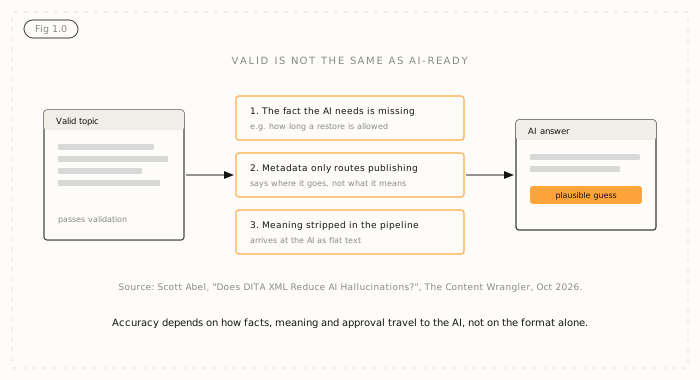
Even DITA's own experts say "not on its own"
This month Scott Abel of The Content Wrangler, one of the most respected voices in structured content, asked directly: does DITA XML reduce AI hallucinations? His answer was, in short, not by itself. It is worth ten minutes of anyone's time, and it makes three points every content team should take seriously, whatever platform they use.
1. Valid content can still leave out the fact the AI needs
A topic can pass every validation rule and still omit a prerequisite, a dependency or a limit. Abel's example is a task for restoring deleted projects that never says how long a trial user has to do it. A person might know the answer from context. An AI will fill the gap with something plausible.
2. Most teams use metadata only to control publishing
Metadata usually decides which audience, product or output a topic goes to. It rarely tells a reader, human or machine, when an instruction applies or what a value means. That is the information an AI needs most.
3. Meaning gets stripped out before the AI sees it
Between the source and the model sit a publishing pipeline, a transform and usually a chunker. Each step can flatten what the author meant. Content that was carefully modelled in the repository can arrive at the AI as a wall of text.
None of these are problems with a standard. They are problems with how facts, meaning and approval travel from the author to the AI. That is where AI readiness is won or lost.
What AI-ready content actually needs
If the format alone is not the answer, what is? Working back from Abel's three gaps, AI-ready content needs four properties.
- Each fact lives in one place. A retention period, a torque value or a support limit is held once as an approved value, not retyped in forty topics.
- Metadata describes meaning, not just routing. The AI can tell what a value is and which product, region or version it applies to.
- Only approved content reaches the AI. Drafts and superseded versions never become answers.
- Structure survives publishing. The AI receives the hierarchy, the resolved values and a stable ID for every topic, so every answer can be traced back to its source.
The test is simple. Pick one critical fact in your documentation and ask: where does it live, who approved it, and could an AI tell you where its answer came from?
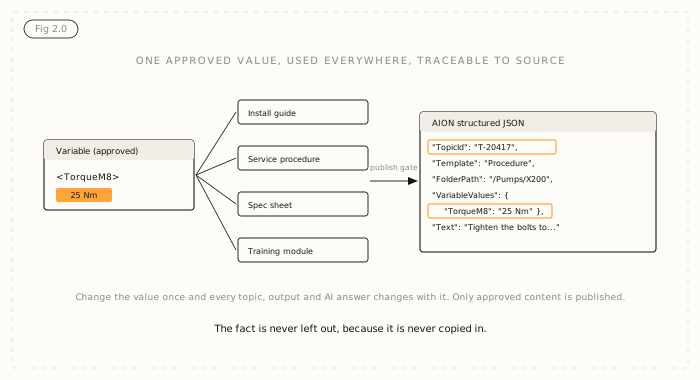
How Author-it delivers this out of the box
Author-it has produced structured, single-sourced, governed content for more than 25 years. The structure AI needs is what the platform was built to produce, so none of the following is a project you have to start before you see value.
Your model is configuration, not a specialization project
In an XML standard, modelling content that does not fit the default types usually means planning and building specializations, then maintaining them. In Author-it, you shape the model to your own products and knowledge through templates, variables and variant criteria such as product, region or release. That is configuration, with no code, and your administrators own it.
Facts live in one place
Variables hold a value such as a retention period or a torque setting once, as a single approved value. Every topic that needs it references the variable, and the value is resolved when content is published. Change it once and every topic, every output and every AI answer changes with it. That closes the first of Abel's gaps: the fact is not left out, because it is never copied in the first place.
Governance is the gate
Release states and permissions are defined by each organization and control what can be edited, reviewed and published. Content has to pass that gate to be published, and that includes publishing for AI. Unapproved content cannot reach the AI's source.
AION publishes structure the AI can use
AION is Author-it's structured JSON output for AI and retrieval pipelines. Instead of flattening content into text, it publishes the hierarchy of books and topics, clean Markdown text, the template type, the resolved variable values, the folder path, last-modified detail and a stable ID for every topic. The AI receives what the author meant, not a scrape of what the page looked like, and every answer can point back to a specific, approved topic.
Writers write
Authors work in a familiar editor. There is no XML to learn, so their time goes on what the content says, which is the part that decides whether the AI gets it right.
Same outcome, far less effort
DITA is a respected standard, and many teams run it well. This is not an argument against it. It is an argument about effort. The outcome AI needs, one approved fact delivered with its meaning and its source, does not require a specialization project, an XML learning curve or a custom pipeline to rebuild the meaning your publishing step removed.
If you already use Author-it, you are not behind. You are already doing what this year's conference sessions are teaching teams to build. The work now is to get the most from it: move critical facts into variables, use your metadata to say what content means, and publish to AION.
If you are evaluating platforms for AI, ask every vendor the same three questions. Where does each fact live? What stops a draft reaching the AI? Can every answer be traced to an approved source? The answers will tell you more than the format on the data sheet.
Check your own content
Take the Structure Challenge to see how your content would hold up, or see what AION output looks like. If you are an Author-it customer and your team is being asked about AI readiness, talk to your account manager. We are happy to walk through your content with you.

AI-ready content FAQ
Q: Does DITA reduce AI hallucinations?
A: Not on its own. Valid DITA can still leave out a fact the AI needs, use metadata only to control publishing, or lose meaning in the publishing pipeline. Structure helps, but accuracy depends on how facts, meaning and approval reach the AI.
Q: What makes content AI-ready?
A: AI-ready content keeps each fact in one approved place, uses metadata to describe what content means, lets only approved content reach the AI, and publishes in a structure that keeps the hierarchy and a stable ID for every topic so answers can be traced.
Q: Do I need DITA to prepare content for AI?
A: No. The outcome AI needs is governed, structured content with traceable sources. Author-it delivers that without DITA or XML authoring, using configuration rather than specialization projects.
Q: How do variables help AI accuracy?
A: A variable holds a value such as a retention period or torque setting once, as a single approved value. Every topic references it, so the fact is never copied, never out of date in one place, and resolved consistently in every output, including AI output.
Q: What is AION?
A: AION is Author-it's structured JSON publishing output for AI and retrieval pipelines. It publishes the content hierarchy, clean Markdown text, template type, resolved variable values, folder path, last-modified detail and a stable ID for every topic.
Q: Can unapproved content reach the AI through AION?
A: No. Content must pass its release-state gate to be published, and AION is a published output. Drafts and unapproved content cannot reach AION output.
Q: We already use Author-it. Is our content AI-ready?
A: The foundations are already in place: single-sourced topics, variables, release states and AION output. The practical next steps are moving critical facts into variables, using metadata to describe meaning, and publishing to AION.
Published on:
Author:
October 13, 2026
Related Resources
Article
AI-ready content: why structure alone isn't enough
Even DITA's own experts say structure alone won't stop AI hallucinations. Here are the three gaps, and what actually closes them.

Article
The CCMS reckoning: six priorities for the AI era
A response to the industry's CCMS reckoning: the six priorities content leaders now face, and an honest look at which are shipped versus roadmap.
Article
AI-ready content: who has actually shipped it?
A practical field guide to separating AI-ready content marketing from vendors who have actually shipped a structured, governed output for AI.