Article
What EU right to repair means for HVAC makers

Summary:
From 31 July 2026, the EU right to repair directive turns repair information into documentation you have to publish and keep current. Under Directive (EU) 2024/1799, HVAC manufacturers must run a free repair web page, guarantee spare-parts availability, and share maintenance and disassembly instructions. The Digital Product Passport then adds these as structured data fields. The catch: this content has to stay accurate across every market and language for years after a model ships. Producing and maintaining it by hand doesn't scale, which is why makers are moving to a single source for HVAC documentation.
What changes on 31 July 2026
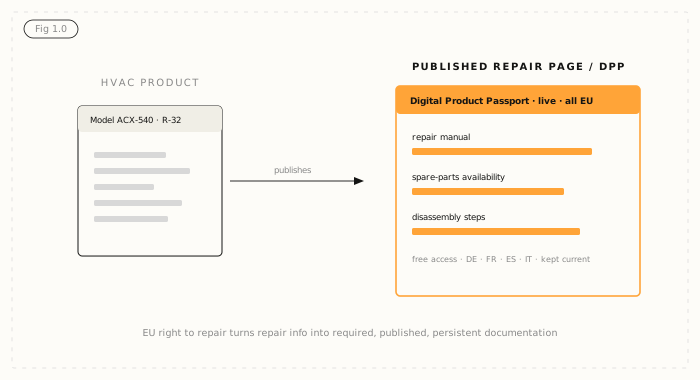
Directive (EU) 2024/1799, the EU right to repair directive, comes into force on 31 July 2026 across all 27 member states. It moves repair from a service you might offer to an obligation you have to document. For HVAC makers, three things become mandatory: a free-access web page that explains how to repair the product, a guarantee that spare parts stay available for a defined period, and clear maintenance and repair information for the people doing the work.
This isn't a PDF you send when someone asks. It's published content that has to be live, findable, and correct the day a regulator or an installer looks for it. That single shift - from on-request to always-published - is what most documentation teams are unprepared for.
The directive sits on top of the wider EU compliance web HVAC makers already navigate: Ecodesign and energy labelling, the F-Gas Regulation, and CE marking. What's new is that repair information stops being a supporting document and becomes a regulated output in its own right. If you sell into the EU, it applies to the products in scope regardless of where you manufacture them.
The repair documentation you now have to publish
The directive names specific repair information obligations, and each one is a piece of documentation you have to produce and keep current. Here's how the old approach compares with what's now required.
None of these are one-off tasks. Each field has to hold true for the life of the product, in every language, on every market's page.
Why the Digital Product Passport raises the stakes
The Digital Product Passport (DPP) is what makes these obligations stick. Phasing in from 2026 under the EU's Ecodesign for Sustainable Products Regulation, the DPP attaches a set of structured data fields to each product - and repair manuals, spare-parts availability periods, and disassembly instructions are among them.
These fields are machine-readable, tied to the product's identity, and expected to persist and stay accurate for years. That's where compliance stops being a launch task and becomes an ongoing one. Every model, every variant, every language needs its passport fields kept live. If you want to see how that maps to records a regulator can inspect, we cover it in keeping HVAC compliance documentation audit-ready.
Why scattered files can't keep this current
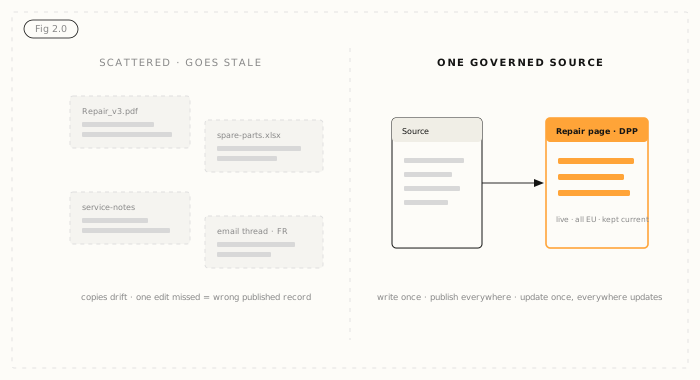
Here's the problem most HVAC makers are about to hit. Repair information today lives in scattered places: a manual in one PDF, spare-parts data in a spreadsheet, disassembly steps in an engineer's service notes, translations sitting in email threads.
A single product line can run to thousands of configurations - series, tonnage, refrigerant, voltage - each needing docs that match. When a spare part is superseded or a procedure changes, someone has to find and update every copy, in every language, on every market's page. Miss one and the published record is wrong, which under the new rules is a compliance gap, not a typo. Manual maintenance across manufacturing documentation at that scale doesn't hold up.
The costs compound quietly. Translation gets redone for content that never changed. Two teams publish slightly different repair steps for the same unit. A model reaches end of production but its spare-parts page still has to be maintained for years. None of this is dramatic on its own, but across a full catalogue it's the difference between a team that keeps up and one that's always behind.
What good looks like: one governed source
The fix isn't more people copying files between systems. It's structured authoring and single-source publishing. You write each repair procedure, spare-parts entry, and disassembly step once as a reusable component, then publish it to the free repair web page, the Digital Product Passport fields, service PDFs, and every language from that one source. Change the component once and every output updates together.
A Component Content Management System is built for this. Author-it manages content as components, reuses them across product lines, and runs translation so only new or changed content gets sent out - one global manufacturer cut translation costs by up to 90% and reuses 60-70% of its content this way. Its publishing gate governance means unapproved content can't reach a published output, so what's on your repair page has been reviewed first.
If you're weighing tools, our guide to the best CCMS for regulated industries walks through what matters. And for teams feeding this content into machine-readable passports and AI systems, AION structured JSON output publishes the same source in a format downstream systems can consume. The obligations arrive on 31 July 2026 whether or not your content is ready. A single, governed source is how you meet them without a documentation team drowning.

EU right to repair HVAC FAQ
Q: What documentation does the EU right to repair directive require from HVAC manufacturers?
A: The EU right to repair directive, Directive (EU) 2024/1799, applies from 31 July 2026 across all 27 member states and turns repair information into required, published documentation. HVAC manufacturers must run a free-access web page that explains how to repair the product, guarantee the availability of spare parts for a defined period, and provide clear maintenance and repair instructions. From 2026 the Digital Product Passport phases these obligations in as structured data fields, including repair manuals, spare-parts availability periods and step-by-step disassembly instructions. This EU right to repair HVAC documentation has to stay accurate across every market and language you sell in, for years after a model ships. Because the content is published and persistent, a single-source approach like Author-it's Component Content Management System lets you write each repair procedure once and keep every market's version current from one governed source.
Q: When does Directive (EU) 2024/1799 take effect?
A: The directive comes into force on 31 July 2026 and applies across all 27 EU member states. Member states transposed it into national law ahead of that date, so the repair web page, spare-parts availability guarantee, and repair information obligations are enforceable from day one, not phased in gradually.
Q: What is a Digital Product Passport for HVAC equipment?
A: A Digital Product Passport is a set of structured, machine-readable data fields attached to a product under the EU's Ecodesign for Sustainable Products Regulation. For HVAC equipment, those fields include repair manuals, spare-parts availability periods, and disassembly instructions. The passport is tied to the product's identity and is expected to stay accurate and available for years after the product ships.
Q: How long do HVAC makers have to keep spare parts and repair information available?
A: The directive requires spare parts to remain available for a defined period after the last unit is placed on the market, and repair information to stay published for the product's supported life. The exact periods depend on the product category's Ecodesign rules, but the practical effect is the same: this documentation has to be maintained for years, not archived after launch.
Q: Does the repair page have to be free and public?
A: Yes. The directive requires a free-access web page, so repair and maintenance information cannot sit behind a login, a paywall, or a dealer-only portal. Anyone repairing the product must be able to reach the instructions without an account.
Q: Why is scattered documentation a compliance risk under these rules?
A: Repair content spread across PDFs, spreadsheets, service notes, and email goes stale quietly. When a spare part is superseded or a procedure changes, every copy in every language has to be updated. Miss one and the published record is wrong - which under the new rules is a compliance gap. A single governed source removes the duplicate copies that create that risk.
Q: How does a CCMS help meet EU right to repair obligations?
A: A Component Content Management System stores each repair procedure, spare-parts entry, and disassembly step once as a reusable component, then publishes it to the repair web page, the Digital Product Passport fields, PDFs, and every language from one source. A change made once flows to every output, and a publishing gate keeps unapproved content from reaching a published page - so the record stays accurate and current without manual copying.
Published on:
Author:
July 10, 2026
Adrian Winks
CEO
Related Resources
Article
Field crew AI: when a wrong answer is a safety risk
Why safety-critical field operations can't run AI on ungoverned content - and what deterministic, traceable answers actually require.
Article
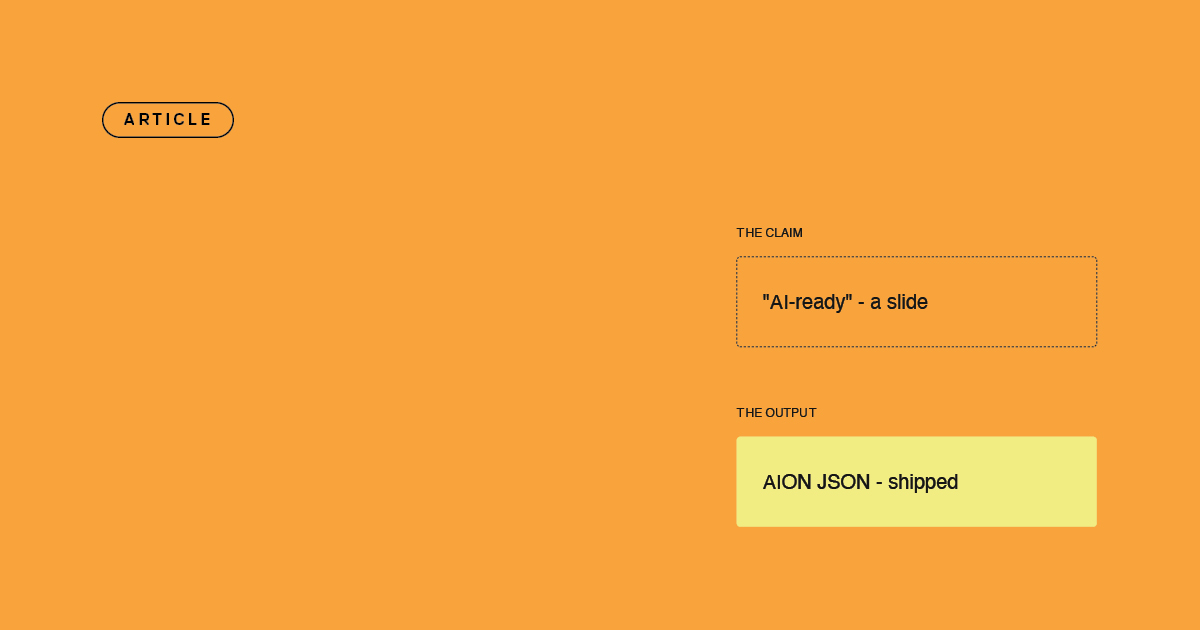
AI-ready content: who has actually shipped it?
A practical field guide to separating AI-ready content marketing from vendors who have actually shipped a structured, governed output for AI.
Article
Future-proof your content for an AI stack that changes
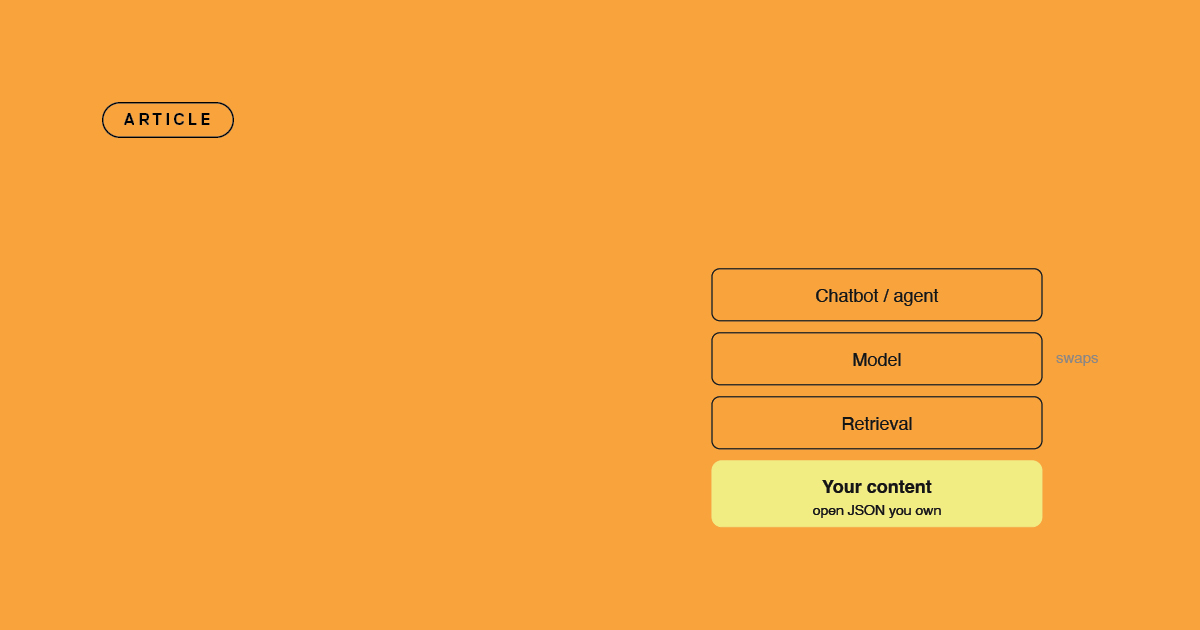
Models and tools churn constantly. Future-proof content for AI by owning the one layer that lasts - your content, as open structured JSON.