Article
How to prevent AI hallucinations in enterprise content

Summary:
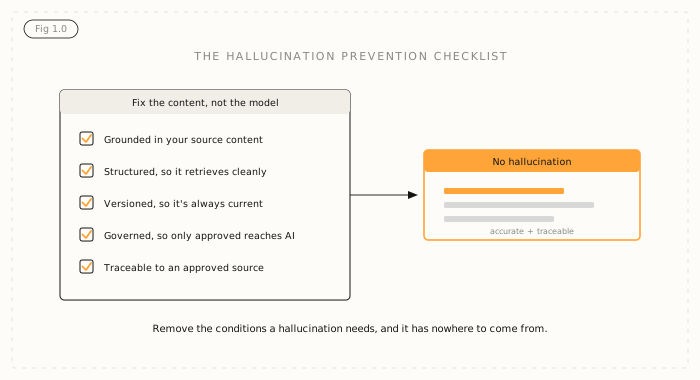
You prevent AI hallucinations in enterprise content by fixing the content the AI reads from, not by tuning the model. A hallucination is a confident, wrong answer, and most enterprise hallucinations trace back to the same source: the AI was fed content that was unstructured, outdated, or never approved. The prevention playbook is practical. Ground every answer in your own source content so the model retrieves facts instead of guessing. Structure that content so it can be retrieved cleanly, in whole thoughts rather than fragments. Version it so the AI only ever sees the current answer. Govern it so unapproved drafts can't reach the model at all. And keep provenance so every answer can be traced back to an approved source and checked. Do those five things and you remove the conditions hallucinations need. The model still matters, but the content is where enterprise accuracy is actually won.
What causes AI hallucinations in enterprise content?
A hallucination is when an AI gives a confident answer that is wrong. In consumer chatbots that is often the model inventing something. In enterprise settings the cause is usually simpler and more fixable: the AI was handed bad content. It retrieved an unstructured fragment, an outdated version, or an unapproved draft, and answered from that.
We cover the mechanics of this in why your AI gives wrong answers. This guide is the practical playbook for preventing it across all your enterprise content, not just product answers.
The five-step hallucination prevention playbook
Prevention is a content job, and it comes down to five steps.
- Ground it. Point the AI at your own source content so it retrieves facts instead of guessing - the core idea behind retrieval-augmented generation.
- Structure it. Break content into clean components so retrieval returns whole thoughts, not fragments cut mid-sentence.
- Version it. Keep one current source so the AI can never surface last year's answer.
- Govern it. Route content through approval so unapproved drafts can't reach the model at all.
- Trace it. Keep provenance so every answer links back to an approved source and can be checked.
Notice that none of these steps touch the model. They all fix what the model reads.
A quick self-check
If you're not sure how exposed you are, run through the risk factors below and the fix for each.
Every risk on that list is a content problem with a content fix. There is more on the accuracy side in why structured content makes AI accurate.
Where model choice fits (and where it doesn't)
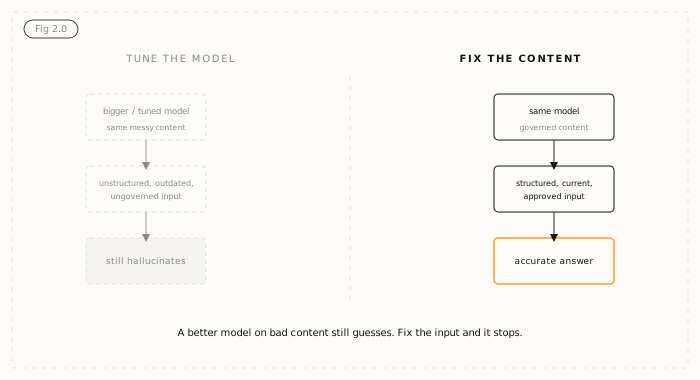
A better model helps with reasoning and fluency. It does not know your products, your policies, or which version is current, so it cannot fix a content problem on its own. Fine-tuning bakes in knowledge that goes stale the moment your content changes.
For enterprise facts, grounding on governed content beats tuning the model nearly every time. The model is the last mile, not the source of truth.
Where Author-it fits
Author-it gives the AI content that already passes that checklist. Content is authored as structured components, versioned, and run through Review and Approve, then published to AION as structured JSON with the IDs, timestamps, and authorship that provide provenance.
The publishing gate is the key part: unapproved content provably cannot reach the AI, which removes an entire class of hallucination at the source. See how Author-it powers AI content, or benchmark your content with the Structured Content Challenge.

Hallucination Prevention FAQ
Q: How do you prevent AI hallucinations in enterprise content?
A: Prevent them by fixing the content the AI reads, not the model. Ground answers in your own source content, structure it so it retrieves cleanly, version it so only the current answer is available, govern it so unapproved drafts can't reach the model, and keep provenance so answers can be traced and checked. Together these remove the conditions hallucinations need.
Q: What causes AI hallucinations?
A: A hallucination is a confident, wrong answer. In enterprise settings it is usually caused by bad input rather than the model itself: the AI retrieved unstructured, outdated, or unapproved content and answered from it. Fix the content and most enterprise hallucinations disappear.
Q: Can you stop AI hallucinations completely?
A: You can't guarantee zero, but you can remove the conditions that cause most of them. Grounding, structure, versioning, governance, and provenance eliminate the content-driven hallucinations that dominate enterprise use. A residual risk remains from the model, which is why traceability to a source matters for checking answers.
Q: Does a better AI model reduce hallucinations?
A: Only partly. A stronger model reasons and writes better, but it still doesn't know your products, policies, or which version is current. If it is answering from unstructured or outdated content, it will still hallucinate. Fixing the content it reads has more impact than upgrading the model.
Q: Does RAG prevent hallucinations?
A: Retrieval-augmented generation reduces hallucinations by grounding answers in retrieved source content instead of the model's memory. It only works, though, if the content it retrieves is structured, current, and approved. RAG on messy content still surfaces wrong answers, so grounding and content quality go together.
Q: How does structured content reduce hallucinations?
A: Structured content breaks information into clean, typed components so retrieval returns whole, in-context answers rather than fragments cut mid-sentence. It also carries metadata like version and approval status, so the AI can be limited to current, approved content - removing two of the most common causes of wrong answers.
Q: What is the fastest way to reduce AI hallucinations in enterprise content?
A: Ground the AI in a single, approved source and cut off access to everything else. Even before full restructuring, restricting the model to current, approved content and adding provenance removes the outdated-and-unapproved category of hallucination, which is the largest one in most organisations.
Published on:
Author:
September 7, 2026
Quinn Wright
Head of Sales