Article
Docs-as-code vs CCMS: the limits at scale

Summary:
Docs-as-code - Markdown in Git, built with a static site generator - is the default in a lot of software teams, and for good reason. It also hits hard limits when documentation has to scale across products, languages, compliance, and now AI. This piece is honest about what docs-as-code gets right and where a Component Content Management System takes over. The short version: Markdown is prose with formatting; structured content carries the type, metadata, and governance that reuse and reliable AI retrieval need.
What docs-as-code gets right
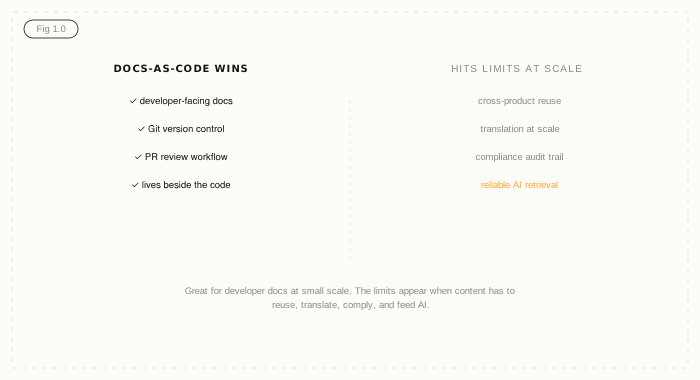
Credit where it's due. Docs-as-code keeps documentation next to the code, in version control, reviewed through the same pull-request workflow engineers already use. For developer-facing docs at small to medium scale, that's a genuinely good fit, and swapping it for something heavier would be a mistake.
The question isn't whether docs-as-code is good - it's what happens when your content has to do more than serve developers. If that's where you are, our CCMS evaluation checklist is a useful way to see what you'd be adding.
Where it hits limits at scale
The limits show up as content grows and audiences multiply. Reuse across products means copy-pasting Markdown, which drifts. Translation has no workflow that tracks what changed, so you re-translate whole files. Compliance needs an audit trail and controlled approvals that Git commit history only approximates. And Markdown carries no semantic structure, which becomes the sharpest limit once you point AI at it.
Markdown vs structured content for AI
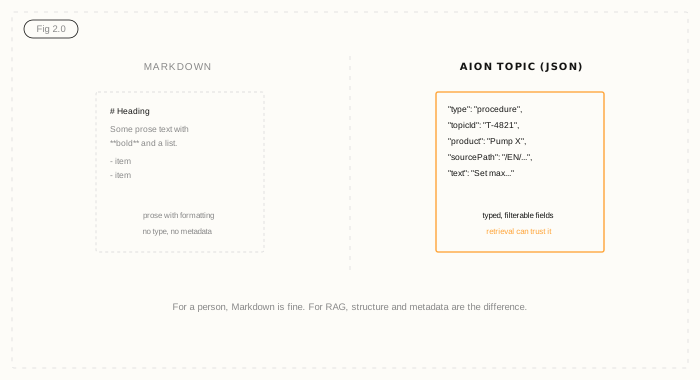
This is the one that's changed the calculus. Markdown is prose with formatting - a heading, some bold, a list. It has no type, no identifiers, no metadata to filter on. A structured topic in a format like AION carries a content type, a topic identifier, product and version metadata, a source path, and the body with variables resolved. For a person reading a page, that difference is invisible. For a RAG pipeline deciding what to retrieve and whether to trust it, it's the whole game.
Do you have to choose?
Not always, and not immediately. Plenty of teams keep docs-as-code for developer references and move structured product documentation - the content that has to reuse, translate, comply, and feed AI - into a CCMS. The trigger to move isn't ideology; it's the pattern of copy-paste reuse, translation pain, compliance gaps, and stalled AI projects.
Where Author-it fits
Author-it is the destination for the content docs-as-code struggles with at scale. It manages content as reusable components with single-sourcing, translation against the source, version control, and a built-in audit trail, and it publishes to multiple channels from one source. Its structured JSON output, AION, gives an AI pipeline typed, governed content instead of raw Markdown. You keep your engineering workflow where it fits and give structured documentation a system built for it. Benchmark your content with the Structured Content Challenge.

Docs-as-code FAQ
Q: What is the difference between docs-as-code and a CCMS?
A: Docs-as-code authors documentation as Markdown in version control, built and published like software. A CCMS manages content as reusable, typed components with single-sourcing, translation, governance, and multi-channel output. Docs-as-code optimises for the developer workflow; a CCMS optimises for reuse, governance, and scale across products, languages, and AI.
Q: Is docs-as-code good enough for documentation?
A: For developer-facing docs at small to medium scale, yes - it keeps docs beside the code, in version control, reviewed through pull requests. It stops being enough when content has to reuse across products, translate at scale, meet compliance requirements, or feed AI reliably, because Markdown lacks the structure and metadata those need.
Q: Where does docs-as-code break down at scale?
A: Reuse across products becomes copy-paste that drifts, translation has no workflow that tracks changes so you re-translate whole files, compliance needs an audit trail that commit history only approximates, and Markdown's lack of semantic structure limits reliable AI retrieval. Individually manageable; together they cap how far docs-as-code scales.
Q: Is Markdown good enough for AI and RAG?
A: Markdown is prose with formatting - no type, no identifiers, no metadata to filter on. A RAG pipeline can index it but can't filter or trust it the way it can structured content. A structured format like AION carries content type, identifiers, product and version metadata, and resolved variables, which is what retrieval actually uses.
Q: Can you use docs-as-code and a CCMS together?
A: Yes, and many teams do. They keep docs-as-code for developer references where it fits and move structured product documentation - the content that must reuse, translate, comply, and feed AI - into a CCMS. Using each for the job it's good at is usually better than forcing one tool to do both.
Q: When should a software team move from docs-as-code to a CCMS?
A: When the pattern appears: copy-paste reuse across products, translation pain, compliance gaps a commit log can't fill, and AI projects stalling on unstructured Markdown. That's the signal documentation has outgrown docs-as-code for the content that scales, and needs a system built for reuse, governance, and AI-ready output.
Published on:
Author:
June 9, 2026
Osmar Silva
CTO
Related Resources

Article
The CCMS reckoning: six priorities for the AI era
A response to the industry's CCMS reckoning: the six priorities content leaders now face, and an honest look at which are shipped versus roadmap.

Article
Content lock-in: the exit tax nobody budgets for
The cost of leaving a content platform rarely makes the business case - until you try to switch. Here is the exit tax, and how open output removes it.
Article
DITA vs structured authoring without XML
It's a fit question, not a quality one - and you don't need DITA to get AI-ready content.