Article
Content debt: what it costs and how to fix it

Summary:
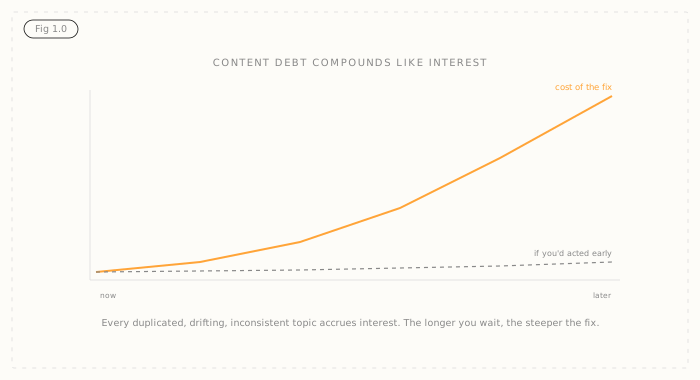
Content debt is the documentation version of technical debt: the accumulated cost of shortcuts you took to ship faster - duplicated content, outdated topics, inconsistent terminology, undocumented features. Like technical debt, it charges interest. Every duplicate doubles your update and translation cost, and inconsistent terminology now also breaks AI retrieval. This guide quantifies what content debt costs and lays out how to get out of it without a big-bang rewrite.
What content debt actually is
Software teams understand technical debt. Content debt is the same idea applied to documentation, and it's underused as a concept precisely because the cost is quiet. It builds up as duplicated content maintained in several places, topics nobody has had time to update, terminology that drifts because there's no single source, and features that were never documented and generate support tickets instead. If you want to put a number on it, our guide to calculating CCMS ROI covers the same cost levers.
What it costs, and why it compounds
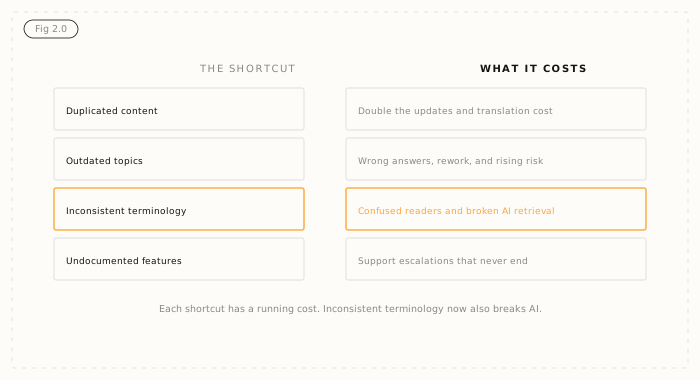
The trap is that each shortcut has a running cost, not a one-off one. A duplicated topic costs double to translate, double to update, and adds the risk that the copies disagree. An outdated topic produces wrong answers and rework. Inconsistent terminology confuses readers, and - the newer cost - breaks AI retrieval, because a model can't tell that three different names mean the same thing. Undocumented features never stop generating escalations. Left alone, the interest compounds: the longer you wait, the more expensive the eventual fix.
How to get out of it
You don't pay content debt down with a heroic rewrite. You do it systematically. Start with an inventory to see the scale and find the worst offenders. Consolidate duplicated content to a single source so a fix lands once. Standardise terminology so readers and AI both get consistency. Retire what's dead rather than migrating it. Then structure what remains as reusable components so debt stops re-accruing. The work pays off inside about a year for most teams, because the running costs stop the moment the duplication does.
Where Author-it fits
Author-it is built to both clear content debt and stop it coming back. Single-sourcing removes duplication at the root, so a change is made once. Consistent components and metadata standardise terminology. Version control and an audit trail keep content current and provable. And the same structured content publishes to AION, so paying down content debt also makes your content AI-ready - one project, two returns. If you want to size your debt before you start, the Structured Content Challenge is a quick diagnostic.

Content Debt FAQ
Q: What is content debt?
A: Content debt is the documentation version of technical debt: the accumulated cost of shortcuts taken to ship faster, such as duplicated content, outdated topics, inconsistent terminology, and undocumented features. Like technical debt, it charges interest - each shortcut has a running cost that compounds until it is addressed.
Q: How is content debt different from technical debt?
A: They're the same idea in different domains. Technical debt is the cost of code shortcuts; content debt is the cost of documentation shortcuts. Both accrue interest, both are invisible until they slow you down, and both are paid off systematically rather than in one heroic effort. Content debt is simply less talked about.
Q: What does content debt cost?
A: It costs on a running basis. A duplicated topic costs double to translate and update and risks copies disagreeing. Outdated topics cause wrong answers and rework. Inconsistent terminology confuses readers and breaks AI retrieval. Undocumented features generate ongoing support escalations. The total grows the longer the debt is left unaddressed.
Q: How does content debt affect AI?
A: Badly. Duplicated and inconsistent content is exactly what makes AI retrieval unreliable - a model can't tell that three different names mean the same thing, or which duplicate is current. So content debt that was merely expensive now also degrades every AI feature built on the content, which raises the urgency of paying it down.
Q: How do you reduce content debt?
A: Systematically, not with a big-bang rewrite. Inventory the content to find the worst offenders, consolidate duplicates to a single source, standardise terminology, retire dead content rather than migrating it, and structure what remains as reusable components so debt stops re-accruing. For most teams the effort pays off within about a year.
Q: Does a CCMS help with content debt?
A: Yes, both to clear it and to prevent it. Single-sourcing removes duplication at the root, consistent components standardise terminology, and version control keeps content current and provable. The same structured content also becomes AI-ready, so paying down content debt delivers a second return rather than being pure cleanup.
Published on:
Author:
June 6, 2026
Adrian Winks
CEO
Related Resources

Article
Content lock-in: the exit tax nobody budgets for
The cost of leaving a content platform rarely makes the business case - until you try to switch. Here is the exit tax, and how open output removes it.

Article
The real cost of DITA - and when you don't need it
The cost of DITA is mostly staffing and process. Here is where it hides - and how to get topic reuse and single-source publishing without XML.
Article
Managing spare parts catalogs across variants
Options, revisions, and regional variants multiply parts lists and service manuals fast - here's how to maintain them all from a single source.