Article
Build vs buy a CCMS: the real cost of in-house

Summary:
Building your own CCMS looks cheaper on day one and rarely is. The initial build is the small, visible cost; maintenance, security, the missing roadmap, and key-person risk are the bill that arrives later. AI made this worse, not better - the target keeps moving, and an internal tool is always catching up. Build can be the right call for a genuinely unique need, but content infrastructure is rarely the thing your business competes on. Here's the honest version of the decision.

Why building in-house is tempting
The pitch writes itself. You have engineers. You know your content better than any vendor. A bought system never fits perfectly, and a subscription line item is easy to question. So building your own looks like control and saving money at the same time.
That instinct is reasonable, and sometimes right. But the comparison people make - build cost versus subscription cost - is the wrong one. The real comparison is the total cost of owning a content platform for years against the cost of buying one, and on that basis the maths usually flips.
The build is the cheap part
Getting a first version working is the visible cost, and it is the smallest one. What follows is where the money goes.
Maintenance never stops. Someone has to fix bugs, manage upgrades, and keep the thing running while the people who built it move on to other projects. Security and compliance are a permanent obligation - access control, audit trails, data handling, certifications - and in regulated industries that bar is high and always rising. There is no product roadmap but the one you fund yourself, so every new capability is a new internal project competing with your actual product work. And there is key-person risk: when the one engineer who understands the system leaves, you inherit a black box you depend on. None of this shows up in the day-one budget, and all of it shows up later. For the structured way to weigh this, see the business case for a CCMS.
AI made it harder, not easier
If you were leaning toward build, AI is the argument against it. The requirements for AI-ready content are moving fast - structured output, governance, provenance, the formats RAG pipelines and agents expect. A vendor with a roadmap ships these and iterates. An internal tool has to chase each shift with a new project, and it is always a release behind.
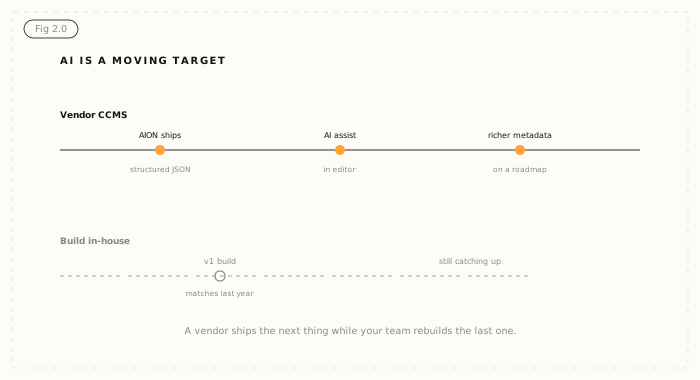
The result is a tool that matches last year's needs by the time it is done. Author-it shipped AI-ready structured output via AION as a standard format, and the roadmap keeps moving with the field. Reproducing that internally, and keeping it current, is a standing commitment most teams underestimate.
When building in-house does make sense
To be fair, build is not always wrong. If your content workflow is genuinely unique in a way no platform can serve, if content tooling is itself a core part of what you sell, or if you have a funded, permanent team whose job is to own and evolve the system, building can be the right answer. The honest test is simple: is a content platform a thing your business competes on? For a software company selling a documentation product, maybe. For almost everyone else, it is infrastructure - necessary, but not a differentiator - and infrastructure is exactly the kind of thing worth buying.
What good looks like: buy, and spend your engineers on the product
The strongest argument for buying is opportunity cost. Every engineer maintaining an internal content system is an engineer not working on the product your customers actually pay for. A proven CCMS hands you the platform, the roadmap, the security posture, and the support, so your team stays pointed at the work that differentiates you. You also get something an internal build can't quickly buy: years of accumulated information-architecture and governance expertise baked into how the product works. You can model the difference with the content ROI calculator, and the broader picture is in what a CCMS is.
Where Author-it fits
This is Author-it's view, so weigh it accordingly. We have spent 25+ years building and maintaining a CCMS for regulated industries - which means the maintenance, security, compliance, and roadmap costs that would land on your team land on ours instead. Structured authoring without DITA, built-in review and approval, translation reuse, and AI-ready output via AION are already built, supported, and moving forward on a release cadence. If you were planning to build all of that and keep it current, the more useful question is whether that effort is better spent on the product only your team can build.

Build vs Buy FAQ
Q: Should we build our own CCMS or buy one?
A: For most organisations, buying is the better choice. Building looks cheaper on day one but carries ongoing maintenance, security, compliance, and roadmap costs that a vendor absorbs for you. Build makes sense only when your content workflow is genuinely unique, content tooling is part of what you sell, or you have a funded permanent team to own it.
Q: Is building a CCMS in-house cheaper?
A: Rarely, once you count the full lifecycle. The initial build is the smallest cost. Maintenance, upgrades, security, compliance, and the absence of a vendor roadmap accumulate year after year, and AI requirements add a constant catch-up cost. Compared over several years, buying a proven CCMS is usually lower total cost.
Q: What are the hidden costs of building a CCMS in-house?
A: Ongoing maintenance and upgrades, security and compliance obligations, the lack of a product roadmap so every new feature is an internal project, and key-person risk when the engineers who built it move on. There is also opportunity cost: the engineering time spent on content tooling is time not spent on your core product.
Q: When does building content tooling in-house make sense?
A: When your content workflow is genuinely unique and no platform can serve it, when content tooling is itself a core part of what you sell, or when you have a funded, permanent team dedicated to owning and evolving the system. The deciding question is whether a content platform is something your business actually competes on.
Q: How does AI affect the build vs buy decision for a CCMS?
A: AI strengthens the case for buying. Requirements for AI-ready content - structured output, governance, provenance, RAG-friendly formats - are changing quickly. A vendor with a roadmap ships and iterates on these, while an internal tool has to chase each change with a new project and is always a release behind.
Q: How long does implementing a bought CCMS take compared with building one?
A: A bought CCMS is typically in production within weeks to a few months, including content migration with services support. Building a comparable system in-house takes far longer to reach the same capability, and unlike a bought platform it never stops requiring engineering effort to maintain and extend.
Published on:
Author:
May 8, 2026
Quinn Wright
Head of Sales
Related Resources

Article
Content lock-in: the exit tax nobody budgets for
The cost of leaving a content platform rarely makes the business case - until you try to switch. Here is the exit tax, and how open output removes it.

Article
The real cost of DITA - and when you don't need it
The cost of DITA is mostly staffing and process. Here is where it hides - and how to get topic reuse and single-source publishing without XML.

Article
Content debt: what it costs and how to fix it
Like technical debt, content debt charges interest - and now it breaks your AI too.