What the demo shows us
Your AI Content Foundation needs to be as strong as the results you want from it.
WHAT JUST HAPPENED
AI Content Foundation demo, explained
The demo asked one question of two AI knowledge foundations. Nothing about the model changed between the two answers. The only variable was what it had been grounded on.
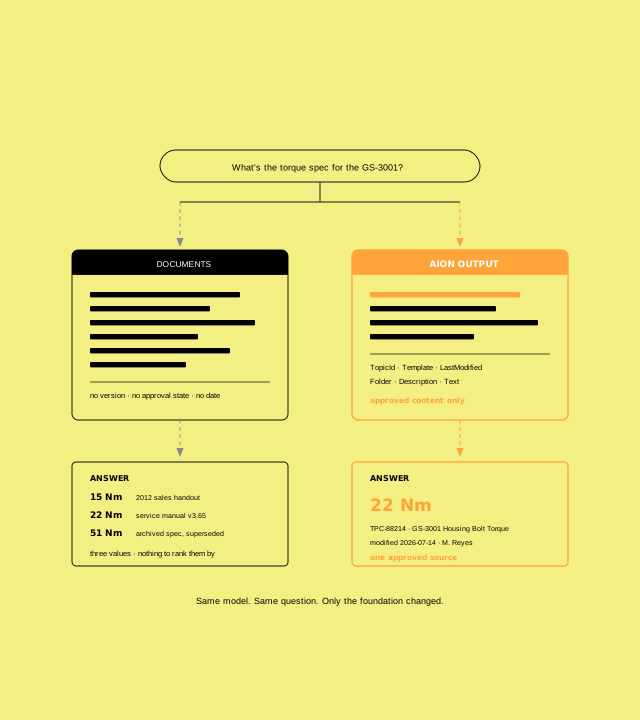
Take the manufacturing example. The question was the torque spec for the housing bolts on a pressure regulator.
THE OLD WAY
Grounded on a folder of documents
The answer came back with three values: 15 Nm, 22 Nm and 51 Nm. The 15 came from a 2012 sales handout with no revision number. The 22 came from page 188 of the current service manual. The 51 came from an archived spec, superseded in 2019, that nobody removed from the folder.
All three documents were in the source folder. None of them carried a version, an approval state or a reliable date. So the retrieval system had no basis for choosing between them, and it did the only honest thing available to it: it returned all three.
That's the good outcome. The bad outcome is when it returns one of the three, confidently, with a filename underneath it.

THE CORRECT WAY
Grounded on AION structured JSON
The answer came back as 22 Nm, in a diagonal sequence, over two passes - with the topic it came from attached.
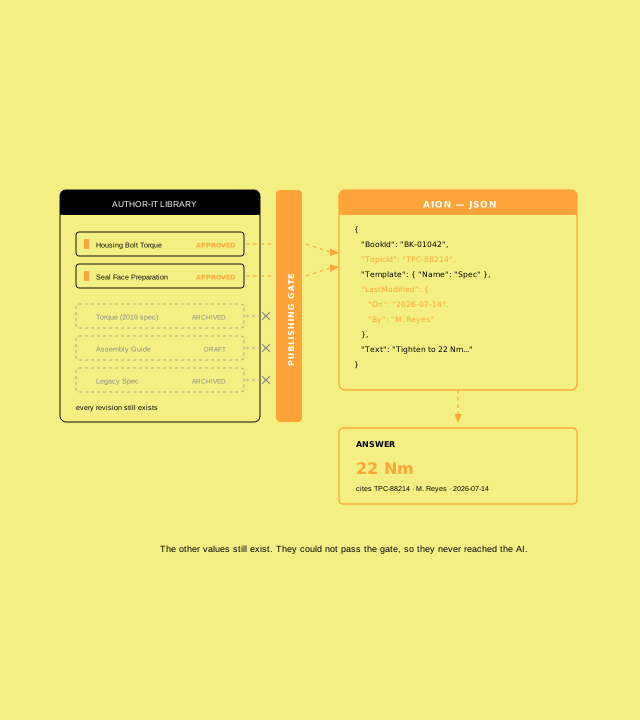
The 15 Nm and 51 Nm figures still exist in the Author-it library. They sit on archived topics, and archived topics cannot be published. AION is a publishing output, so those values were never in the file the AI was reading. The question of which value to trust never arose, because only one value was ever in scope.
FOOD FOR AI
What the AI actually sees
This is the published output the AI was reading. One job, one book, the variable values used to resolve it, and the topic the answer came from. Every field here ships in the file - no separate lookup, no metadata sidecar.
Two things to notice. The torque value appears in VariablesValues as a resolved value, so it is already the number rather than a token to be looked up somewhere else. And Text reads as finished content, because it was resolved at publish time.
What isn't in that file matters as much as what is. No drafts. No archived revisions. No superseded topics. They all exist in the library. None of them could pass the publishing gate, so none of them reached the AI.
{
  "JobId": "JOB-20260714-001",
  "BookId": "BK-01042",
  "VariablesValues": [
    { "Name": "TorqueSpec", "Value": "22 Nm" },
    { "Name": "BoltGrade", "Value": "8.8" }
  ],
  "Content": [
    {
      "TopicId": "TPC-88214",
      "Type": "topic",
      "Template": {
        "Name": "Specification",
        "Id": "TPL-00034"
      },
      "LastModified": {
        "On": "2026-07-14T09:22:00Z",
        "By": "M. Reyes"
      },
      "Folder": "/Products/GS-3001/Service/Specifications",
      "Description": "GS-3001 Housing Bolt Torque",
      "Text": "Tighten housing bolts to 22 Nm in a diagonal sequence, over two passes."
    }
  ]
}
WHY AION BEATS DOCUMENTS
A document folder has nothing to rank on
Retrieval systems rank passages by similarity to the question. They can't rank by authority, because a PDF carries none. These are the four things a governed source gives an AI that a folder cannot.
GOVERNANCE IS KEY
The problem was never that unstructured content is always wrong
It isn't. Run the demo and you'll hit a question where the document folder gives you exactly the right answer. The PPE requirements are correct. The retention period is correct. The webhook list is correct.
That's the actual problem. A source that's right most of the time and gives you no way to tell which times is a source you have to check every time. And if your process is to verify every AI answer against the original document, you haven't automated anything. You've added a step, and you're paying for the model as well.
Governance isn't about catching a system that's usually wrong. It's about not having to check a system that's usually right.
in real life
The same system. Three industries. The same result.
Manufacturing
A field tech asks an AI for the SOP for replacing a cooling unit.
Without Author-it: the AI finds a PDF from 2022 and answers confidently. The SOP changed in 2024. The field tech follows outdated steps.
With AION: the AI ingests the current, governed SOP. It knows the content type (Procedure), the folder (Safety/EU), and the modification history. It gives the right answer - and can cite which revision.
Software
A customer asks an AI support agent about a feature that changed in the latest release.
Without Author-it: the support AI was trained on a documentation export from six months ago. It describes the old behaviour. The customer is confused. A ticket is opened.
With AION: help content is republished with every release. The AI always ingests the current version. The answer reflects what the product actually does today.
Utilities
A contractor in the field asks an AI assistant for the correct isolation procedure.
Without Author-it: the AI pulls a procedure from a scraped operations manual. It doesn't know if it's been superseded. The contractor can't verify the source.
With AION: the AI cites the exact approved procedure, folder path, and last-modified date. The contractor - and the safety officer reviewing the incident log - can trace exactly what was cited and when.
"AIT allowed us to grow from 1 help system and 20 paper manuals to multiple help systems and well over 100 paper manuals. Single-sourcing, reuse, variants, and release states allow us to work smarter, not harder, as we keep up with release updates."

Customer review from G2

Trusted by leading organisations where accuracy matters. 25+ years of structured content. Now AI-ready.


FREE GUIDE · PDF
AI Content Readiness Guide
The demo shows what a governed foundation buys you. The guide covers how to build one on your own content, in your own stack. It's vendor-neutral and practical: you could follow it without ever buying anything from us.


Documents vs structured JSON FAQ
They don't cause hallucinations so much as cause something harder to catch: confident answers drawn from sources the model has no way to rank. A PDF carries no version, no approval state, and often no reliable date. When three documents in the same folder give three different values, a retrieval system has no basis for choosing between them, so it returns whichever passage scored highest on similarity to the question. The output looks authoritative and cites a filename. Neither of those things makes it correct.
For a small, low-stakes knowledge base, yes. Markdown is clean, it chunks well, and it strips the layout noise that breaks PDF extraction. It stops being good enough at the point where an answer carries regulatory, safety or warranty consequence, because a Markdown file carries no approval state, no version lineage and no relationship to whatever produced it. A .md file can tell you what the content says. It can't tell you whether anyone approved it.
AION is Author-it's structured JSON publishing format, released in 2026.R1 as standard at no extra cost. Each output carries the content hierarchy of books, sub-books and topics; the Markdown body text; object IDs for every topic and book; template names; timestamps and last-modified dates; authorship metadata; source folder paths; resolved variable values; and description metadata. It's a publishing output rather than an export, which means it comes through the same publishing gate as every other format Author-it produces.
Yes. AION is standard JSON, so it goes into the pipeline you already have - your usual embedding model and vector store, no special connector. Two things change in practice. Topics are already the chunk, so you're not guessing at boundaries and cutting a procedure in half. And every node carries provenance you can keep as metadata, which means you can filter on it at query time and cite it in the answer.
Through the publishing gate, which is architectural rather than configurable. Content in Author-it moves through release states: Draft, In Review, Approved, Published. Only approved content can be published to an output, and AION is an output like any other. A draft procedure, a superseded revision or an archived spec can't appear in an AION file, because it can't get through the gate that produces the file. There's no setting to switch that off.
No. Structure is about consistent components, defined relationships and enforced governance, not about a particular markup standard. Author-it delivers structured authoring without DITA or XML, so subject matter experts write in a familiar editor while the system handles reuse, versioning and output. The AI consuming the content sees the same structure either way. The people creating it have a considerably easier time of it.