Guide
How to calculate CCMS ROI: the business case

Summary:
The case for a CCMS is a financial one, and it's stronger than most teams assume - but only if you build it on your own numbers rather than a vendor's. This guide gives you a simple ROI framework with four inputs: translation spend, writer time, audit preparation, and support escalations caused by documentation errors. Put your figures in and a payback period falls out. Industry benchmarks land around 9-10 months for a modest deployment, and Author-it customers have reported savings well into seven figures.
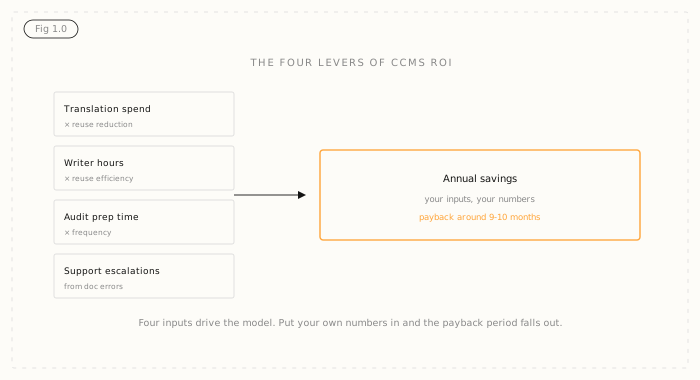
The four levers of CCMS ROI
Almost all the return comes from four places, and you can estimate each with numbers you already have. If you'd rather skip straight to the model, the Author-it ROI calculator does the arithmetic for you.
Translation spend times reuse reduction: if high content reuse means you only translate new or changed components, translation cost drops sharply. Author-it manufacturing customers have cut translation spend by up to 90%.
Writer hours times reuse efficiency: writers stop recreating the same content and spend time on new material. Reuse rates of 60-90% are common in mature deployments.
Audit preparation time times frequency: when the current version and its history are retrievable on demand, audit prep stops being a fire drill.
Support escalations from documentation errors: fewer wrong or out-of-date answers means fewer tickets and escalations.
Turning the levers into a number
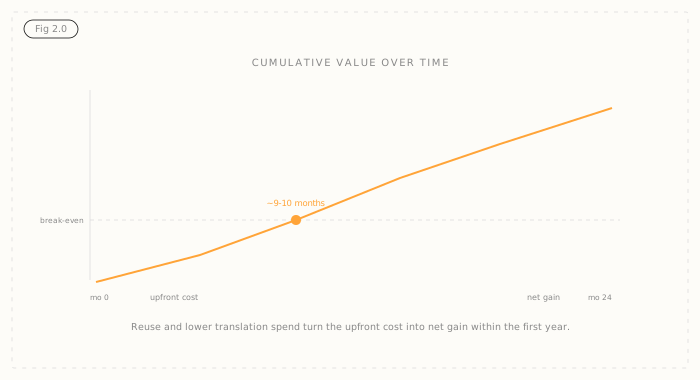
Take your current annual translation spend, your writers' time on duplicated content, your audit prep hours, and your documentation-driven support costs. Apply a conservative reuse improvement to each - you don't need aggressive assumptions for the case to work. Set the total annual saving against the cost of the system and implementation, and you have a payback period. For most teams that lands inside the first year.
The benchmarks, honestly
Industry data puts payback for a modest CCMS deployment at roughly 9-10 months. Author-it's own customers give a sense of the ceiling: a global consumer products manufacturer reported over 3 million dollars in annual savings with 60-70% content reuse, and a global software company reported over 2 million dollars a year with reuse up to 90%. Your number will be your own - the point of a model is that you don't have to take anyone's word for it.
Where Author-it fits
Rather than argue the figures, Author-it gives you a model to run. The ROI calculator takes your inputs and returns a payback period and multi-year return, so the business case is yours, not a slide. If you want to test the assumption underneath it - how much reuse your content actually supports - start with the Structured Content Challenge. And the same structured content that drives these savings is what makes your content AI-ready via AION, a second return that's getting harder to ignore.

CCMS ROI FAQ
Q: How do you calculate the ROI of a CCMS?
A: Estimate savings across four levers using numbers you already have: translation spend reduced by content reuse, writer hours freed by not recreating content, audit preparation time saved by on-demand retrieval, and support escalations avoided from fewer documentation errors. Total the annual saving, set it against system and implementation cost, and the payback period falls out. Conservative assumptions are usually enough.
Q: What is the payback period for a CCMS?
A: Industry benchmarks put payback for a modest CCMS deployment at roughly 9-10 months, driven mainly by reduced translation spend and reuse of writer time. The exact figure depends on your content volume, number of languages, and reuse rate, which is why running your own numbers through an ROI model gives a firmer answer than a benchmark.
Q: What savings does a CCMS deliver?
A: Mostly from content reuse: lower translation spend because only new or changed content is translated, less writer time recreating existing content, faster audit preparation, and fewer support escalations from documentation errors. Author-it customers have reported over 3 million dollars a year in manufacturing and over 2 million a year in software, with reuse rates of 60-90%.
Q: How does content reuse reduce translation costs?
A: With single-sourcing, content is stored once as a component and reused everywhere it appears, so you only send new or changed components for translation rather than whole documents. If a component hasn't changed, you don't pay to translate it again. Organisations with high reuse commonly cut translation spend substantially, and some Author-it customers by up to 90%.
Q: Do CCMS ROI benchmarks apply to my organisation?
A: Treat benchmarks as a sanity check, not a promise. Your return depends on your translation spend, number of languages, content volume, and how much of your content can be reused. That's why the reliable approach is to put your own figures into an ROI model, using conservative reuse assumptions, rather than adopting someone else's headline number.
Q: How do I build the business case for a CCMS internally?
A: Quantify the four levers with your own numbers, use conservative reuse assumptions so the case is defensible, and present the annual saving against total cost as a payback period and multi-year return. Pair it with a note on risk reduction - audit readiness and version control - and, increasingly, AI readiness, which is a second return from the same structured content.
Published on:
Author:
June 29, 2026
Quinn Wright
Head of Sales
Related Resources

Article
Content lock-in: the exit tax nobody budgets for
The cost of leaving a content platform rarely makes the business case - until you try to switch. Here is the exit tax, and how open output removes it.

Article
The real cost of DITA - and when you don't need it
The cost of DITA is mostly staffing and process. Here is where it hides - and how to get topic reuse and single-source publishing without XML.
Article
Content debt: what it costs and how to fix it
Like technical debt, content debt charges interest - and now it breaks your AI too.