Guide
How to implement a CCMS: a realistic timeline

Summary:
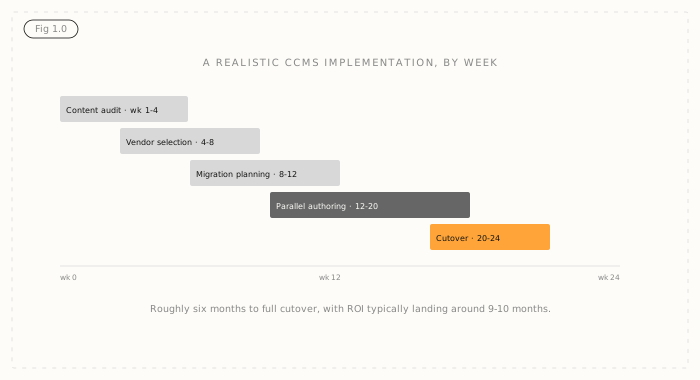
Migration anxiety is the biggest reason CCMS projects stall before they start, and most of that anxiety comes from not knowing what the timeline actually looks like. A realistic CCMS implementation runs in phases over roughly six months: content audit, vendor selection, migration planning, parallel authoring, and phased cutover. This guide sets out each phase, the risks that slip the schedule, and how to mitigate them. Industry experience puts ROI at around 9-10 months for a modest deployment.
The phases, honestly
A well-run implementation isn't a single event. It's five phases, and the early ones matter most.
Content audit (weeks 1-4): catalogue what you have, what's current, what's duplicated, and what to retire. Teams almost always find they need to migrate less than they feared.
Vendor selection (weeks 4-8): run candidates through a consistent scorecard. Our 17-question evaluation checklist keeps this stage honest.
Migration planning (weeks 8-12): design the component model and information architecture, and plan the order of migration.
Parallel authoring (weeks 12-20): both systems run so nothing stops shipping while content moves.
Phased cutover (weeks 20-24): move content in tranches, contain risk at each step, then retire the old system.
When ROI actually lands
The build takes about six months; the return comes later. Industry benchmarks put payback for a modest CCMS deployment at roughly 9-10 months, driven by reduced translation spend, faster updates through reuse, and less time lost to version and audit problems. The exact figure depends on your content volume and reuse rate, which is why an ROI model beats a rule of thumb - and why the content audit in phase one is worth doing properly.
The risks that slip the schedule
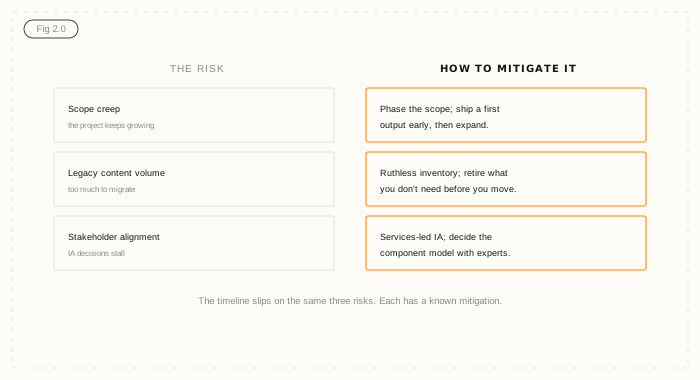
Three risks account for most overruns. Scope creep, where the project keeps growing - mitigate by phasing scope and shipping a first output early. Legacy content volume, where there's simply too much to move - mitigate with a ruthless inventory that retires what you don't need. And stakeholder alignment, where information-architecture decisions stall - mitigate with services-led IA so those calls are made with experienced help rather than by committee.
Where Author-it fits
Author-it implementations are services-led, which is what keeps the timeline honest. The team runs the audit, designs the information architecture, and handles migration alongside your people, drawing on 25+ years of doing it in regulated industries - the active migration often completes within about 90 days once planning is done. You also get an ROI model rather than a guess: see how Author-it calculates it with the ROI calculator, or benchmark your content first with the Structured Content Challenge.

CCMS Implementation FAQ
Q: How long does it take to implement a CCMS?
A: A well-run implementation takes roughly six months across five phases: content audit, vendor selection, migration planning, parallel authoring, and phased cutover. The active migration portion is often around 90 days once planning is done. The exact timeline depends on content volume and how much is retired versus restructured.
Q: What are the phases of a CCMS implementation?
A: Five: content audit (catalogue and retire), vendor selection (score candidates consistently), migration planning (design the component model and information architecture), parallel authoring (run both systems so publishing continues), and phased cutover (migrate in tranches, then retire the old system). The early phases carry the most leverage.
Q: When does a CCMS pay for itself?
A: Industry benchmarks put payback for a modest CCMS deployment at roughly 9-10 months, driven by reduced translation spend, faster updates through reuse, and less time lost to version and audit problems. The exact figure depends on your content volume and reuse rate, so an ROI model gives a better answer than a rule of thumb.
Q: What causes CCMS implementations to run over?
A: Three risks account for most overruns: scope creep, excessive legacy content volume, and stalled stakeholder alignment on information architecture. Each has a known mitigation - phase the scope and ship early, run a ruthless inventory that retires content, and use services-led IA so decisions are made with experienced help.
Q: Do we need to migrate all our content at once?
A: No, and you shouldn't. A phased cutover migrates content in tranches, by product line or document set, so risk is contained at each step and publishing never stops. A content audit first usually shows you need to migrate less than expected, because a lot of legacy content can be retired.
Q: How do we reduce CCMS implementation risk?
A: Start with a thorough content audit, decide the information architecture before migrating at scale, phase the rollout rather than attempting a big bang, and use a services-led implementation so experienced people handle the audit, IA, and migration alongside your team. Those four steps remove most of the risk that stalls projects.
Published on:
Author:
July 1, 2026
Adrian Winks
CEO
Related Resources

Article
Content lock-in: the exit tax nobody budgets for
The cost of leaving a content platform rarely makes the business case - until you try to switch. Here is the exit tax, and how open output removes it.

Article
The real cost of DITA - and when you don't need it
The cost of DITA is mostly staffing and process. Here is where it hides - and how to get topic reuse and single-source publishing without XML.

Article
Content debt: what it costs and how to fix it
Like technical debt, content debt charges interest - and now it breaks your AI too.