Article
Who enforces structure? DITA, DocBook and Author-it compared

Summary:
"Structured authoring" covers three different kinds of enforcement: valid markup, enforced information typing, and a gate that stops non-conforming content being approved or published. DITA enforces typing through the standard and leaves the gate to your CCMS. DocBook, the XML model Paligo builds on, deliberately does not enforce topic types, and Paligo says plainly that it has no enforced information typing. Author-it enforces typing with rules on structured templates and gates it with release states and publishing profiles, but only where you switch the rules on. Ask any vendor which of the three levels it enforces, and show you, before you assume "structured" means the same thing everywhere.
Three things "enforced structure" can mean
Buyers use "structured authoring" as if it were one feature. It's at least three, and vendors are strong on different ones.
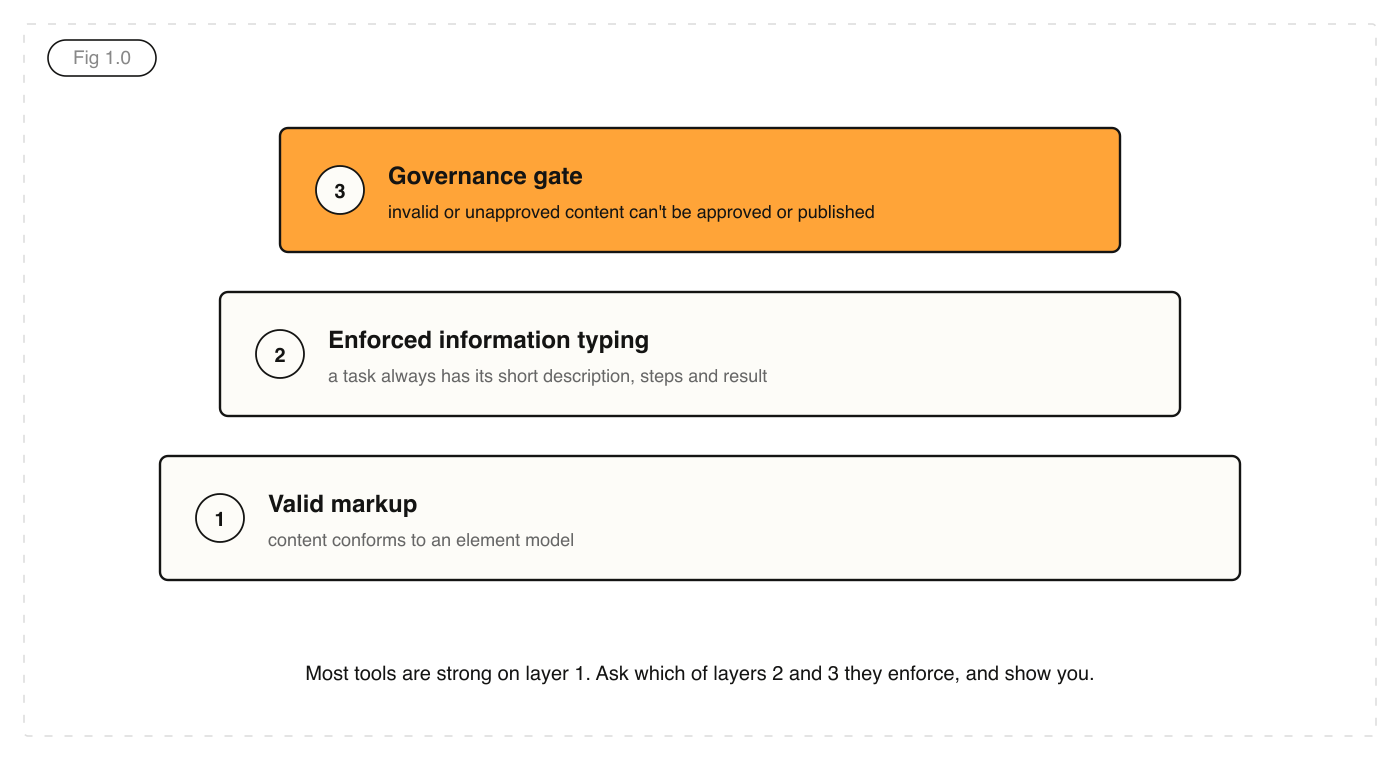
- Valid markup. The content conforms to an element model. You can't put a table where only paragraphs are allowed. Every XML-based tool does this.
- Enforced information typing. A task must look like a task: a short description, steps, maybe a result, in that order, every time. This is what most people mean when they say "structured writing".
- A governance gate. Content that breaks the rules can't be approved, and unapproved content can't be published, to readers or to AI.
The first is the easy part. The second is what makes content consistent. The third is what makes the first two stick when deadlines arrive.
DITA: typing by standard
DITA's whole design is information typing. Concept, task and reference topics have different element models, and a DTD or schema stops a task from containing things a task can't contain. Teams tighten it further with constraints and specialisation. If enforced typing is your priority, DITA delivers it out of the box.
What DITA doesn't include is the gate. Review, approval, release states and publishing control come from whichever CCMS you run DITA in, so the third level depends on your product choice, not the standard. And the strictness has a price: authors work in XML, or in an editor that hides it, and someone owns the model. We've covered that in the real cost of DITA.
DocBook and Paligo: flexibility by design
Paligo builds on a customised version of DocBook, another open XML standard. Its own comparison of DocBook and DITA says "The DocBook committee deliberately chose not to implement topic typing", and presents that as a strength: flexible authoring that doesn't force writers into restrictive topic types.
Paligo is open about what that means for its own product. In an interview published by technical writing consultant Craig Wright of Straygoat, Paligo CEO Anders Svensson said "A topic is a topic in Paligo", adding that information typing is not enforced at topic level. Wright's own summary was direct: "In Paligo there is no enforced information typing." Writers have elements such as procedures available, and every topic has every element available.
That is a legitimate design choice, and many teams like it. It means Paligo enforces valid markup strongly, and leaves information typing to your style guide and your reviewers.
Author-it: typing by rules you choose
Author-it doesn't use an XML standard. Content is stored as objects in a relational library, and authors write with paragraph and character styles, never direct formatting. That's the baseline.
Enforced typing comes from structured templates. In the Structure Builder you define rules for each topic or book type: what is required, in what order, how many times, and which styles, images, variables and embedded topics are allowed. A Task template can require a short description first and a steps group after it. Authors see validation in the Editor's Rules tab and an example topic in the Example tab.
The gate is built in. A structure can name a release state that enforces validation, so a topic that breaks the rules can't be moved into it. Publishing profiles that only take that release state never publish invalid content, including AION output for AI. The catch is that rules are opt-in, per template. A library where nobody switched them on gets the baseline and nothing more. We explain the mechanics in does Author-it enforce structured authoring?
Side by side
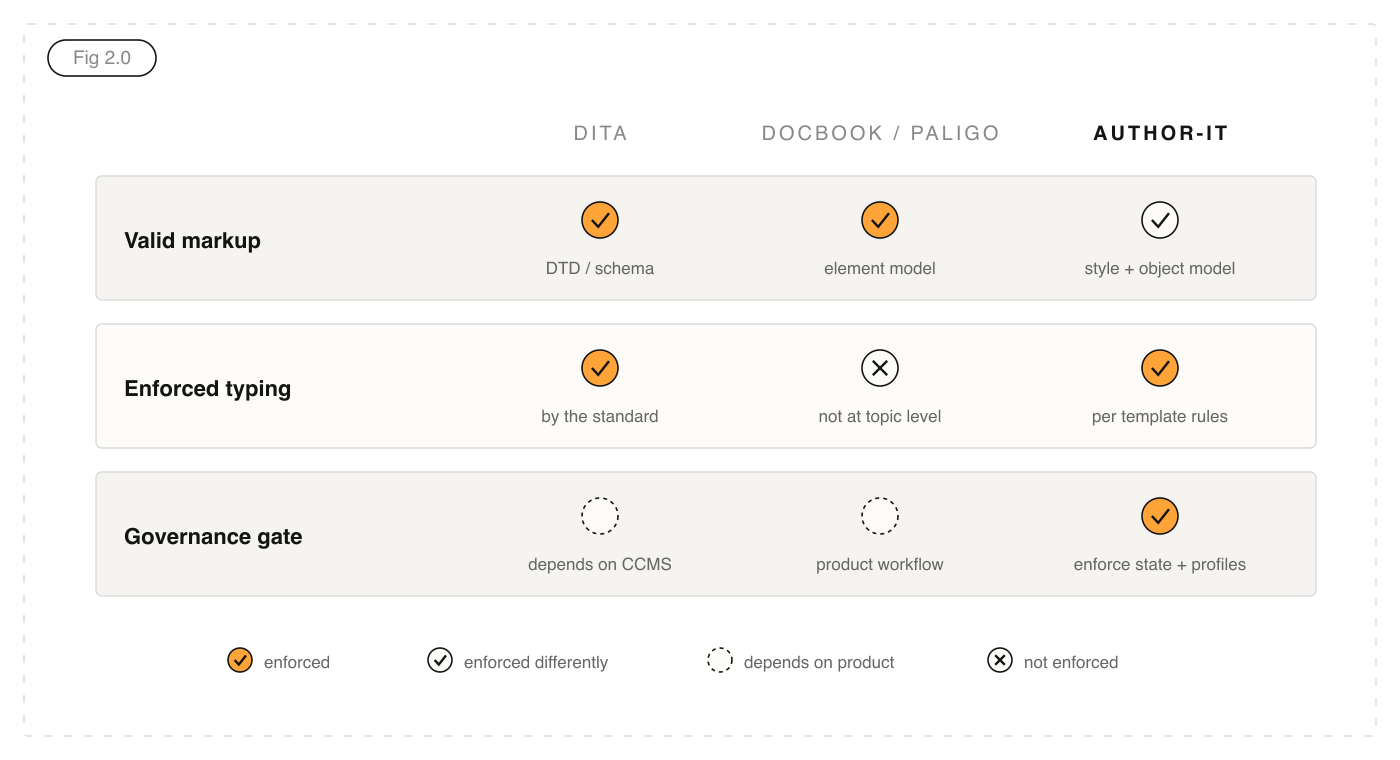
| Approach | Valid markup | Enforced information typing | Governance gate |
|---|---|---|---|
| DITA | Yes, DTD or schema | Yes, built into the standard; tighten with constraints | Not in the standard; depends on your CCMS |
| DocBook, as used by Paligo | Yes, customised DocBook element model | No, by design; typing is not enforced at topic level | Depends on product workflow; not part of DocBook |
| Author-it | Style- and object-based model, no XML authoring | Yes, when structure rules are switched on for a template | Yes, enforcing release states plus publishing profile filters |
| Word, help authoring tools, Markdown | Mostly no; templates, styles or linting | Not without extra tooling | Manual |
No column is "best". A team that wants writers free to shape topics may prefer DocBook's flexibility. A team that wants an open standard and is ready for XML may prefer DITA. A team that wants typing enforced in a familiar editor, with the gate in the same system, is the case Author-it is built for.
Questions to ask any vendor
- Show me a task topic that fails validation. What stops it being approved?
- Can I make a section required in one topic type and prohibited in another?
- Where do the rules live, and who can change them?
- When I tighten a rule, what happens to content that's already approved?
- Can unapproved or invalid content reach published output, or the AI?
- Is enforcement on by default, or does someone have to configure it? Who does that in your implementation plan?
The last question matters most, and it applies to us as much as anyone. Enforcement you never configure is enforcement you don't have. If you're evaluating Author-it, ask us to show the Structure Builder on your own content type. If you're an Author-it customer whose library runs on ordinary templates, our guide to setting up Author-it like DITA is the place to start. For the full comparisons, see Author-it vs DITA and Author-it vs Paligo.

Enforced structure FAQ
Q: What does enforced structured authoring mean?
A: It can mean three things: valid markup that conforms to an element model, enforced information typing so every task or concept has the same required parts, and a governance gate that stops non-conforming or unapproved content being published. Tools differ on which of the three they enforce.
Q: Does DITA enforce topic types?
A: Yes. Concept, task and reference topics have different element models, and a DTD or schema enforces them. Constraints and specialisation can tighten them further. Review, approval and publishing control are not part of the standard and come from the CCMS you use.
Q: Does Paligo enforce information typing?
A: Not at topic level. Paligo is built on a customised DocBook model, and DocBook deliberately does not implement topic typing. Paligo's CEO has said that a topic is a topic in Paligo and that typing is not enforced at topic level, although writers have elements such as procedures available.
Q: Does Author-it enforce information typing?
A: Yes, when structure rules are switched on for a template. The Structure Builder defines required content, order, occurrences and allowed styles and objects for each topic or book type, and a release state set to enforce the structure cannot be assigned to content that fails the rules.
Q: What is the difference between DITA and DocBook?
A: Both are open XML standards for technical documentation. DITA is built around typed topics such as concept, task and reference. DocBook offers a broad element model without enforced topic typing, which gives writers more freedom and less consistency by default.
Q: What should I ask vendors about enforced structure?
A: Ask them to show a topic that fails validation and what stops it being approved, whether a section can be required in one type and prohibited in another, who can change the rules, what happens to approved content when rules change, whether invalid content can reach published or AI output, and whether enforcement is on by default.
Published on:
Author:
November 22, 2026
Osmar Silva
CTO