Guide
CCMS buyer's guide for IT teams and CIOs

Summary:
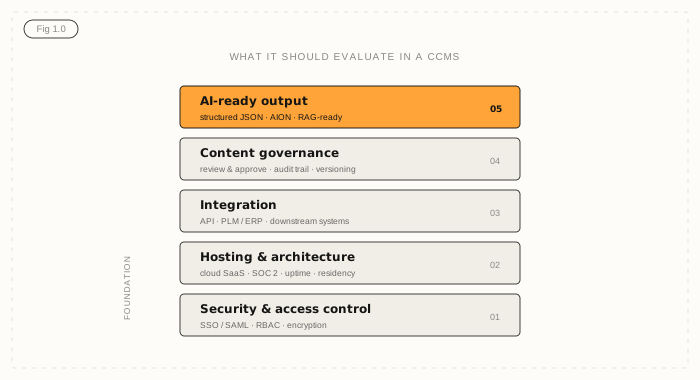
When a Component Content Management System (CCMS) purchase lands on IT's desk, the risk is evaluating it like any other app - on features and price - and missing what actually matters: how content is secured, governed, integrated, and whether it can safely feed your AI systems. This buyer's guide gives IT teams and CIOs the evaluation criteria that count, across five layers: security and access control, architecture and hosting, integration, content governance, and AI-readiness. Author-it has run this evaluation with regulated enterprises for 25+ years, and those same five layers decide whether a CCMS becomes core infrastructure or expensive shelfware.
Why the CCMS decision keeps landing on IT
More CCMS evaluations are now run by IT teams who have never bought one before. The purchase used to sit with documentation or technical writing leads. Increasingly it gets routed through procurement and security, and the technical due diligence falls to IT - people who know infrastructure cold but have rarely had to assess a content platform.
That is not a problem. IT is exactly the right team to pressure-test security, architecture, and integration. It just means the evaluation criteria you would apply to a typical SaaS tool are not enough. A CCMS sits at the centre of how an organisation creates, controls, and publishes its content - so the questions that matter are about governance and data flow, not just uptime and login screens.
This guide is written for that scenario. If you have inherited a CCMS shortlist and want to know what good looks like, the five sections below are the ones to work through.
What a CCMS actually does, in terms IT will recognise
A Component Content Management System stores content as small, reusable components rather than whole documents, then assembles and publishes them to multiple outputs from a single source. Think of it as version-controlled, structured source content with a build pipeline - closer to how engineering manages code than how most teams manage Word files.
In Author-it, the building blocks are Topics (individual components such as a procedure, warning, or specification), assembled into Books (deliverables like a manual or compliance document), all stored in a central Library that acts as the single source of truth. Change a component once and every output that uses it updates - this is single-source publishing. If the category is new to you, our explainer on what a CCMS is and how it works is a good primer before you evaluate vendors.
The distinction that matters for IT: general-purpose collaboration tools and wikis store documents. A CCMS manages content at the component level, with the metadata, versioning, and access control that structured authoring depends on. That structural difference is what makes everything in the rest of this guide possible.
Security and access control: ask these first
Start your CCMS evaluation with security, because it is the hardest thing to retrofit. A content platform holds some of your most sensitive material - product specs, safety procedures, regulated documentation - so the access and governance model matters as much as the feature list.
The questions worth asking every vendor: Does it support single sign-on via SAML or your existing identity provider? Is access controlled by role, down to the component and folder level, so people only see and edit what they should? Is content encrypted in transit and at rest? Can the vendor show current SOC 2 and ISO 27001 evidence, and tell you where data is hosted and whether residency options exist? And critically - is there a complete audit trail showing who changed what, when, and who approved it?
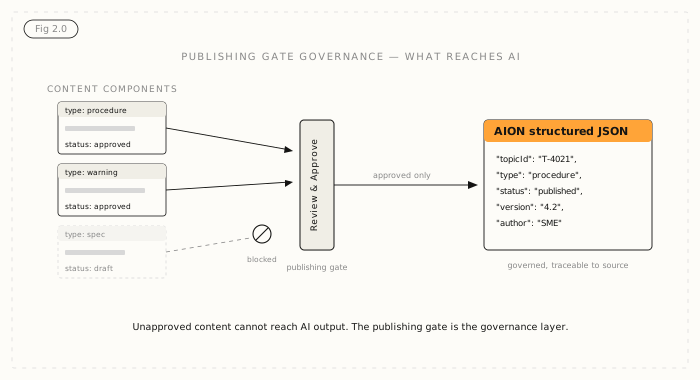
That last point is where a CCMS built for regulated industries pulls ahead. In Author-it, content moves through defined release states - Draft, In Review, Approved, Published - with a built-in Review and Approve workflow and a full audit trail. Approval is not a bolt-on; it is architectural. Unapproved content provably cannot reach a published output. For any team facing an audit, that governance layer is the difference between confidence and a scramble.
Architecture, hosting and integration
A CCMS should reduce IT's operational load, not add to it. The better modern platforms are cloud-hosted SaaS - no servers for your team to patch, predictable uptime, and updates handled by the vendor. Confirm the hosting model, the uptime commitment, and how releases are delivered before you commit.
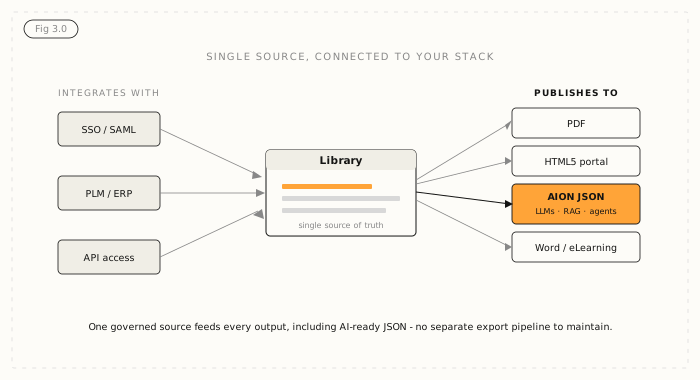
Then look at how it connects to the rest of your stack. A CCMS rarely lives alone: it needs to exchange data with PLM, ERP, and downstream publishing systems. Check for a documented API and real integration capability, not just a promise. The goal is a single governed source that feeds every output and system, rather than another silo your team has to sync by hand.
Watch for hidden IT dependency. Some structured authoring platforms - particularly DITA-based, XML-first systems - require specialist skills and ongoing engineering support just to keep authors productive. That dependency is a cost, and it usually lands on IT. Author-it delivers structured authoring without requiring DITA or XML, which keeps the day-to-day burden off your team.
Admin overhead and total cost of ownership
Evaluate cost over three to five years, not year one. The sticker price is the smallest part of the total cost of ownership. The real numbers are in implementation, migration, training, integration work, and the ongoing admin overhead of keeping the system running - and hidden costs can add well beyond the advertised licence fee.
Ask who administers the system day to day, how much specialist skill it demands, and what migration from your current tools actually involves. A services-led vendor that handles information architecture and migration - Author-it has migrated customers from Word, SharePoint, Confluence, and legacy help tools, most within 90 days - de-risks the part of the project that usually overruns. To model the numbers for your own content, our CCMS ROI calculator is a useful starting point, and if the shortlist includes an in-house option, weigh it against the hidden maintenance cost in our guide to building versus buying a CCMS.
AI-readiness: can it feed governed content to your AI stack?
This is the criterion most CCMS shortlists miss, and the one CIOs increasingly care about most. If your organisation is building anything on AI - a support copilot, a RAG pipeline, an internal knowledge agent - it will only ever be as accurate as the content feeding it. Unstructured PDFs and wiki pages produce unstructured, unverifiable answers. Structured, governed content produces accurate, traceable ones.
So the question for any CCMS is: what does it output for AI? Author-it publishes AION, a structured JSON format built for direct ingestion into LLMs, RAG pipelines, and AI agents. It carries the content hierarchy, component metadata, resolved variables, timestamps, and authorship - and because of the publishing gate, only approved content ever reaches it. That is what makes structured content the AI Content Foundation: the governed layer enterprise AI depends on to answer accurately and cite its source.
As of 2026, AION is the only shipped, purpose-built structured JSON output for AI ingestion in the CCMS category - richer metadata such as approval state and version history is on the roadmap. If AI is on your agenda, read how AION delivers AI-ready structured content and what an AI-ready CCMS actually means, then bring those questions to every vendor on your list.
The CCMS evaluation checklist for IT teams
Use this checklist to score every CCMS on your shortlist. If a vendor cannot answer a question clearly, treat that as the answer. It is grouped by the five layers above, and it is also available as a one-page PDF you can share with your evaluation team.
Security and access control
- Single sign-on via SAML or your identity provider
- Role-based access control down to component and folder level
- Encryption in transit and at rest
- Current SOC 2 and ISO 27001 evidence available
- Defined data hosting location and residency options
- Complete audit trail of changes and approvals
Architecture and hosting
- Cloud-hosted SaaS with a stated uptime commitment
- Vendor-managed updates and patching
- Clear release cadence and change communication
Integration
- Documented, supported API
- Proven integration with PLM, ERP, and downstream systems
- No specialist skill required just to keep authors productive
Content governance
- Built-in review and approval workflow, not a bolt-on
- Defined content lifecycle and release states
- Component-level version control with full history
- Unapproved content cannot reach published output
AI-readiness
- Structured output format purpose-built for LLMs and RAG - not just a Markdown or PDF export
- Governance carried into the AI output, so only approved content is exposed
- Metadata and provenance so every AI answer traces back to an approved source
Before you shortlist, it is worth benchmarking your current setup. The Structured Content Challenge is a quick way to see how AI-ready your existing content actually is.
Where Author-it fits
Author-it is a Component Content Management System built for regulated industries - Manufacturing, Software, and Utilities - where content accuracy is a compliance requirement, not a nice-to-have. It delivers structured authoring without DITA or XML, built-in Review and Approve governance, single-source publishing to every format, and AION structured JSON for AI ingestion, backed by a services team that handles migration and information architecture.
If a CCMS evaluation has landed on your desk, that combination - enterprise security, low IT overhead, and governed AI-ready output - is what to hold every option against. Score them honestly against the five layers, and the right choice usually makes itself obvious.

CCMS buyer FAQ
Q: What should IT teams look for when evaluating a CCMS?
A: Evaluate a CCMS across five layers: security and access control (SSO, role-based access, encryption, SOC 2 and ISO 27001), architecture and hosting (cloud SaaS, uptime, vendor-managed updates), integration (documented API, PLM and ERP connectivity), content governance (built-in review and approval, audit trail, version control), and AI-readiness (structured output built for LLMs and RAG). Features and price matter less than how content is secured, governed, and made available to downstream systems.
Q: Is a CCMS secure enough for regulated content?
A: A CCMS built for regulated industries is designed for exactly this. Look for single sign-on, role-based access control down to the component level, encryption in transit and at rest, current SOC 2 and ISO 27001 evidence, and a complete audit trail of who changed and approved what. Author-it also enforces a publishing gate, meaning unapproved content provably cannot reach a published output - which is what auditors want to see.
Q: What questions should we ask a CCMS vendor about security?
A: Ask whether it supports SSO via SAML or your identity provider, whether access is controlled by role down to folder and component level, whether content is encrypted in transit and at rest, whether they can share current SOC 2 and ISO 27001 evidence, where data is hosted and what residency options exist, and whether there is a full audit trail of changes and approvals. If a vendor cannot answer these clearly, treat that as the answer.
Q: Does a CCMS integrate with our existing systems like SSO, PLM, and ERP?
A: A capable CCMS integrates with your identity provider for single sign-on and exchanges content with PLM, ERP, and downstream publishing systems through a documented API. The aim is a single governed source that feeds every system rather than another silo to sync manually. Confirm the API is documented and supported, and ask for real integration examples rather than a roadmap promise.
Q: What does AI-ready mean for a CCMS?
A: An AI-ready CCMS outputs structured content in a format built for direct ingestion into LLMs, RAG pipelines, and AI agents - carrying metadata, resolved variables, and provenance so answers can be traced to an approved source. A Markdown or PDF export is not enough. Author-it publishes AION, structured JSON for AI ingestion, and its publishing gate ensures only approved content reaches the AI output.
Q: How long does a CCMS migration take?
A: With a services-led vendor, most migrations complete within about 90 days. Author-it has migrated customers from Word, SharePoint, Confluence, FrameMaker, and legacy help tools. Timeline depends on content volume and how much restructuring is needed, so ask each vendor what migration involves, who does the work, and how exceptions are handled - the migration is usually the part of the project that overruns if it is underestimated.
Q: Should we build our own content management system instead of buying a CCMS?
A: Building in-house looks cheaper until you account for ongoing maintenance, the absence of a product roadmap, and the single point of failure when the person who built it leaves. A dedicated CCMS brings structured authoring, governance, single-source publishing, and AI-ready output that would take years to replicate. For most teams the total cost of ownership favours buying, especially once AI-readiness and compliance are in scope.
Q: What is the total cost of ownership of a CCMS?
A: Total cost of ownership includes the licence or subscription plus implementation, content migration, training, integration work, and ongoing administration - evaluated over three to five years, not year one. Hidden costs, such as the specialist skills some XML-first platforms require, can add well beyond the advertised price. Model it against the content you produce and the reuse you can achieve; high reuse is where a CCMS pays back.
Published on:
Author:
July 2, 2026
Osmar Silva
CTO
Related Resources

Article
Field crew AI: when a wrong answer is a safety risk
Why safety-critical field operations can't run AI on ungoverned content - and what deterministic, traceable answers actually require.
Article
AI-ready content: who has actually shipped it?
A practical field guide to separating AI-ready content marketing from vendors who have actually shipped a structured, governed output for AI.

Article
Content lock-in: the exit tax nobody budgets for
The cost of leaving a content platform rarely makes the business case - until you try to switch. Here is the exit tax, and how open output removes it.