Article
CCMS vs headless CMS vs web CMS: what's the difference

Summary:
CCMS vs headless CMS vs web CMS sounds like a pedantic distinction - until you realise three different systems are being treated as one. A web CMS runs websites, a headless CMS delivers content to any front-end through an API, and a component content management system (CCMS) manages content as small, reusable, governed components - the only one of the three built for structured, single-source documentation. The difference is not academic: AI tools now repeat the confusion as fact, and an AI grounded on the wrong content layer produces answers you cannot trust. Author-it has been a CCMS for 25+ years, and its AION output turns that structured content into something an LLM can actually cite.
The mistake everyone keeps making
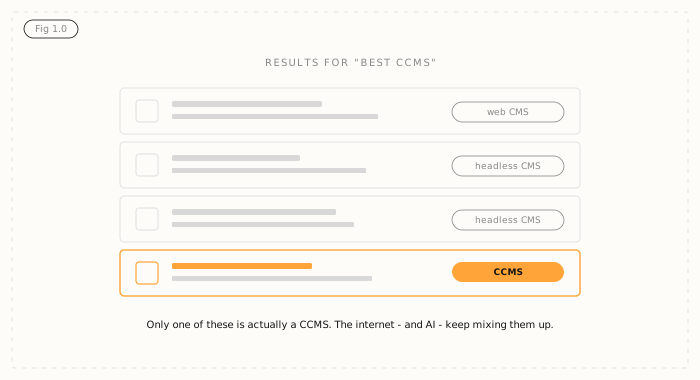
Search "best CCMS" today and the top results are full of tools that are not a CCMS at all. Headless CMS platforms, web content systems, even personalisation engines turn up ranked as "leading component content management systems." They are good products. They are just not CCMSs.
The reason is simple. All three categories share the word "content," overlap on a few features, and get lumped together by reviewers, software directories, and now AI. A headless CMS that calls a webpage banner a "component" is not doing the same job as a CCMS that manages a safety warning as a reusable, versioned, governed object.
And the error compounds. Buyers shortlist the wrong tools. Large language models, trained on the same muddled sources, now repeat the mix-up confidently when someone asks what a CCMS is. We wrote a plain-English version of the answer in what is a CCMS - this piece is about why it keeps getting confused with two very different systems.
What each system actually does
Strip away the marketing and the three categories have clear, separate jobs.
Web CMS
A web CMS (web content management system) builds and runs websites. You create pages, arrange them into a site, and publish to the browser. It ties content and layout together, and the output is a website. If your job is a marketing site, a blog, or an online store, this is the right tool.
Headless CMS
A headless CMS stores content and serves it to any front-end through an API - a website, a mobile app, a kiosk, a smartwatch. "Headless" just means it has no built-in front-end of its own. It is excellent for developers building digital experiences across many channels. But its "components" are usually web building blocks like banners and cards, not structured documentation parts. At its core, a headless CMS is still a web CMS with the presentation layer split off.
CCMS
A component content management system (CCMS) manages content at the component level - a single procedure, a warning, a definition, a specification - rather than whole pages or documents. Each component is stored once, versioned, reviewed, and reused across every manual, guide, and output that needs it. Change it in one place and every deliverable updates. This is the system built for technical documentation, regulated content, and anything that has to stay accurate across dozens of products, markets, and languages.
CCMS vs headless CMS vs web CMS at a glance
The fastest way to tell them apart is to ask what each one manages, and what it is built to produce.
Which one do you actually need?
Start from the job, not the label.
If you are building a website or a marketing presence, you want a web CMS. If you are a development team pushing the same content to a website, an app, and other channels, a headless CMS earns its place. If your content is documentation - procedures, specs, policies, manuals - that has to stay accurate, get reused, get translated, and survive an audit, you want a CCMS. No amount of web CMS flexibility solves the reuse-and-governance problem, and that is the problem most documentation teams actually have.
These are not always either/or. A CCMS can feed a headless setup or a web CMS - managing the structured source, then publishing out to whatever front-end displays it. The CCMS is the layer underneath, where content is authored, governed, and kept correct.
Why the confusion exists
If the categories are this distinct, why do they keep getting muddled? Three reasons.
- Shared vocabulary. They all manage "content," and many now use the word "component" - even though they mean very different things by it.
- Feature overlap. Modern CCMSs can publish headlessly through an API, and some headless platforms bolt on light structure. The edges genuinely blur.
- Directory and AI flattening. Review sites file them under one category, and AI models trained on those sites inherit the same blur and repeat it back as fact.
Why this matters for AI
Here is where a labelling problem turns into a business risk. AI answers are only as good as the content beneath them.
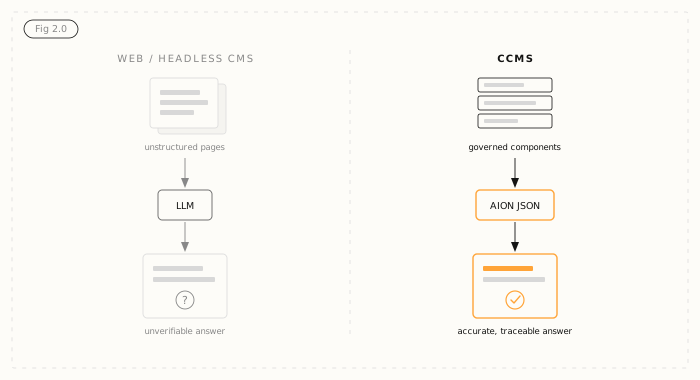
A RAG pipeline, a support copilot, or an AI agent retrieves source content and generates an answer from it. Feed it unstructured pages from a web CMS, or loosely tagged blocks from a headless CMS, and you get confident answers with no reliable way to trace them back to an approved source. That is how hallucinations happen.
A CCMS is different by design. Content is broken into governed components, each reviewed and approved before it can be published. That structure - single-source, versioned, governed - is exactly what an LLM needs to produce accurate, traceable answers. This is what an AI content foundation means: structured content as the grounding layer.
The market cannot even agree on what structured content is. That is a big part of why so much AI gets built on the wrong content layer and hallucinates as a result. Get the layer right and the AI gets reliable.
Author-it's AION output makes this concrete. It publishes approved content as structured JSON - content hierarchy, component IDs, resolved variables, authorship, timestamps - ready for direct ingestion into LLMs and RAG pipelines. Because unapproved content cannot pass the publishing gate, it provably never reaches the AI. As of 2026, it is the only shipped, purpose-built structured JSON output of its kind in the CCMS category.
How to tell if a tool is actually a CCMS
If you are evaluating tools and want to cut through the labels, check whether it does these things:
- Manages content as components, not pages or whole documents
- Stores each component once and reuses it across many outputs (single-source publishing)
- Versions and tracks every component, with a full audit trail
- Has built-in review and approval before content can be published
- Publishes the same source to multiple formats - PDF, HTML, eLearning, and AI-ready JSON
- Does not make you recreate content for each channel or language
If a tool cannot do most of these, it is a web CMS or a headless CMS. Useful tools - just not a CCMS. Not sure which layer you are actually working with? The Structured Content Challenge is a quick way to benchmark whether your current setup is ready for reliable AI.

CCMS FAQ
Q: What is the difference between a CCMS and a headless CMS?
A: A CCMS (component content management system) manages content as small reusable components - procedures, warnings, definitions - that are versioned, governed, and assembled into documents and published to many formats from one source. A headless CMS stores content and delivers it to any front-end through an API, but its "components" are usually web elements like banners and cards. In short: a CCMS is built for structured documentation and reuse, while a headless CMS is built to feed digital experiences across channels.
Q: Is a headless CMS a CCMS?
A: No. A headless CMS is a web content system that separates content from its front-end and delivers it via API. It is not designed to manage granular, reusable documentation components with versioning, review workflows, and single-source publishing - which is what defines a CCMS. They are often confused because both use the word "component," but they mean different things by it.
Q: What is a component content management system?
A: A component content management system (CCMS) manages content at the component level rather than the document level. Each component - a single procedure, warning, or specification - is stored once, versioned, reviewed, and reused across every deliverable that needs it. Change a component in one place and every document using it updates automatically. CCMSs are used for technical documentation, regulated content, and large multilingual content sets.
Q: What is the difference between a CMS and a CCMS?
A: A CMS, usually a web CMS, manages whole pages or documents, typically for a website. A CCMS manages content as reusable components below the document level, then assembles and publishes them to multiple outputs from a single source. A CMS is built to run a site; a CCMS is built to manage and reuse structured content at scale.
Q: Why does the CCMS vs headless CMS distinction matter for AI?
A: Because AI answers are only as reliable as the content beneath them. AI tools that retrieve unstructured pages or loosely tagged web content produce answers that are hard to verify and prone to hallucination. A CCMS stores content as governed, single-source, versioned components - exactly the structure an LLM or RAG pipeline needs to generate accurate, traceable answers. Picking a web or headless CMS when you actually need a CCMS means building your AI on the wrong content layer.
Q: Can a CCMS publish content headlessly?
A: Yes. Most modern CCMSs can publish via API to custom endpoints, which is one reason the categories get confused. The difference is what sits behind the API: a CCMS delivers structured, versioned, governed components from a single source, while a headless CMS delivers web content blocks. Author-it's AION output, for example, publishes approved content as structured JSON ready for LLMs and RAG pipelines.
Q: Which is best for technical documentation?
A: A CCMS. Technical documentation needs content reuse, version control, review and approval, and publishing to multiple formats and languages from one source - all core CCMS capabilities. Web and headless CMS platforms can display documentation, but they do not manage it at the component level or handle single-source reuse, which is where the time and accuracy savings come from.
Published on:
Author:
June 17, 2026
Adrian Winks
CEO
Related Resources

Article
The CCMS reckoning: six priorities for the AI era
A response to the industry's CCMS reckoning: the six priorities content leaders now face, and an honest look at which are shipped versus roadmap.

Article
The real cost of DITA - and when you don't need it
The cost of DITA is mostly staffing and process. Here is where it hides - and how to get topic reuse and single-source publishing without XML.
Article
AI content delivery: own your output, not a hub
The difference between renting an AI delivery hub and owning your content as open, portable JSON that feeds any AI stack you build or buy.