Article
How to build a business case for a CCMS

Summary:
A business case for a Component Content Management System (CCMS) translates content operations into the language a CFO already understands - cost lines and ROI streams. The strongest cases quantify four cost categories (duplication waste, translation overhead, compliance exposure, AI grounding) against four ROI streams (reuse rate, cycle time reduction, translation savings, AI-ready output). The 2026 version of this case includes a line that didn't exist 12 months ago - and that line is starting to dominate the spreadsheet.
Want to see these numbers on your own operation before you read on? The ROI calculator runs on real customer benchmarks, not guesswork.
CCMS business case in five lines
If you only have five lines for the executive summary, use these.
- Your team is paying to write the same content multiple times.
- Your team is paying to translate it multiple times too.
- Your auditors charge you when the wrong version is the live version.
- Your AI initiatives need governed, structured content - or they amplify the problem.
- A CCMS replaces a chunk of all four costs with one platform that scales without scaling headcount.
That's the short version. Everything below is what goes in the document underneath those five lines.
Why a 2026 CCMS business case looks different
Two years ago, the case for a CCMS was a translation-and-compliance argument with a content reuse story bolted on top. It still works. It's just no longer the strongest argument in the room.
The strongest argument in 2026 is AI grounding.
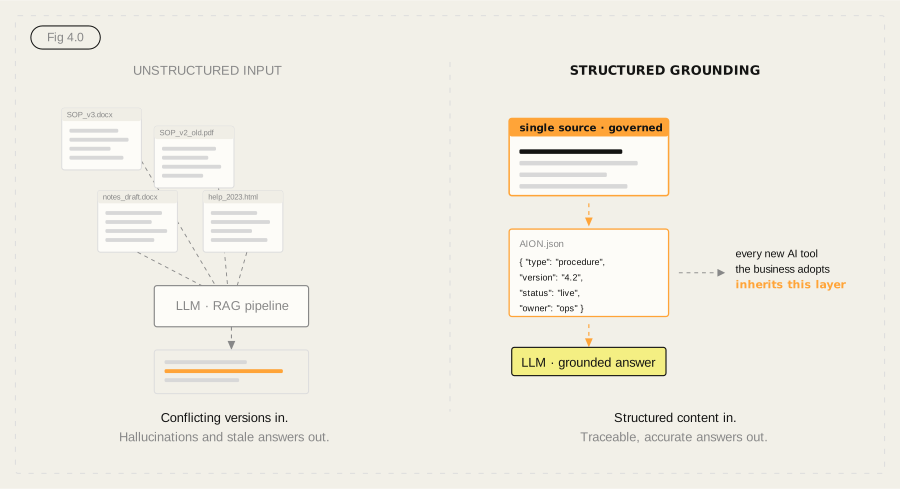
Here's why. Every enterprise has spun up at least one AI initiative - a customer support agent, an internal knowledge assistant, a compliance copilot, a content generation tool. Each one needs source content to function. And each one is finding out the same thing: unstructured content (PDFs, Word docs, SharePoint folders, version-drifted help content) feeds AI noise, not knowledge. Models hallucinate, retrieve outdated answers, or quietly cite the wrong revision of a procedure that an auditor will eventually find.
Structured, governed, single-sourced content - the kind a CCMS produces by default - is what RAG pipelines and enterprise LLMs actually need. It is the AI content foundation every tool sits on top of. Which means the conversation with your CFO no longer ends at "we'll save on translation." It ends at "every AI tool the business buys for the next five years runs on top of this."
That's a different magnitude of argument.
Audit your current state first
A CCMS business case is only as credible as the baseline you start from. Before proposing a future state, document the current one. The numbers you need:
- Hours per month spent updating content that lives in multiple places
- Annual translation spend, broken down by language and document type
- Translation rework - how much of last year's translation cost was for content you'd already paid to translate
- Audit findings - any documentation-related observations from internal or external audits in the last 24 months
- AI initiatives in flight or planned, and which of them are blocked or compromised by content quality
- Number of authoring tools currently in use across the business, and their licence cost
- Time to publish for a typical product update - from content change to published output, across every channel
If the answer to any of these is "we don't know," that's a finding for the case. Visibility is the first thing a CCMS buys you.
The four cost lines that matter
Most CCMS business cases undercount the cost of the current state. These four lines are where the money actually goes.
1. Duplication waste
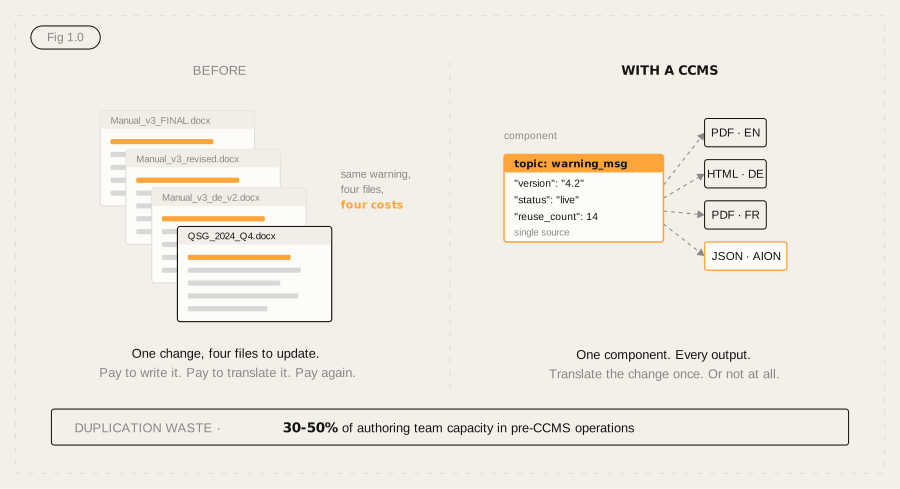
The same product warning, safety note, or specification lives in 14 documents. Every change touches 14 files. Every translation pays 14 times. Every audit finds at least one of the 14 that's out of date.
In a typical pre-CCMS content operation, 30-50% of authoring team capacity goes to maintaining duplicated content. That's a payroll line, even if it isn't broken out as one.
2. Translation and localisation overhead
Translation is usually the easiest cost line to quantify because finance can already see it in the books. The hidden part is translation rework - paying to translate content that hasn't actually changed, just because it's embedded in a document that has.
A CCMS publishing at component level only sends new or changed components for translation. Customers regularly cut translation spend by 30-50%. At a global manufacturer with $4M in annual translation costs, that's $1.2-2M back. (And that's before you factor in the cycle time saved.)
3. Compliance and audit exposure
In regulated industries - pharma, utilities, software with FDA touchpoints, manufacturing - documentation isn't just operational, it's a liability. A multi-million-dollar fine for an outdated SOP is a single line item that can dwarf the entire CCMS investment.
You don't put "$5M risk avoided" in the business case (the CFO will rightly push back). You put "documentation findings reduced from X to 0" - and you let the implied risk speak for itself.
4. AI grounding cost (new in 2026)
Every AI tool the business buys needs content to function. Most enterprises end up with one of two outcomes:
- They build a separate AI content store, duplicating the source-of-truth problem they were trying to solve.
- They point AI tools at SharePoint or Confluence and live with the hallucinations.
Neither is sustainable. The CCMS line item replaces both - one governed source, structured for human and machine consumption from the same content. Author-it customers using AION (our structured JSON output for LLMs) avoid the cost of building separate AI infrastructure entirely. Whatever LLM, RAG pipeline, or knowledge agent the business adopts, the content is already in the right shape.
The four ROI streams that defend the spend
Costs are one half of the case. Here's what shows up on the other side.
1. Reuse rate
The headline metric. The percentage of your content that's reused rather than rewritten. Author-it customers regularly hit 60-90% reuse. At 90%, every change you make ripples across nine output instances automatically - which means you're producing 10x the output for the same authoring effort.
Lead with this metric. It maps directly to "do more with less" without forcing anyone to translate it.
2. Cycle time reduction
How long it takes a content change to hit every output channel. In a document-based shop, this is days or weeks. In a structured CCMS, it's minutes. Customers consistently cut up to two weeks per content cycle - which means product launches ship with documentation, not after.
Map cycle time to revenue impact where you can. A two-week documentation delay on a launch in five markets has a number attached.
3. Translation savings
Quantified above. The compounding factor: as your product range, market footprint, or release cadence grows, translation cost in a document-based workflow grows linearly. In a CCMS, it grows with new content only. The savings compound year over year.
4. AI-ready output without separate infrastructure
The line that didn't exist 12 months ago. With structured content as the foundation and a JSON output format like AION, every AI initiative the business launches inherits a clean, governed content layer for free. No content pipeline build. No separate vector store maintenance. No second source-of-truth problem.
The way to express this in the case: "Avoided cost of building separate AI content infrastructure: $X" - where $X is whatever your team's estimate is for standing up a parallel content pipeline for AI consumption. It's almost always six figures, and often seven.

Halfway through building the case? If you would rather pressure-test the numbers with us, book a 20-minute call and we will look at your operation together.
What to actually put in the document
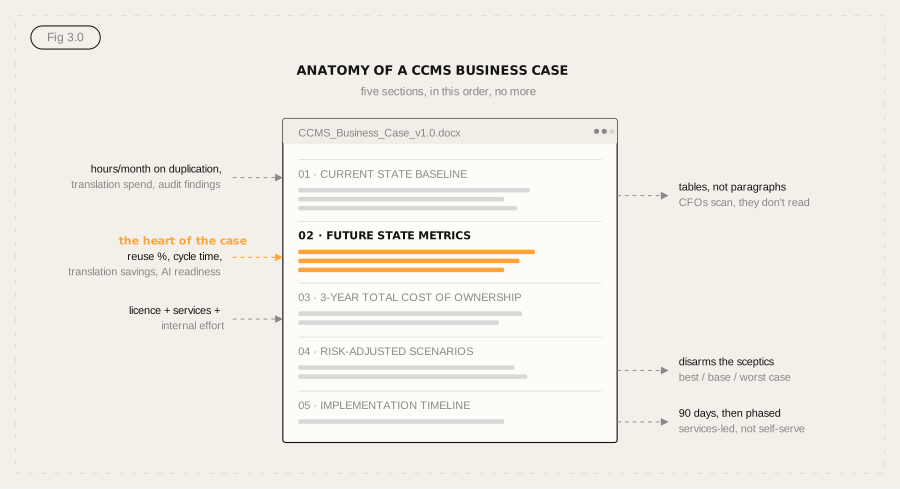
The case itself - the document you walk into the room with - has five sections. Don't add more. CFOs don't read more.
1. Current state baseline
The numbers you collected in the audit. One page. Tables, not paragraphs.
2. Future state metrics
Specific, quantified targets. Reuse rate target. Cycle time target. Translation cost target. AI readiness target. With timeframes attached - 12, 24, 36 months.
This section is the heart of the case. If anything is going to be highlighted, it's this.
3. Total cost of ownership over three years
Licence costs, implementation services, internal effort, training. Three-year view because most CCMS implementations break even between months 12 and 18 - and the case is significantly stronger when you show the compounding savings in years two and three.
4. Risk-adjusted scenarios
Best case, base case, worst case. The worst case isn't "the CCMS doesn't work" - it's "we adopt it slowly and only see 50% of projected reuse." Show that even the worst case beats the do-nothing scenario. This is the section that disarms the sceptics in the room.
5. Implementation timeline
90-day plan, then a phased rollout. Vendor-led implementation matters here - point to a partner who's done it before in your industry. Self-serve CCMS implementations stall. Services-led ones don't.
The mistakes that sink CCMS business cases
Six common ways the case dies before it gets approved. Avoid all of them.
- Leading with features. Nobody approves a budget for "structured authoring with conditional publishing." They approve it for "cuts $1.8M off translation in year two."
- Underestimating duplication waste. This line is hardest to count and easiest to dismiss - which is exactly why you need an actual hours-per-month estimate to bring to the room.
- Treating compliance as a soft benefit. It isn't. Regulators charge real money. Quantify the audit exposure even if you can't put a probability on it.
- Ignoring the AI angle. Every enterprise will run AI on documentation. The business case that mentions this is a 2026 case. The one that doesn't is a 2023 case stapled together.
- Not modelling year three. Year one is mostly implementation cost. The compounding ROI is in years two and three. A one-year case loses; a three-year case wins.
- Skipping the services line. A CCMS implementation without expert services is a stalled project waiting to happen. Bake it in - and pick a vendor whose track record in your industry is documented.
How AI changed the math
Worth saying again, because it's the single biggest shift in this category in a decade.
Before 2024, a CCMS investment paid back through reuse, translation savings, and compliance. Each one was real but each one was incremental. A good CCMS shaved 20-30% off the content operation cost.
Now there's a fourth lever, and it's an order of magnitude bigger.
When the business decides it needs AI on company knowledge - and it will, every business will, often multiple times in parallel - the content layer underneath is suddenly the bottleneck. Without structure, the AI tools are unreliable. With structure, every AI tool the business adopts inherits clean, governed content automatically. The CCMS becomes the AI content foundation for everything the company builds next - not just documentation.
That's a different category of argument. And once an executive sees it framed that way, "should we get a CCMS?" stops being the question. The question becomes how soon.
What to do next
Build the case using the structure above. Get the numbers from your own operation. Quantify what you can, flag what you can't, and bring it to the room.
If you want the longer, vendor-agnostic version - we have our 2026 CCMS Buyer's Guide coming soon. If you'd rather see what your own numbers would look like with Author-it specifically, our ROI calculator isn't complete guesswork, it runs on real customer benchmarks.
Either way, the conversation with your CFO is easier than it's ever been and the math just got much better.

CCMS Business Case FAQ
Q: What goes into a CCMS business case?
A: A CCMS business case quantifies four cost lines (duplication waste, translation overhead, compliance exposure, AI grounding) against four ROI streams (reuse rate, cycle time reduction, translation savings, AI-ready output). The document itself has five sections - current state baseline, future state metrics, three-year total cost of ownership, risk-adjusted scenarios, and implementation timeline. The strongest cases lead with quantified outcomes, not features.
Q: How do I calculate the ROI of a CCMS?
A: Start with three numbers from your current operation - hours per month spent maintaining duplicated content, annual translation spend, and the count of authoring tools you would consolidate. Apply industry benchmarks (60-90% reuse, 30-50% translation savings, up to two weeks cycle time reduction per content release) to project the future state. Compare against three-year total cost of ownership including licence, services, and internal effort. Most implementations break even between months 12 and 18, with the strongest savings appearing in years two and three.
Q: What is the typical payback period for a CCMS?
A: Most CCMS implementations show payback between 12 and 18 months. Year one is dominated by implementation cost. Year two is where the compounding savings (reuse, translation, cycle time) start to outweigh the run-rate cost. By year three, cumulative savings typically exceed cumulative investment by a factor of two to four in mid-market deployments.
Q: How do I justify a CCMS to a CFO who has never heard of one?
A: Translate it into the language they already speak. A CCMS is a content infrastructure investment that reduces operating cost (translation, duplication waste), reduces risk (compliance exposure), and enables future revenue (faster product launches, AI-ready content). Lead with the cost reduction - it is the most defensible. Bring the AI grounding angle as a forward-looking strategic line. In 2026, this is increasingly the line that closes the case.
Q: How does AI change the CCMS business case?
A: AI grounding is the new fourth lever in any 2026 CCMS business case. Every AI initiative an enterprise launches (support agents, knowledge assistants, copilots) needs structured, governed source content to function reliably. Without it, AI tools amplify content errors. With it, every AI initiative inherits a clean, structured content layer automatically. The avoided cost of building separate AI infrastructure is often a six- or seven-figure line on its own, and it is the magnitude that is reframing the category.
Q: What are the hidden costs of staying on Word and SharePoint?
A: Three costs that rarely show up as line items but always show up in the operation - duplication waste (30-50% of content team capacity goes to maintaining the same content in multiple places), translation rework (paying to translate the same content again because it lives in a different document), and AI degradation (LLMs grounded on inconsistent sources hallucinate or cite outdated revisions). Word and SharePoint are general-purpose tools - they cost less to license but more to operate at scale.
Q: What is the difference between a CCMS and a CMS for ROI purposes?
A: A traditional CMS manages whole pages or documents. A CCMS manages content at the component level (a procedure step, a warning, a specification) and assembles components into outputs. The ROI difference is that a CMS does not reduce duplication, does not enable component-level translation, and does not natively produce structured output for AI consumption. A CMS has its uses for managing websites. A CCMS is the system that produces accuracy and reuse at scale.
Q: When does a CCMS not make sense?
A: When the team produces a small volume of mostly unique content with limited reuse potential, no localisation requirements, no compliance pressure, and no AI initiatives in flight. In practice, this is rare in mid-market or enterprise organisations. If your content lives in fewer than three or four places, your translation spend is minimal, and your auditors are happy, a CCMS may be premature. Most organisations cross the threshold earlier than they realise.
Published on:
Author:
May 5, 2026
Quinn Wright
Head of Sales
Related Resources

Article
Content lock-in: the exit tax nobody budgets for
The cost of leaving a content platform rarely makes the business case - until you try to switch. Here is the exit tax, and how open output removes it.

Article
The real cost of DITA - and when you don't need it
The cost of DITA is mostly staffing and process. Here is where it hides - and how to get topic reuse and single-source publishing without XML.

Article
Content debt: what it costs and how to fix it
Like technical debt, content debt charges interest - and now it breaks your AI too.