Article
From 800 manuals to one source of truth

Why it matters:
800+ fragmented manuals isn't a documentation problem - it's a business risk that compounds with every product change, compliance audit, and new market.
Summary:
Auto parts manufacturers rarely set out to create a documentation problem - they accumulate one, product line by product line, market by market. By the time most organisations realise the scale of what they're managing, they have hundreds of manuals maintained in silos, critical content duplicated across dozens of files, and no reliable way to push a single update everywhere it needs to go. The modernisation path starts not with software, but with understanding what you actually have - and what it's costing you. For manufacturers that complete the shift to a structured, single-source content library, the results are measurable: one global consumer products manufacturer working with Author-it achieved $3M+ in annual savings with 60-70% content reuse across their entire documentation portfolio.
How do you end up with 800 manuals?
Nobody plans it. You launch a product line and you write a manual. Then another product line, another market, another language. Over ten years, what was once a manageable set of documents becomes an undocumented archive that nobody fully understands.
This is the reality for most mid-to-large auto parts manufacturers right now. Ask a documentation manager how many manuals they maintain and you'll often get a range, not a number. Somewhere between 600 and 1,000. Maybe more.
The problem isn't the volume - it's the structure. Or rather, the lack of it. Each manual was created independently, in its own format, by whoever was responsible at the time. Brake systems documentation lives in one place. Suspension in another. Electrical components in a third. Each with its own version history, its own naming convention, and its own set of slightly-different safety warnings that are almost - but not quite - the same across product lines.
That's the documentation sprawl that manufacturers are now actively trying to fix. And the baby boomer exit from the manufacturing workforce is making it more urgent. Critical product knowledge that's currently sitting in people's heads - or worse, in files only they can navigate - needs to be captured and structured before it walks out the door. See how Author-it supports manufacturing documentation teams managing exactly this kind of challenge.
What triggers the modernisation decision?
Most manufacturers don't decide to modernise documentation on a quiet Tuesday afternoon. Something breaks first.
Common triggers:
- A product recall that reveals three different versions of the same safety procedure in circulation - none of them definitively current
- A compliance audit that requires you to produce version history for documentation going back five years, and you can't do it quickly
- A new market entry that requires 8 new language versions of manuals you can barely manage in one language
- A key technical writer or documentation lead leaving - and taking with them the only mental map of where everything lives
- A regulatory change that means updating a warning across 200+ manuals by hand
Any one of these is painful. Two at once is a crisis. The manufacturers who are furthest ahead on modernisation are usually the ones who've been through one of these moments and decided they couldn't afford another.
What does a single source of truth actually mean?
It's one of those phrases that gets used so often it risks losing meaning. So let's be specific.
A single source of truth for auto parts manufacturer documentation is not a shared folder on a server. It's not SharePoint with better naming conventions. It's a structured content library where every piece of content - every warning, every specification, every installation procedure - exists as a discrete component stored once, and assembled into any manual, for any market, in any format.
In practice, this means:
- A torque specification for a brake caliper exists as one component. Every manual that references that spec points to the same source. When the spec changes, it changes in one place and flows everywhere automatically.
- A safety warning exists once. If it applies to 40 product lines, it appears in 40 manuals - but it's maintained in one location.
- A translation is managed at the component level. If 80% of a manual hasn't changed since the last version, you only translate the 20% that has. You don't retranslate the whole document.
This is what a Component Content Management System (CCMS) - like Author-it - is designed to do. Content is structured as reusable Topics, assembled into Books (your manuals), and published to any format from one Library. To understand the difference between a CCMS and traditional document tools in detail, the Author-it CCMS explainer is worth reading before you start evaluating options.
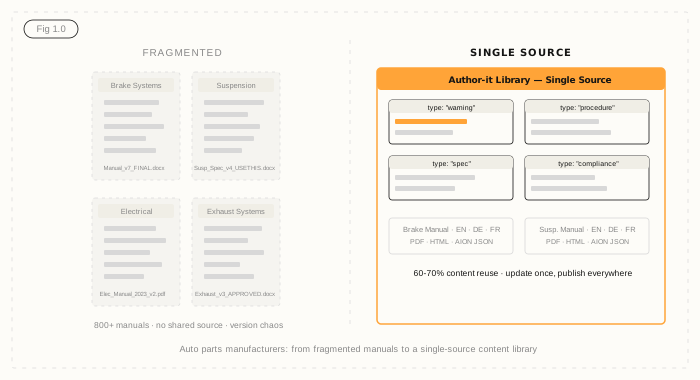
The modernisation path - it starts with a content audit, not a software purchase
This is where most manufacturers get it wrong. They treat documentation modernisation as a software selection project. They evaluate platforms, run demos, build a business case, and then - once the platform is purchased - try to figure out what to do with 800 Word files and a folder structure nobody fully understands.
The right order is the opposite. Start with the content.
A content audit for a large documentation library typically answers four questions:
- What do you actually have? A complete inventory - not just file counts, but content types, product lines, markets, languages, and versions.
- What's duplicated? A warning that appears in identical or near-identical form across 60 manuals is a single-source candidate. Most large libraries are 60-70% duplicated content.
- What's inconsistent? Different versions of the same specification across different manuals are a compliance risk. Finding them before a regulator does is considerably better.
- What's genuinely unique? The 30-40% of content that's truly product-specific and can't be reused - this is what writers should spend their time on after modernisation.
Author-it's implementation team typically completes this kind of audit alongside customers as part of the migration process. The migration from legacy formats - Word, InDesign, FrameMaker - usually completes within 90 days. The comparison between InDesign and CCMS for technical manuals is one of the most common starting points for manufacturers evaluating the switch.
What happens after modernisation - and why it matters for AI
Once content is structured and single-sourced, a product change has a very different impact. Update the torque specification once. It flows to every manual that references it - across every market, every language version, every format. What used to take weeks of manual rework happens automatically.
Translation shifts from a per-document cost to a per-component cost. Only new or changed components go to translation. If 70% of your content didn't change in this release cycle, you don't pay to translate it. For manufacturers operating across 10 or more languages, that reduction in translation spend alone often justifies the investment. The Author-it ROI calculator helps put actual numbers on this for your documentation profile.
There's also a more forward-looking reason to get documentation into structured form now. Smart factory initiatives, field service AI tools, and AI-powered customer portals all depend on the quality of the content feeding them. Unstructured PDFs and Word files don't make reliable source material for AI. Structured, governed, versioned content does.
Author-it's AION output - a structured JSON format designed for direct ingestion into AI systems and RAG pipelines - means that once your documentation is structured and approved, it can feed AI tools accurately. Not scraped, not summarised from PDFs, but traced back to a specific approved component with version history and authorship. For manufacturers beginning to think about AI-assisted field service or customer support, that foundation matters. Learn more about AION and structured AI-ready content output.
The modernisation journey that starts with fixing 800 fragmented manuals ends up being the thing that makes the next decade of documentation - and AI - manageable.

Auto Parts Documentation FAQ
Q: How are auto parts manufacturers modernising their technical documentation?
A: Auto parts manufacturers are modernising by replacing fragmented, product-line-specific document libraries with a single-source content library managed in a Component Content Management System (CCMS). Instead of maintaining hundreds of standalone manuals, content is structured as reusable components - warnings, specifications, procedures - stored once and assembled into any manual, for any market, in any format. Updates flow automatically to every output, and translation is managed at the component level rather than the whole document.
Q: How do you manage 800+ product manuals efficiently?
A: Managing 800+ manuals efficiently requires moving from document-centric to component-centric content management. Each piece of content - a safety warning, a torque specification, an installation procedure - becomes a discrete component stored once in a central library. When that component changes, the change flows automatically to every manual referencing it. This eliminates the manual rework of updating the same content across dozens of files and makes large-scale documentation manageable without scaling headcount.
Q: What is a single source of truth for manufacturing documentation?
A: A single source of truth for manufacturing documentation is a structured content library where every content component exists in one location and is reused across multiple deliverables. It is not a shared folder or a central file server - it is a system where content is separated from formatting, maintained at the component level, and published to any required format or language from one controlled source. Changes in one place propagate everywhere automatically, and version history is tracked at the component level.
Q: What triggers manufacturers to modernise their documentation systems?
A: The most common triggers are a product recall that exposes multiple conflicting versions of a safety procedure, a compliance audit requiring version history that can't be produced quickly, a new market requiring multiple language versions of a large manual library, or a key documentation lead leaving with institutional knowledge. Any of these events makes the cost of documentation fragmentation suddenly visible and concrete.
Q: How long does migration from Word or InDesign to a CCMS take?
A: Migration from legacy formats - Word, InDesign, FrameMaker - to a CCMS typically takes around 90 days with a structured implementation approach. The process starts with a content audit to inventory and categorise existing documentation, identify duplicated content, and map reuse opportunities. Author-it's implementation team works alongside customers through this process, so manufacturers are not left to figure out information architecture on their own.
Q: How does a CCMS reduce translation costs for auto parts documentation?
A: A CCMS reduces translation costs by managing translation at the component level rather than the document level. If a component - a safety warning, a specification, a procedure - has not changed since the last version, it does not go for retranslation. Only new or changed components are sent to translators. For manufacturers operating across 10 or more languages with high content reuse, translation cost reductions of 50-90% are achievable. One global manufacturer working with Author-it reduced translation costs by up to 90%.
Q: Why does structured documentation matter for AI and smart factory initiatives?
A: Smart factory AI tools, field service applications, and AI-powered customer portals all depend on the quality of source content fed into them. Unstructured PDFs and Word documents produce unreliable AI outputs because the content has no consistent structure, no version control, and no governance layer. Structured documentation managed in a CCMS can be output as governed, versioned JSON - via Author-it's AION format - that AI systems can ingest accurately and trace back to specific approved sources.
Q: What is the first step in modernising a large auto parts documentation library?
A: The first step is a content audit - not a software selection. Before evaluating platforms, manufacturers should inventory what they actually have: how many documents, what content types, what markets and languages, how much duplication exists, and what's genuinely product-specific. Most large documentation libraries are 60-70% duplicated content. Understanding this before selecting a system ensures the implementation is built on a clear information architecture rather than digitising existing chaos.
Published on:
Author:
May 11, 2026
Ben Harris
Marketing Lead
Related Resources

Article
The real cost of DITA - and when you don't need it
The cost of DITA is mostly staffing and process. Here is where it hides - and how to get topic reuse and single-source publishing without XML.
Article
AI content delivery: own your output, not a hub
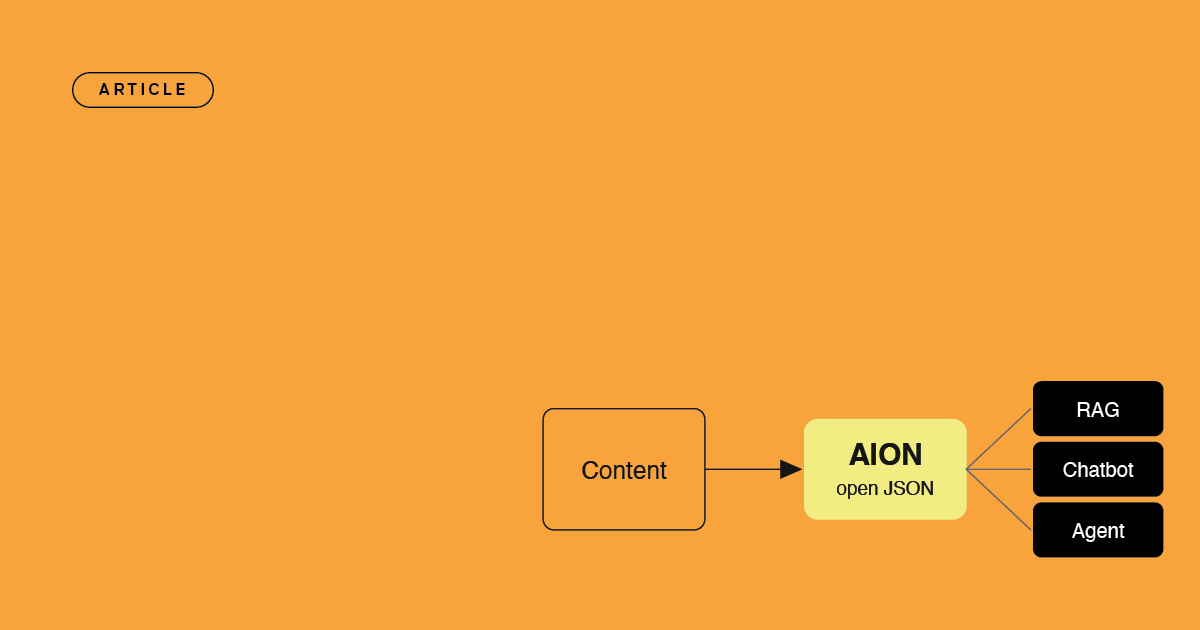
The difference between renting an AI delivery hub and owning your content as open, portable JSON that feeds any AI stack you build or buy.
Article
Managing spare parts catalogs across variants
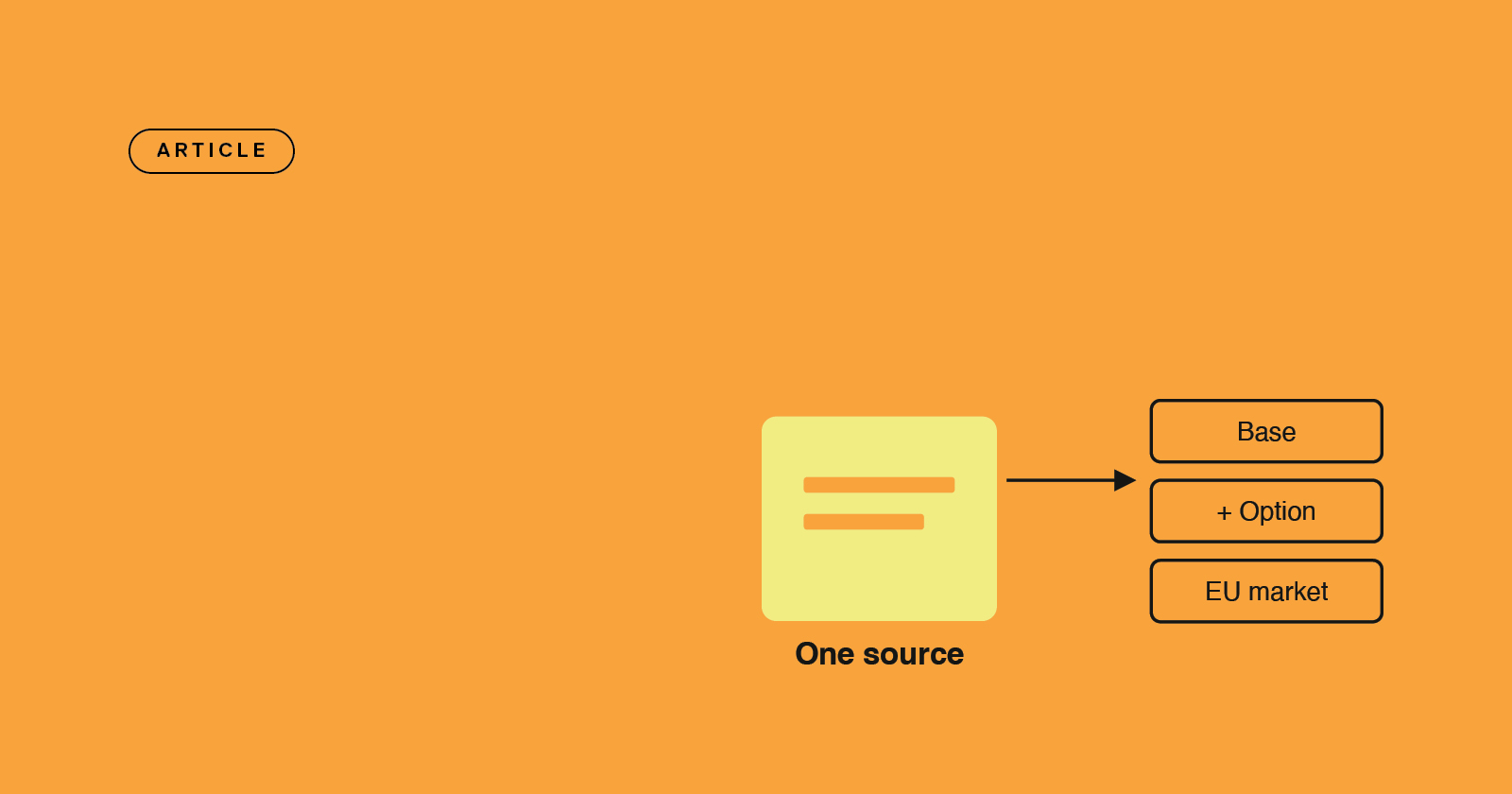
Options, revisions, and regional variants multiply parts lists and service manuals fast - here's how to maintain them all from a single source.