Guide
How to structure documentation for RAG pipelines

Summary:
If your RAG pipeline returns vague or wrong answers, the bottleneck is almost always the content, not the model or the vector database. Retrieval quality is capped by how your source content is structured, chunked, and labelled. This guide covers how to structure documentation for RAG: topic-based chunking, metadata enrichment, and why component content outperforms document exports. Author-it's AION output produces structured JSON - topics, metadata, hierarchy, and resolved variables - that drops into a retrieval pipeline without the usual cleanup.
Why content quality is the ceiling on RAG
If you've built a retrieval-augmented generation pipeline, you know the plateau. You tune chunk size, swap embedding models, add a reranker, adjust top-k. Each change buys a little, then the accuracy curve flattens. The reason is usually upstream: the content you're retrieving from was never structured for retrieval.
Everything downstream inherits the quality of the source. A better embedding model can't recover meaning that the source never encoded. If you want to see what a clean, structured input looks like before reading further, here's AION, Author-it's structured JSON output. For the business-level version of this argument, we cover why structured content makes AI accurate separately. This guide is the engineering companion.
Chunking: stop splitting documents, start retrieving topics
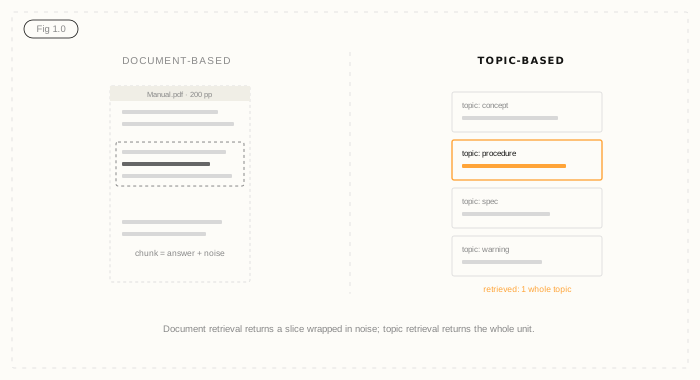
Fixed-size chunking - 512 tokens with some overlap - is the default because it's easy, not because it's good. It splits mid-thought. It severs a warning from the procedure it belongs to. It puts half a table in one chunk and half in the next. The embedding then represents a fragment, and retrieval returns fragments.
Topic-based content is already chunked by meaning. A procedure, a concept, a specification, a warning - each is a self-contained unit with clear boundaries. When your source is authored as components, the natural retrieval unit is the topic, and it arrives whole. You stop guessing at chunk boundaries because the content author already drew them where the meaning is.
Metadata: what retrieval needs that prose doesn't have
Good retrieval is rarely pure vector similarity. You want hybrid search and metadata filters - restrict to a product line, a content type, an audience - before or alongside the semantic match. That requires metadata on every chunk.
Unstructured PDFs and wiki pages carry almost none. Teams end up trying to regex a version number out of a footer or infer a product from a filename, which is brittle and usually wrong. Structured content carries type, product, identifiers, source path, and resolved variable values natively, so the filter fields exist before the content ever reaches your pipeline. Resolved variables matter more than they sound: they mean you index the real value, not a "{productName}" placeholder that pollutes the embedding.
Topic-based vs document-based content in retrieval
Document-based retrieval returns a slice of a large file. The answer is somewhere in there, wrapped in the surrounding page, and the model has to find it and ignore the rest. That's more tokens, more cost, more room for the model to latch onto the wrong sentence.
Topic-based retrieval returns the whole relevant unit and little else. Precision goes up, context bloat goes down, and the model gets a clean, complete input. Across a large corpus that difference compounds - both in answer quality and in token spend.
Before and after: a PDF blob vs an AION topic
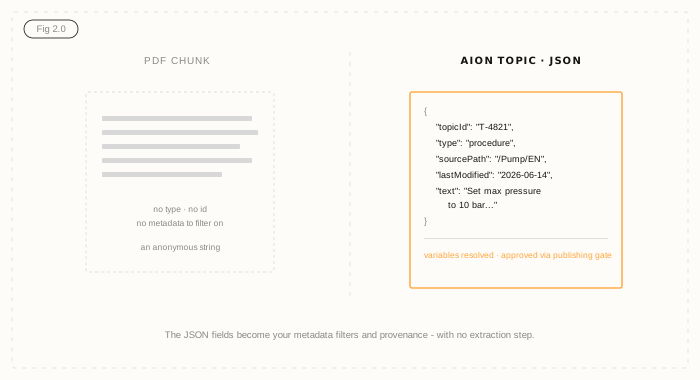
A chunk from a PDF is raw text. No type, no identifier, no source path, no fields to filter on. Your pipeline treats it as an anonymous string and hopes similarity is enough.
An AION topic arrives as JSON: a topic identifier, a content type, template and hierarchy context, last-modified timestamps, authorship, the source folder path, and the body as Markdown with variables already resolved. Those fields become your metadata filters and your provenance trail, with no extraction step. And because Author-it's publishing gate blocks unapproved content from ever reaching AION output, everything in your index is content that cleared review. You don't need a status filter to keep drafts out; they were never in.
Where this leaves your pipeline
You keep your stack. AION doesn't replace your embedding model, vector database, or orchestration - it improves the input those components work on. Structured JSON in means cleaner chunks, real metadata, resolved values, and provenance out.
This is structured authoring Author-it has done for 25+ years, now emitting a format built for retrieval. If your RAG accuracy has plateaued and you've already tuned the model side, the content layer is where the next gain is. See how AION structures content for AI pipelines.

RAG Content FAQ
Q: How should I structure documentation for a RAG pipeline?
A: Author it as self-contained topics rather than long documents, so each retrieval unit is chunked by meaning. Attach metadata to every unit - type, product, identifiers, source path - so you can filter as well as vector-match. Resolve variables to real values before indexing. Structured, component-based content gives you all of this natively, which is why it outperforms document exports in retrieval.
Q: What is the best chunking strategy for RAG?
A: The best chunk boundary is a meaningful one. Fixed-size chunking with token overlap is easy but splits mid-thought and separates related content, so the embedding represents a fragment. Topic-based content is already divided by meaning - a procedure, concept, or specification is a natural, self-contained retrieval unit - so it arrives whole and you stop guessing at boundaries.
Q: Why does topic-based content outperform document-based content in RAG?
A: Document-based retrieval returns a slice of a large file, so the answer comes wrapped in surrounding noise the model has to filter, costing more tokens and inviting errors. Topic-based retrieval returns the whole relevant unit and little else, which raises precision, reduces context bloat, and gives the model a clean, complete input. Across a large corpus that difference compounds.
Q: What metadata does RAG retrieval need?
A: Enough to support hybrid search and filtering: content type, product or product line, identifiers, source path, and any audience or channel tags. This lets you narrow candidates before or alongside the semantic match. Unstructured files carry almost none, forcing brittle extraction; structured content carries these fields natively, along with resolved variable values so you index real content instead of placeholders.
Q: Does AION replace my vector database or model?
A: No. AION is a structured content input, not a pipeline. You keep your embedding model, vector database, and orchestration. AION improves what those components work on by supplying clean, topic-based chunks with real metadata, resolved variables, and provenance, which is the part most enterprise pipelines are missing.
Q: Is Markdown good enough for RAG?
A: Markdown handles formatting but carries no semantic structure - no type, no identifiers, no metadata fields to filter on. It's prose with styling. A structured format like AION gives you the topic boundaries, metadata, resolved variables, and source paths that retrieval actually uses, which is the difference between a chunk you can filter and an anonymous string.
Published on:
Author:
June 18, 2026
Osmar Silva
CTO
Related Resources
Guide
How to structure documentation for RAG pipelines
Your RAG pipeline's ceiling isn't the model or the vector database - it's how your source content is structured.
Article
The token cost of unstructured content at scale
Token pricing looks trivial until you multiply it across thousands of daily queries. Unstructured content makes this problem significantly worse.
Article
Taxonomy, ontology, knowledge graph: the plain guide
Taxonomy is what things are. Ontology is how they relate. A knowledge graph reasons across both. Here's the distinction - and where Author-it fits.