Guide
AI content readiness: a pre-launch checklist

Summary:
Most enterprise AI projects don't stall on the model. They stall on content that was never ready for a machine to read. This AI content readiness checklist gives you 14 checks to run before you deploy a chatbot, copilot, or search feature - covering structure, metadata, governance, and coverage. Work through it and you'll know exactly where your content will make the AI wrong, and what to fix first. Author-it's AION output and publishing gate are built to clear these checks by design.
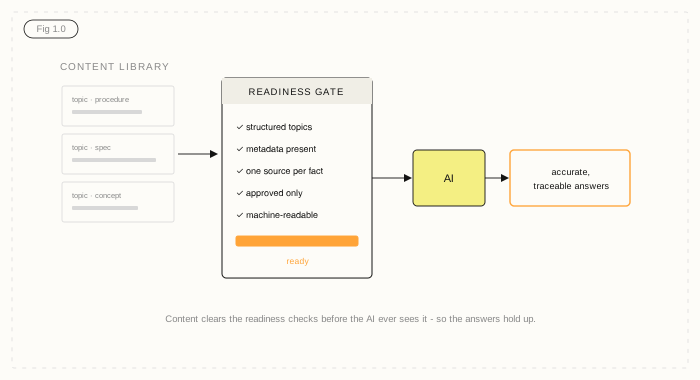
Why content readiness decides your AI project
The pattern is consistent across companies: the AI demo works, the pilot ships, and then the answers start coming back wrong. The team tunes the model, adds a reranker, and plateaus. The real constraint was upstream - the content wasn't in a state a retrieval system could use.
Readiness is cheaper to fix before launch than after. If you're at the planning stage, this is the right time to run the checks below. For the bigger picture on why structure drives accuracy, start with the AI Content Foundation, then work the list.
The readiness checklist
Score each item yes, partial, or no. Anything below yes is a place the AI can go wrong.
Structure and components
- Content is broken into discrete topics - procedures, concepts, specs - not trapped inside long documents.
- Each topic makes sense on its own, without the surrounding page for context.
- Tables, warnings, and steps are structured, not free-form prose an LLM has to interpret.
Metadata and consistency
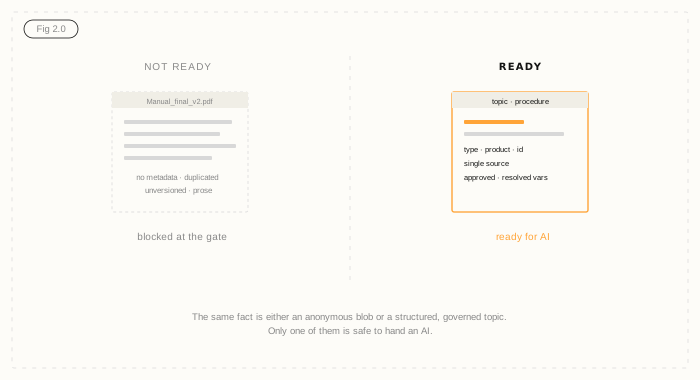
- Every topic carries metadata: type, product, audience, and an identifier.
- Terminology is consistent - one name per concept, part, or feature.
- Variables and placeholders are resolved to real values, not "{productName}".
- Duplicate content is collapsed to a single source, not scattered across files.
Governance and versioning
- There is one authoritative source for each fact.
- You can tell which version of any topic is current.
- Only approved content can reach the AI - a governance gate, not a manual reminder.
- A change at the source propagates to every output automatically.
Coverage and format
- Your highest-frequency questions each have a documented, approved answer.
- Retired and superseded content is removed or clearly marked, not left to be retrieved.
- Content is available in a machine-readable format built for AI - structured JSON, not only PDF and HTML.
How to read your score
Add up the yeses, but pay more attention to the noes and where they cluster. A pile of noes under governance means the AI will confidently serve unapproved or stale content. Noes under structure and metadata mean retrieval will return fragments and guess. Those two groups are where wrong answers actually come from, so fix them first.
You don't have to be perfect to start, but you should go in knowing your gaps rather than discovering them through wrong answers in production. The Structured Content Challenge is a fast way to benchmark where you sit today.
Where Author-it fits
Author-it is built so most of this checklist is true by default. Content is authored as reusable components in a single library, with metadata, consistent terminology, and one source per fact. Review and approval is built in, and the publishing gate means unapproved content provably can't reach the AI.
The output that clears the last check is AION, Author-it's structured JSON for LLMs and RAG pipelines - topics, metadata, hierarchy, source paths, and resolved variables, ready to index. It's the difference between preparing content for AI as a one-off project and having it ready as a matter of course.

AI Readiness FAQ
Q: How do I know if my content is ready for AI?
A: Run a readiness check across four areas: structure (content in discrete topics, not long documents), metadata and consistency (type, product, identifiers, one name per concept), governance (one source per fact, version clarity, a gate that blocks unapproved content), and format (a machine-readable output like structured JSON). Gaps in structure and governance are where AI answers go wrong first, so score those hardest.
Q: What does "AI-ready content" mean?
A: Content a machine can retrieve accurately: broken into self-contained topics, tagged with metadata, consistent in terminology, governed so only approved versions are used, and available in a structured, machine-readable format. It's not about having an AI feature - it's about the source content being clean, current, and structured enough that retrieval returns the right answer.
Q: What is the most common content problem that breaks AI projects?
A: Ungoverned, duplicated content. When the same fact exists in several places with no clear source or version, retrieval can return a stale or unapproved copy and state it confidently. Fixing structure and governance at the source removes the ambiguity, which is a bigger lever than any change to the model.
Q: Do I need to restructure all my content before deploying AI?
A: Not all of it, and not at once. Start with the content behind your highest-frequency questions, get structure, metadata, and governance right there, then expand. What matters is going into launch knowing your gaps rather than discovering them through wrong answers in production.
Q: How does a governance gate improve AI accuracy?
A: A governance gate means only approved content can be published to the format the AI reads, so drafts and superseded versions can't be retrieved at all. You don't need a status filter in the pipeline to keep bad content out - it was never in. In Author-it this gate is architectural, not a manual step someone has to remember.
Q: What format should content be in for AI?
A: A structured, machine-readable format that preserves topic boundaries, metadata, and hierarchy - not just PDF or HTML, which are built for human reading. Author-it's AION output is structured JSON designed for LLMs and RAG pipelines, carrying identifiers, source paths, and resolved variables so the content can be indexed and filtered without a cleanup step.
Published on:
Author:
July 3, 2026
Adrian Winks
CEO
Related Resources

Article
The CCMS reckoning: six priorities for the AI era
A response to the industry's CCMS reckoning: the six priorities content leaders now face, and an honest look at which are shipped versus roadmap.
Article
AI-ready content: who has actually shipped it?
A practical field guide to separating AI-ready content marketing from vendors who have actually shipped a structured, governed output for AI.
Webinar
Author-it 2026.R3 Release Webinar - What's New
The full Author-it 2026.R3 release webinar recording, with the biggest New Word update yet, richer AION output, and the R3 go-live dates.